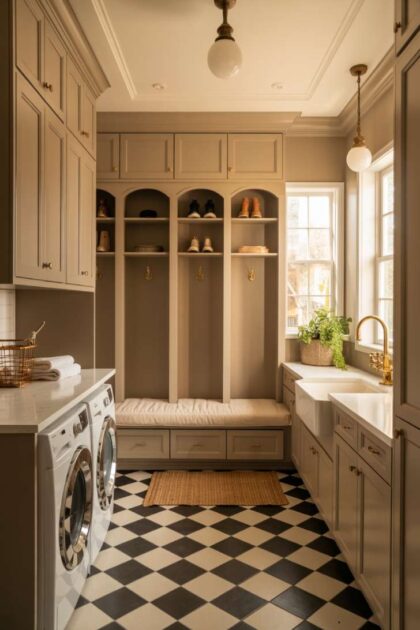
If you’ve ever walked into your home carrying muddy boots, a sports bag, and an armful of grocery bags — all at once — you already know why this room matters.
A mudroom laundry room combo is one of the smartest ways to reclaim order in a busy home.
It stops dirt at the door, puts laundry exactly where it belongs, and gives every family member a designated spot for their stuff.
What makes this space so exciting right now is that it’s no longer just a utility zone tucked behind a door.
Homeowners are treating it like any other room in the house — with real style, real personality, and real built-in storage and organization that actually works.
Whether you’re starting from scratch or rethinking a cramped entryway, these 13 ideas cover every budget, layout, and aesthetic.
Let’s get into it.
What to Consider Before You Start Designing
Before you fall in love with any one look, it pays to spend a few minutes thinking practically.
The shape and square footage of your space will determine which layouts are even possible.
A long, narrow hallway calls for a completely different approach than a square room off the garage.
Think about how many people — and pets — are moving through this space every day.
A family of five with two dogs has very different needs than a couple living in a townhouse.
Consider where the closest plumbing lines are, since adding a utility sink or relocating appliances can add cost quickly.
And finally, be honest about your style preference before you start pinning.
A farmhouse mudroom laundry room and a minimalist one may share the same bones, but they look and feel worlds apart.
Knowing what you want up front saves a lot of backtracking later.
The Timeless Farmhouse Look That Never Gets Old
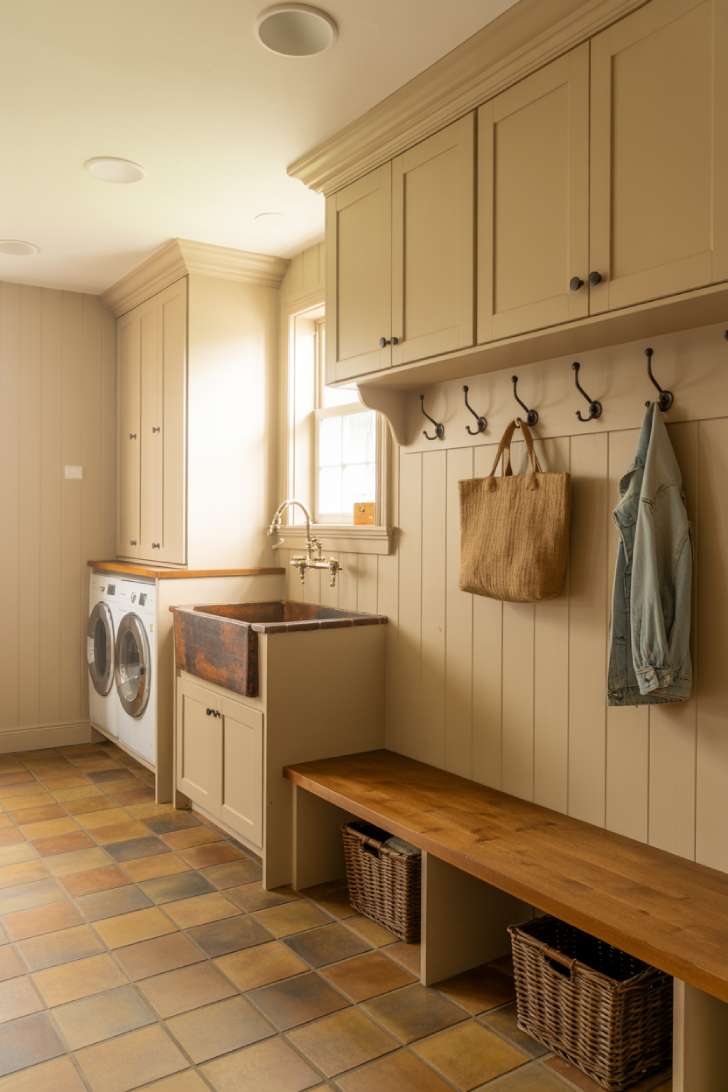
There’s a reason the farmhouse mudroom laundry room combo has been a crowd favorite for years.
It feels warm, lived-in, and genuinely welcoming — even when it’s doing the hardest work in the house.
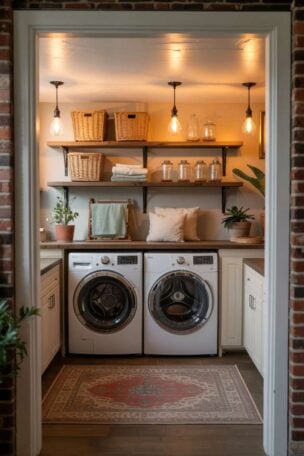
Think shaker-style cabinetry in a creamy white or soft sage, a deep farmhouse sink, and walls dressed in shiplap.
Black iron hooks along the wall add contrast and keep coats, bags, and dog leashes exactly where they need to be.
A wooden bench — whether built-in or freestanding — grounds the whole space with texture and warmth.
The wood grain pulls the eye down and makes the room feel anchored rather than sterile.
That’s the real secret of this style: it balances hard-working materials with enough softness to feel like part of the home, not a separate utility zone.
The creamy white cabinetry keeps things bright without feeling cold, and the natural wood bench introduces just enough organic texture to stop the space from feeling flat.
Light bouncing off the shiplap walls makes even a windowless version of this room feel airy — and that matters enormously in a space that could easily feel like a closet.
Style Blueprint:
- Shaker-style cabinetry in white, cream, or soft sage
- Deep fireclay or cast-iron farmhouse sink with a wall-mounted faucet
- Shiplap walls painted in a warm white
- Black iron or oil-rubbed bronze hooks and hardware
- A solid wood bench with a natural or lightly stained finish
Stacked and Sorted: A Small Mudroom Laundry Room That Works Hard
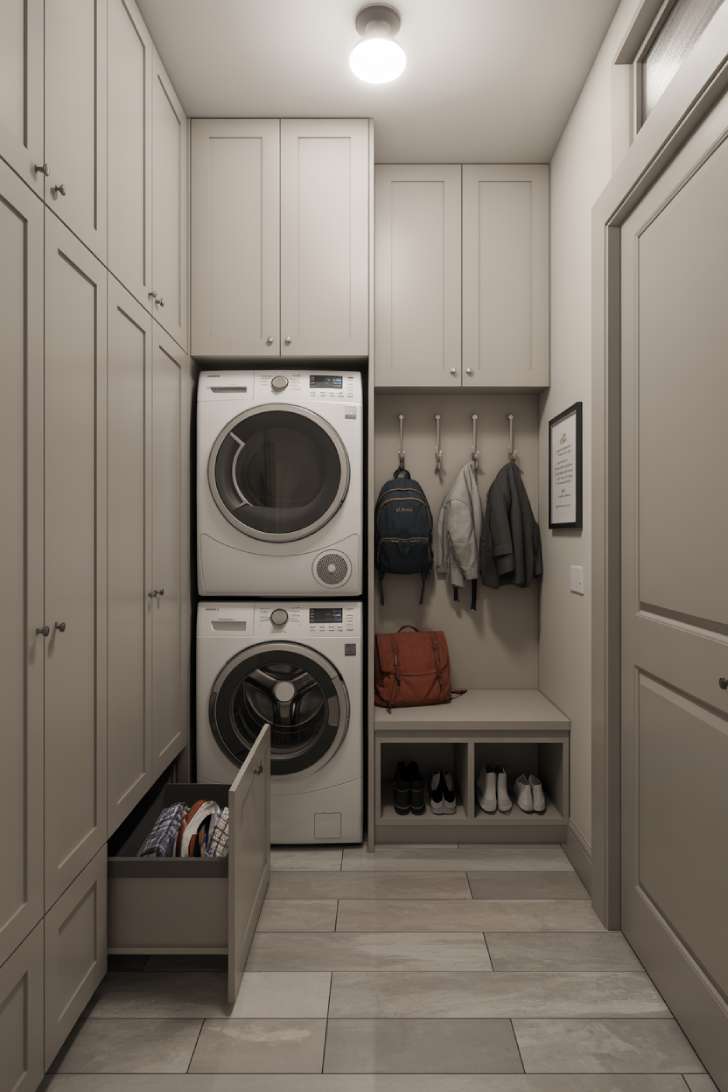
Small spaces don’t have to feel like a compromise.
In fact, some of the most functional small mudroom laundry room ideas come from rooms where every single inch was forced to earn its place.
The move here is to stack the washer and dryer vertically against one wall.
Stacking the appliances immediately frees up a significant run of floor space — enough for a narrow built-in bench, a row of cubbies, and a full column of hooks.
Floor-to-ceiling cabinetry on either side of the appliances makes the vertical space do the heavy lifting.
Washer and dryer placement in a stacked configuration also creates a natural visual symmetry, which makes a tight room feel more intentional than cramped.
A pull-out hamper tucked into the base cabinet keeps dirty laundry off the floor without eating into usable space.
Stacking the appliances shifts the eye upward, which is one of the most effective ways to make a narrow room feel taller and less confined.
Keeping the palette to one or two neutrals removes visual noise — and in a small space, visual noise is what makes a room feel chaotic.
Style Blueprint:
- Stacked front-loading washer and dryer
- Floor-to-ceiling cabinetry on both sides of the appliances
- Pull-out hamper drawer in a base cabinet
- Slim built-in bench with open shoe cubbies below
- A single-color, low-contrast palette throughout
Every Family Member Gets Their Own Locker
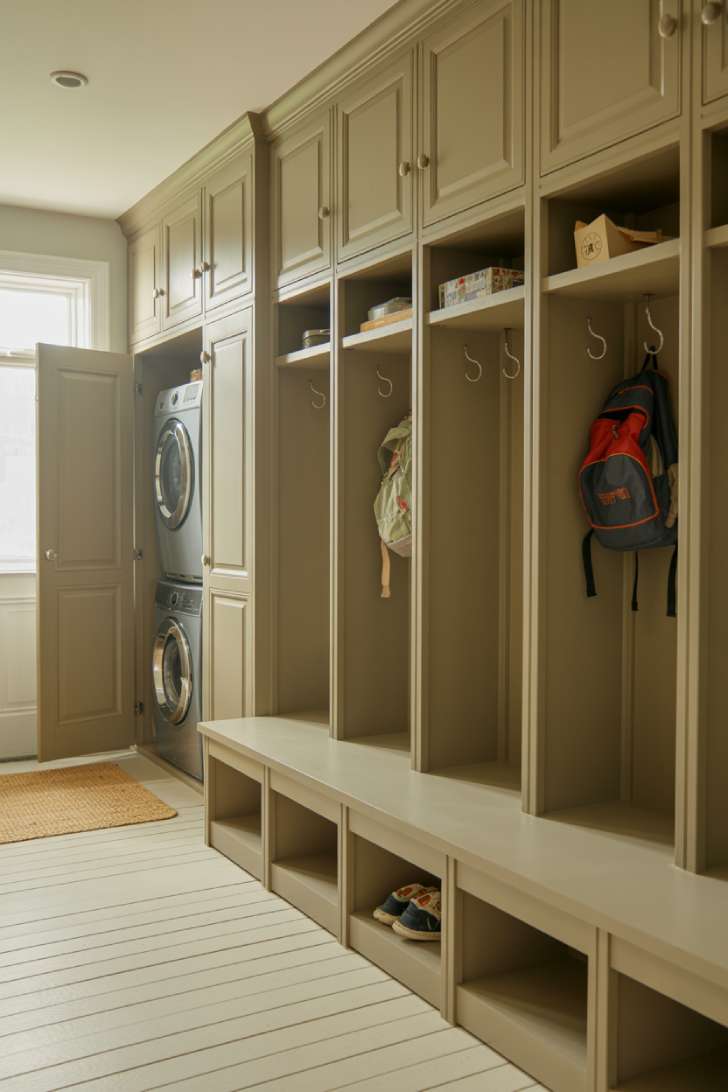
If there is one idea that consistently transforms a chaotic entryway into something genuinely organized, it’s the locker system.
Mudroom locker storage ideas work so well for families because they assign ownership.
Each person gets their own vertical column — a top shelf for hats and helmets, a hook for their coat and bag, a lower cubby for shoes, and a drawer at the base for smaller items.
No more “whose stuff is this?” piled on the bench.
The laundry zone sits at one end of the locker run, integrated seamlessly so the appliances are accessible without dominating the room visually.
Labeling each locker — with a chalkboard panel, a brass nameplate, or even a simple printed tag — adds a personalized layer that actually encourages kids to use the system.
The visual repetition of identical locker columns creates a strong sense of order the moment you walk in.
When everything has a column, a hook, a shelf — the brain registers the space as controlled, not cluttered.
That sense of calm is worth far more than any decorative detail.
Style Blueprint:
- Floor-to-ceiling locker-style built-ins with at least four defined vertical zones per column
- Dedicated hook, shelf, cubby, and drawer within each locker
- Concealed laundry appliances behind matching panel doors at one end
- Chalkboard label panel or brass nameplate on each locker
- A durable runner along the bench zone for comfort and texture
The Clean-Line Minimalist That Hides Everything
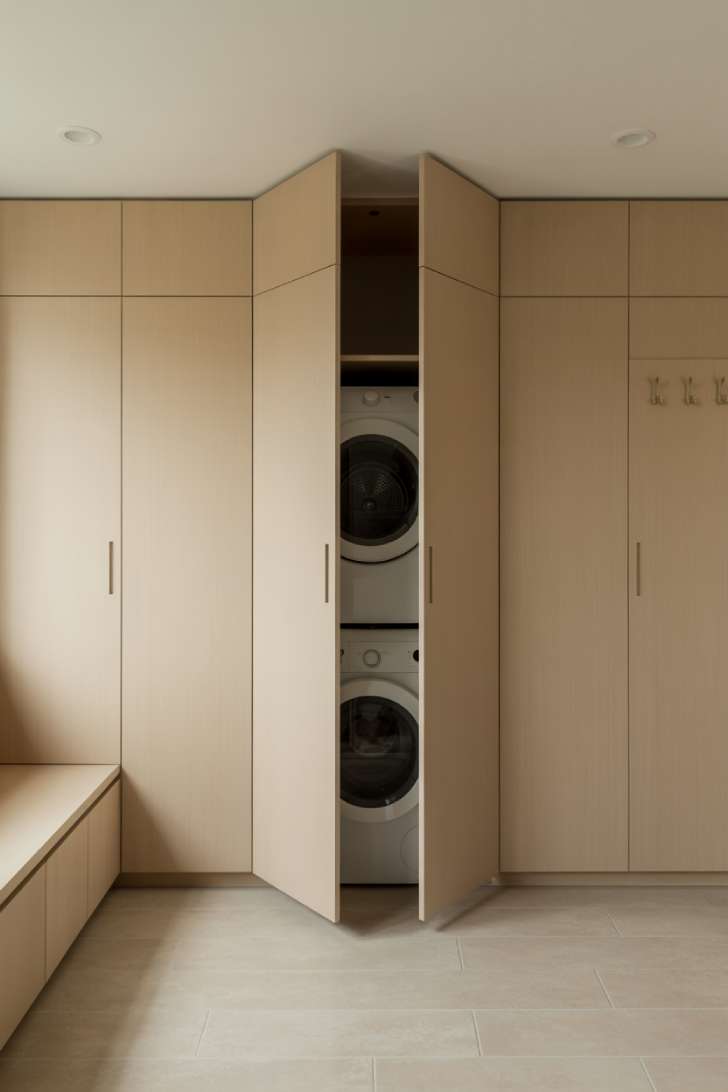
Not everyone wants their laundry room to look like a laundry room.
For the minimalist homeowner, the goal is a mudroom laundry room layout where everything disappears behind a wall of seamless cabinetry.
Handleless cabinet doors — pushed open with a gentle press — keep the facade completely uninterrupted.
The washer and dryer live behind bi-fold or pocket doors, invisible when not in use.
The bench is built in, low-profile, and finished in the same material as the cabinet base so it reads as one continuous element.
A pale, monochromatic palette — think warm white, soft greige, or cool light gray — removes any visual distraction.
What’s left is a space that feels more like a high-end hallway than a utility room.
Concealing the appliances removes the biggest visual disruptor in a utility space.
Without the washer and dryer in plain view, the room stops reading as a “work space” and starts reading as a calm, composed part of the home.
That psychological shift changes how you feel every time you walk through the door — and that matters.
Style Blueprint:
- Flat-panel, handleless cabinetry in a single matte finish
- Push-to-open or integrated pull hardware on all doors
- Bi-fold or pocket doors concealing the washer and dryer
- A built-in bench finished in the same material as the cabinetry
- Recessed ceiling lighting for a clean, shadow-free look
Design Pro-Tip: Before you finalize your cabinet layout, walk through the room the way you actually would on a typical morning — with boots in hand, a bag on your shoulder, and the laundry basket under your arm. If you can’t move comfortably from the door to the bench to the appliances without turning sideways, the layout needs to change.
The Galley Layout That Makes Narrow Spaces Feel Intentional
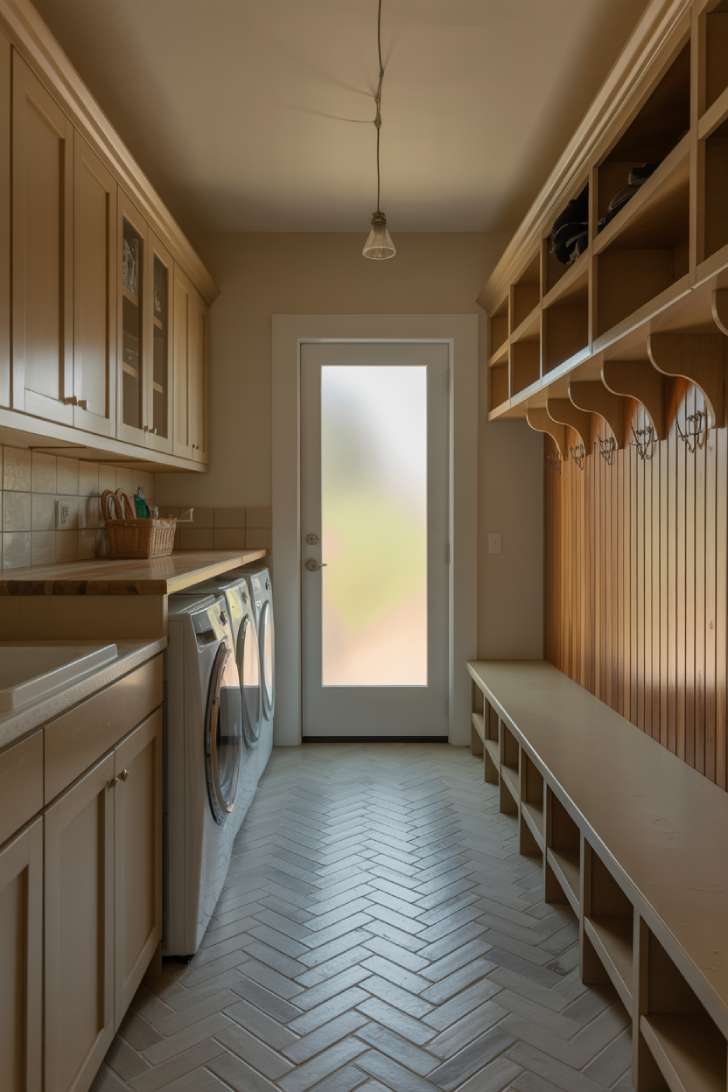
A long, narrow room is one of the most common layouts homeowners deal with — and one of the most underestimated.
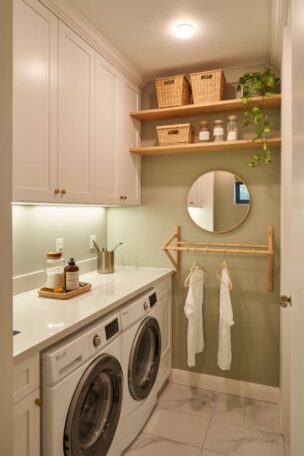
The galley mudroom laundry room layout puts the appliances and cabinetry along one wall, and the bench, hooks, and cubbies along the opposite wall.
The center stays completely clear, which keeps traffic moving and the room feeling open.
What makes the galley work visually is repetition.
Matching cabinet heights on both walls, a consistent floor tile running straight down the length of the room, and hardware in the same finish throughout — these are the things that make a narrow room feel considered rather than squeezed.
Light colors are a genuine advantage here.
A soft white or pale sage on the walls reflects light back into the space, making a corridor-style room feel wider than it actually is.
The herringbone tile running down the center of the floor does something clever — it creates a visual “path” that actually draws the eye forward, making the room feel longer and more deliberate.
That directional energy is exactly what a galley layout needs to feel like a design choice, not a limitation.
Style Blueprint:
- Matching upper and lower cabinetry running the full length of one wall
- Built-in bench with shoe cubbies along the opposite wall
- Directional floor tile — herringbone or straight-lay running lengthwise
- A single pendant or linear light fixture down the center of the ceiling
- Consistent hardware finish on both walls for visual unity
A Folding Station That Makes Laundry Actually Enjoyable
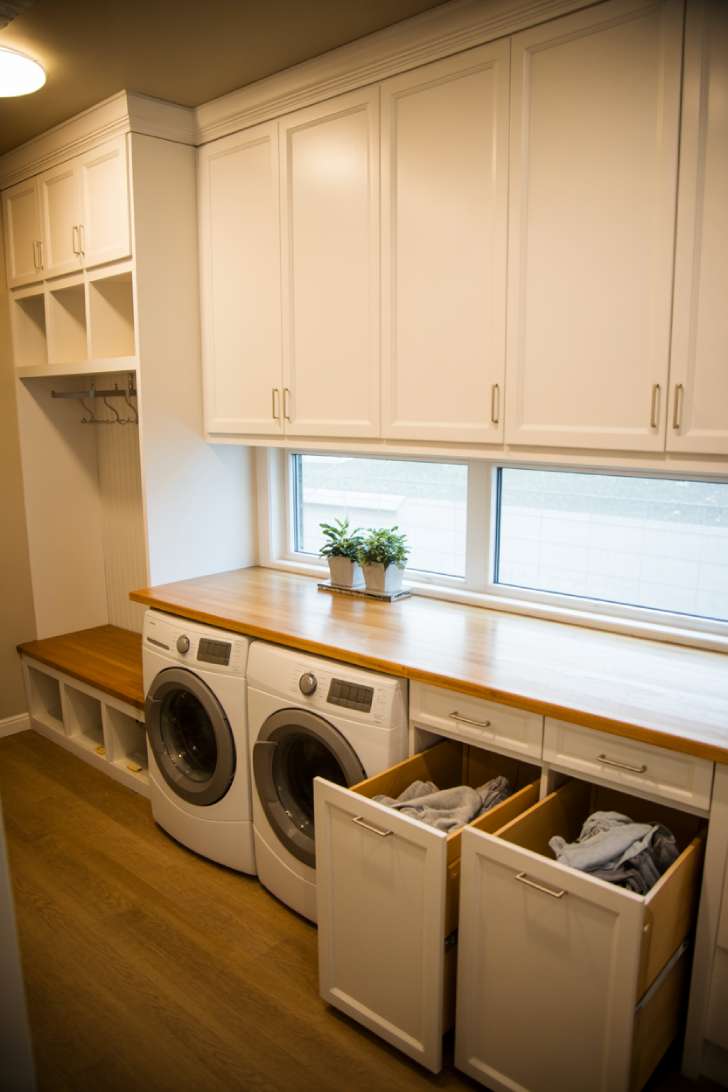
Let’s be real — the folding is always the part that gets avoided.
A dedicated laundry room folding station changes that completely.
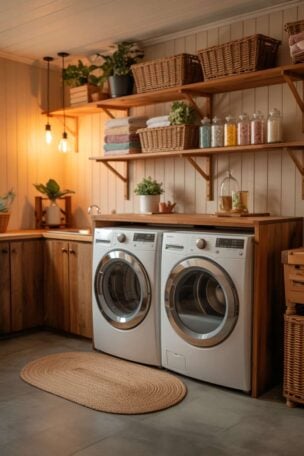
The setup is straightforward: a wide countertop spans the full width of the washer and dryer, giving you a proper, flat surface that doesn’t require you to use the bed or the couch.
Butcher block is a warm, tactile choice that adds character.
Quartz is easier to wipe clean and holds up better to moisture.
Either works.
Upper cabinets above the counter store detergent, dryer sheets, and stain removers out of sight.
Below the counter, pull-out laundry sorters — one for darks, one for lights — mean pre-sorting happens automatically as laundry comes in from the mudroom.
Natural light hitting a butcher block counter does something no overhead light can replicate — it makes the surface glow with warmth, which transforms what would otherwise feel like a chore station into a genuinely pleasant workspace.
Positioning the folding station directly beside a window isn’t just practical. It’s the detail that makes the room feel designed rather than assembled.
Style Blueprint:
- Butcher block or quartz countertop spanning the full width of the appliances
- Extended counter section to one side for dedicated folding surface
- Pull-out laundry sorter drawers built into the base cabinet
- Upper cabinets running to the ceiling above the counter
- A window or light source positioned directly above the folding area
The Bench-and-Cubby Setup Every Busy Family Needs
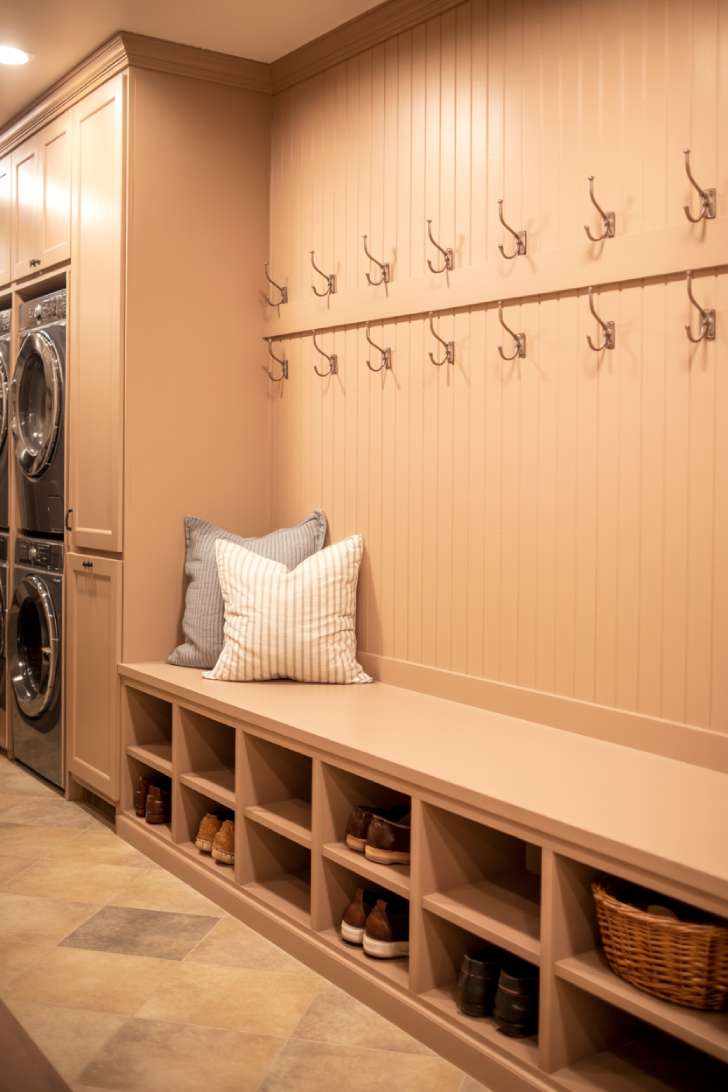
Of all the elements in a mudroom, the bench-and-cubby combination is the one that gets the most daily use.
It’s where shoes come off, bags get dropped, and kids collapse after school.
Getting it right matters.
A laundry room bench with cubbies works best when it’s built in rather than freestanding — it looks more polished, it’s more stable, and it can be sized precisely to the space.
The cubbies below should be tall enough for boots, not just flat shoes.
The hooks above should be set at two heights — one for adults, one for kids — so everyone can actually reach their own.
Adding a cushion to the bench top introduces softness and a chance for a bit of color or pattern, which goes a long way in a room that can otherwise feel very utilitarian.
The cushion does more work than it looks like it does.
Fabric introduces the one element that hard-surfaced rooms — tile, wood, painted cabinet — completely lack: acoustic softness.
A room with no fabric feels louder and colder, even subconsciously.
One cushion and one basket changes that entirely.
Style Blueprint:
- Built-in bench sized precisely to the wall width, with a painted or stained wood finish
- Open cubbies below the bench sized to accommodate tall boots
- Hooks installed at two heights — adult level and child level
- A cushioned bench top in a durable, washable fabric
- At least two woven or fabric baskets integrated into the cubby run
Design Pro-Tip: When planning your hook placement, space them at least 30 centimeters apart. Hooks that are too close together mean bulky coats and bags overlap, which defeats the whole point. Width is more valuable than quantity here.
Bold Floor Tile That Does the Design Heavy Lifting
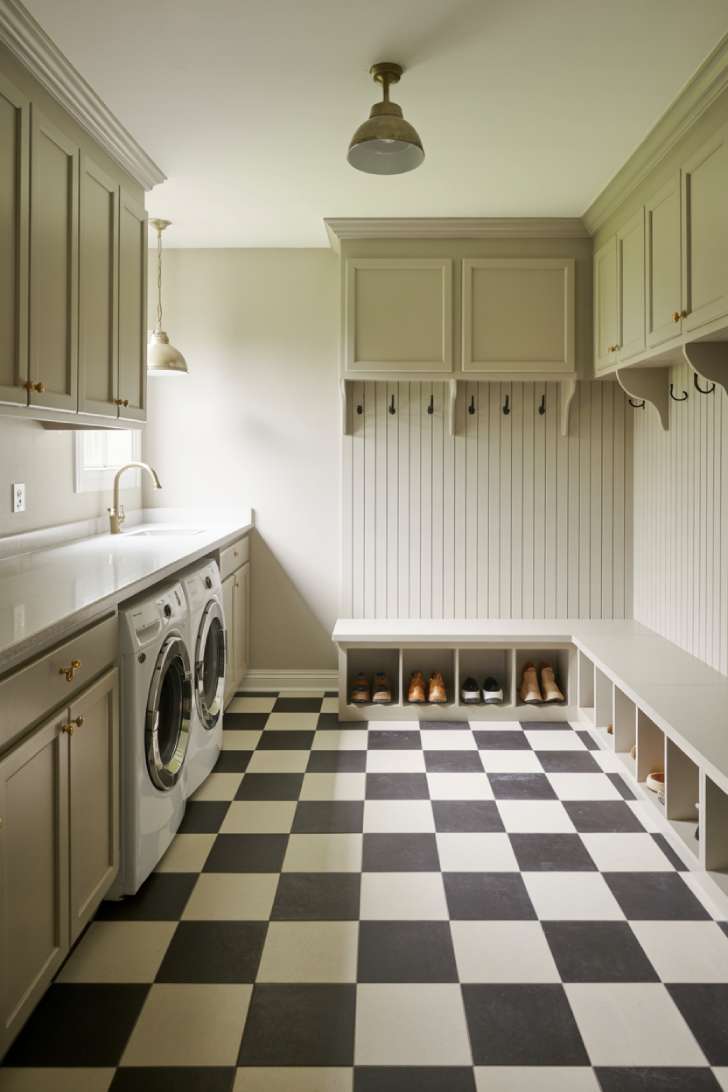
Sometimes the most impactful design decision in a room has nothing to do with the walls or the cabinets.
It’s the floor.
Mudroom laundry room flooring is an area where homeowners consistently play it too safe — and then regret it.
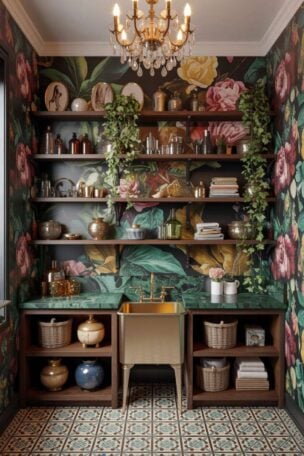
A bold tile choice — black and white checkerboard, intricate encaustic cement tile, or a graphic hexagonal mosaic — visually unifies the mudroom and laundry zones into one cohesive space.
It also draws the eye downward, which grounds the room and makes it feel finished in a way that plain tile simply can’t achieve.
The practical upside is real too: darker or patterned tiles hide dirt, scuffs, and water marks far better than a plain light-colored floor.
Keep the walls and cabinetry in solid, restrained tones so the floor gets the attention it deserves.
A high-contrast floor pattern creates a visual anchor that pulls the entire room together — even when the rest of the space is relatively simple.
The optical energy of a checkerboard or geometric tile does something neutral floors can’t: it makes the room feel like a decision was made, not just a box that was filled with furniture.
Style Blueprint:
- Large-scale checkerboard, encaustic, or geometric pattern tile in a durable porcelain or ceramic
- Restrained, solid-color cabinetry and walls to let the floor speak
- Minimal, consistent hardware in a single metal finish — brass, black, or nickel
- A simple pendant light in a metal finish that ties to the hardware
- Tight grout lines in a matching or tonal color to keep the pattern crisp
The Utility Sink That Earns Its Place Every Single Day
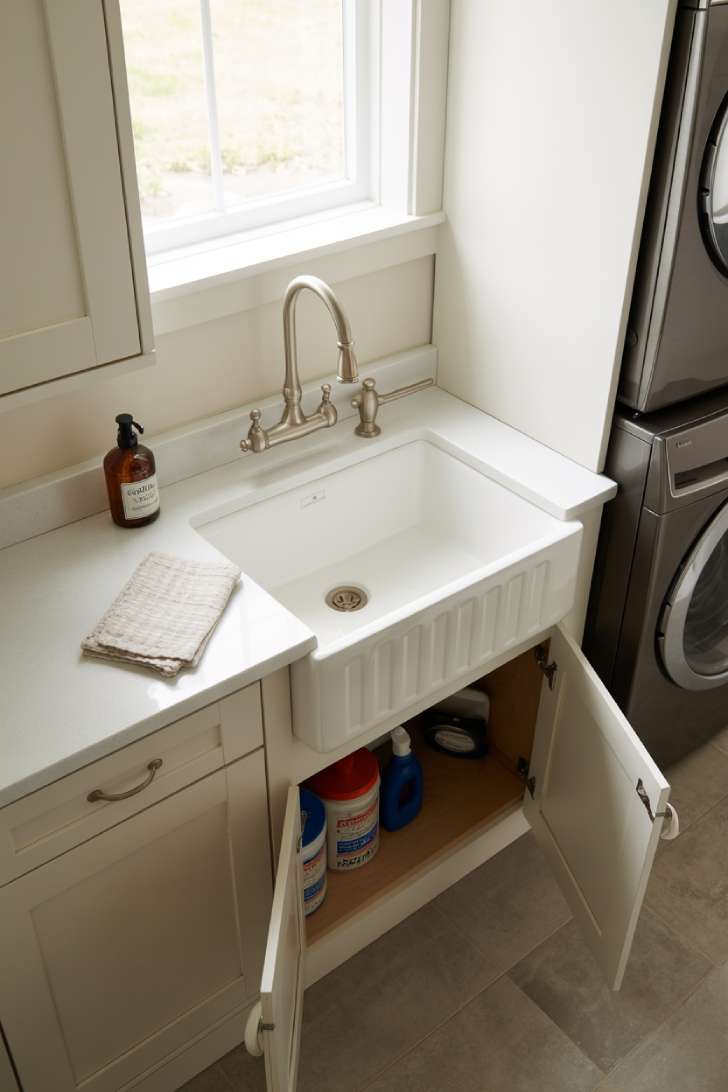
A utility sink for laundry room use isn’t a luxury — it’s one of those additions that, once you have it, you genuinely can’t imagine doing without.
Pre-treating a grass stain, rinsing out a paintbrush, washing garden mud off your hands before touching anything else in the house — the utility sink handles all of it.
A deep farmhouse basin is the most popular choice, and for good reason.
The depth handles large items — soaking a comforter, rinsing out a mop head — without splashing water all over the floor.
Mounting a wall-mount faucet with a pull-out spray head above the basin adds flexibility without cluttering the counter.
Flanking the sink with narrow cabinets on both sides keeps cleaning supplies, laundry products, and hand towels within arm’s reach.
Placing the sink below or near a window is one of the most effective lighting decisions you can make in a utility space.
Natural light hitting a white sink makes the whole room feel cleaner and brighter — and it makes it far easier to check whether a stain has actually come out.
Function and mood, addressed in one move.
Style Blueprint:
- Deep-basin fireclay, stainless steel, or composite farmhouse sink
- Wall-mounted faucet with pull-out spray head in a consistent metal finish
- Flanking base cabinets with cleaning supply and laundry product storage
- A window or dedicated light source positioned directly above or near the sink
- A small open shelf or hook near the sink for hand towels and frequently used items
The L-Shape That Turns a Corner Into the Best Spot in the Room
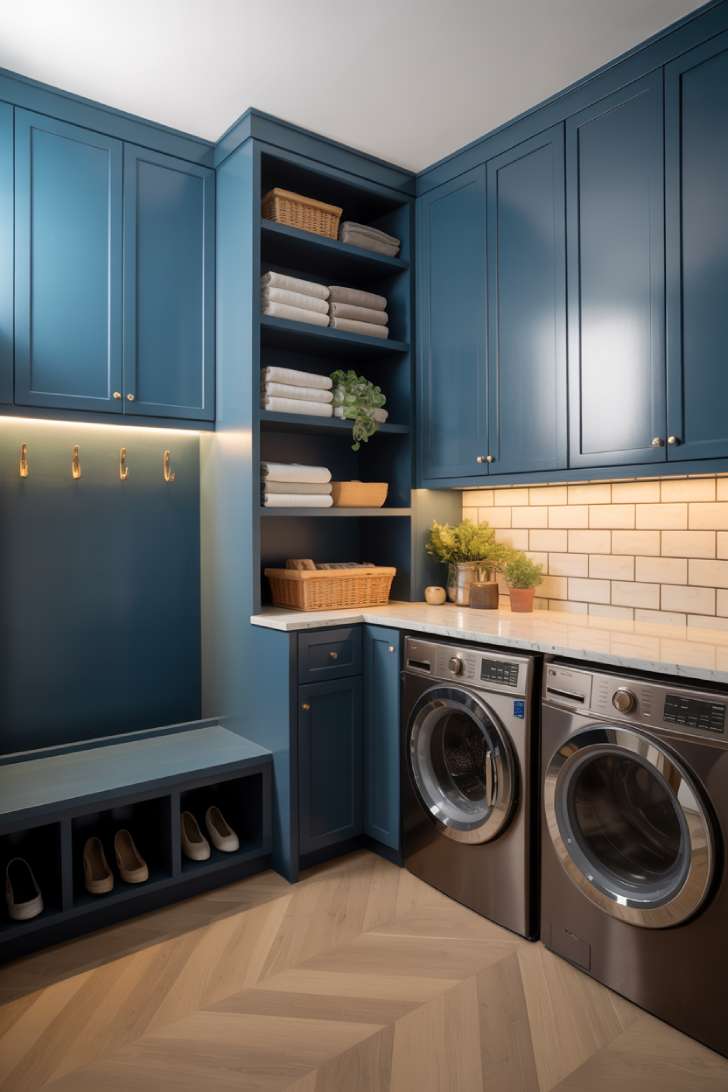
An L-shaped mudroom laundry room layout is one of the most practical configurations available, especially in rooms that have a natural corner to work with.
The appliances go along one wall.
The bench, hooks, and locker storage run along the adjacent wall.
Where the two walls meet — that corner — becomes an opportunity.
A tall cabinet tower in the corner maximizes storage.
A folding counter wrapping around the corner gives you an unusually generous work surface.
Or the corner can stay open, which keeps the room from feeling closed in.
Using the same cabinet finish across both walls is the single most important visual decision in an L-shaped layout — it’s what makes the space read as one room rather than two separate walls of furniture pushed together.
The wraparound counter in an L-shape does something a straight counter simply can’t — it creates a sense of enclosure, almost like a cockpit, that makes the workspace feel intentional and contained.
That feeling of being “set up properly” changes how you approach tasks in the room.
It goes from a chore space to a workspace. A genuinely meaningful shift.
Style Blueprint:
- Matching cabinetry finish across both walls of the L-shape
- Wraparound countertop connecting the two walls at the corner
- Tall open shelving tower or cabinet column positioned at the corner junction
- Built-in bench with shoe cubbies on the shorter arm of the L
- A warm light source — pendant or sconce — positioned over the corner work area
Design Pro-Tip: In an L-shaped layout, the countertop material is what ties the two walls together visually. Keeping the counter continuous — rather than stopping at the corner — is the difference between a built-in feel and an assembled feel. If budget is tight, even a butcher block counter mitered at the corner achieves this.
Dark, Moody, and Completely Unexpected
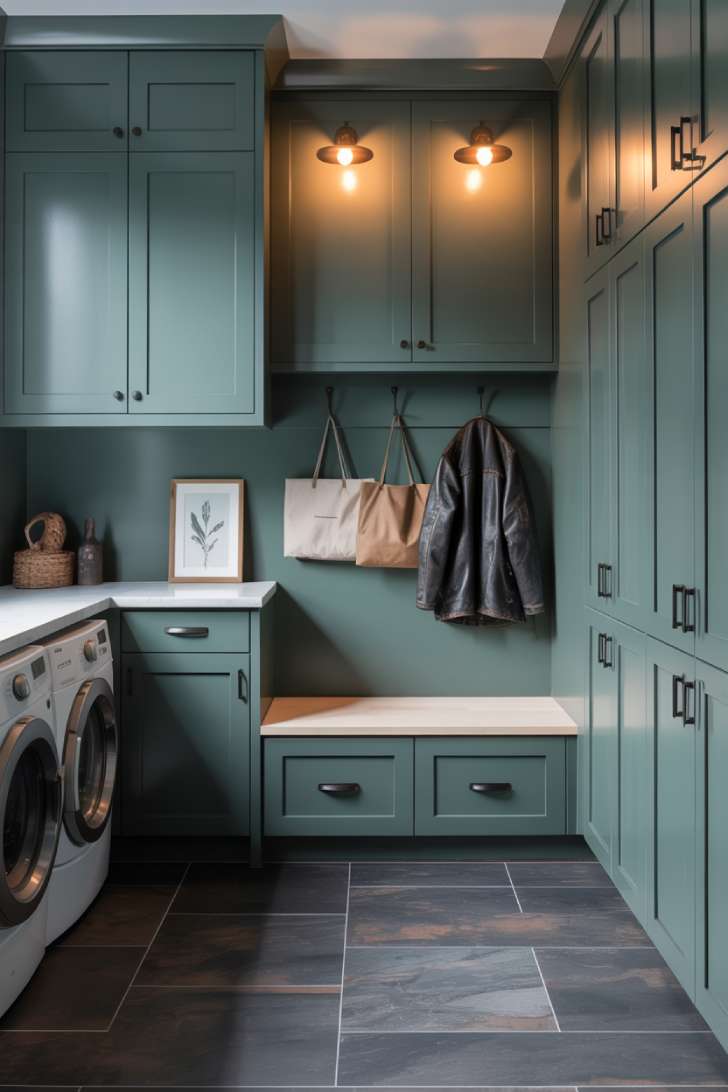
Not every mudroom laundry room needs to be bright white and airy.
Some of the most striking versions of this space lean all the way into depth and drama — and they work beautifully.
Deep navy, forest green, or charcoal cabinetry sets a completely different tone.
Matte black hardware disappears into the dark cabinet face, creating a seamless, refined look that feels expensive without necessarily costing more.
Edison-bulb pendants or warm brass sconces warm the cool tones of dark paint, keeping the space from feeling cold or oppressive.
The real practical upside of dark cabinetry? Fingerprints, scuffs, and everyday wear are nearly invisible.
In a room that gets more daily contact than almost any other in the house, that matters.
Dark rooms work because they remove the pressure for everything to be perfectly clean and white.
There’s a psychological permission that comes with a darker space — it signals that this room is allowed to be a working room.
Paired with warm lighting, that combination feels cozy rather than heavy, and refined rather than rough.
Style Blueprint:
- Floor-to-ceiling cabinetry in a deep, saturated color with a matte or soft-sheen finish
- Matte black hardware throughout — cup pulls, hooks, and faucet
- A bright contrasting countertop — white or light quartz — for visual relief
- Warm-toned lighting — brass sconces, Edison pendants, or warm LED strips
- A dark tile floor in slate, charcoal, or a deep patterned option
Built for Dog Owners: The Pet Wash Station Done Right
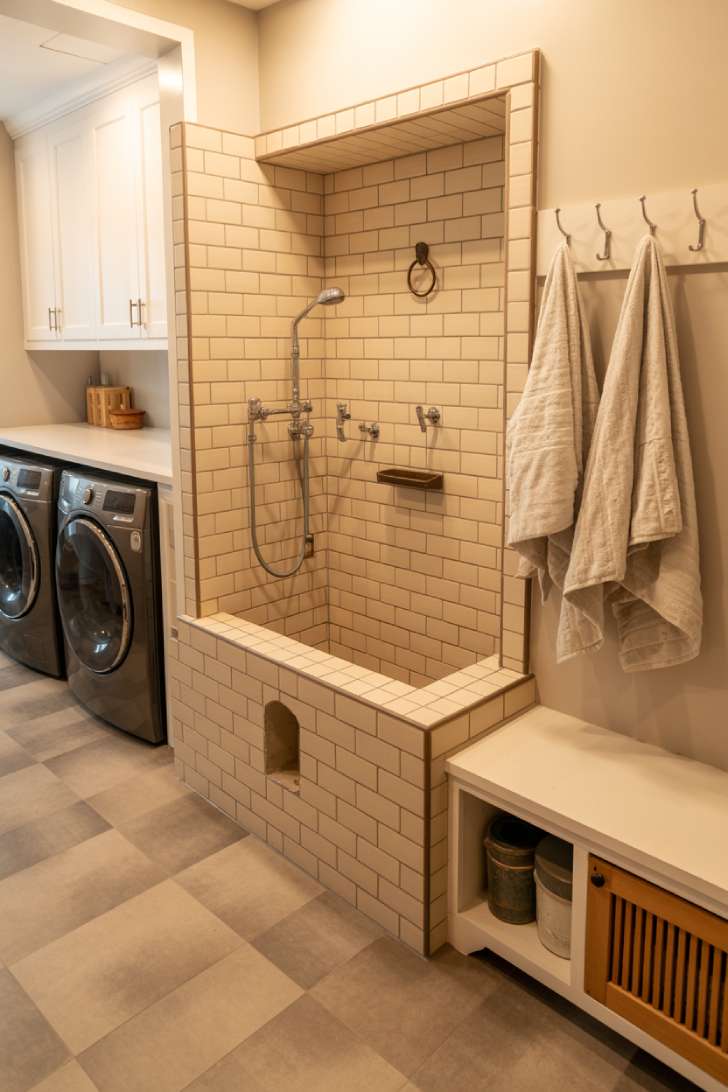
For anyone who has tried to wash a muddy dog in a bathtub — or worse, outside with a garden hose in November — a dedicated pet wash station in the mudroom laundry room is life-changing.
The setup is a raised, tiled shower base — typically waist height — with a drain, a handheld sprayer mounted to the wall, and a non-slip mat on the floor of the basin.
Raising the station to waist height is the key detail.
It removes the need to bend or kneel, which makes a real difference when you’re wrestling with a wet Labrador who would very much like to leave.
A wall-mounted leash ring just outside the station keeps the dog still during washing.
Nearby, a row of hooks holds towels dedicated to pet drying, and a small cabinet stores shampoo, brushes, and treats.
The laundry appliances sit on the adjacent wall — close enough that wet pet towels go directly from dog to machine.
Positioning the pet station adjacent to the laundry appliances — rather than across the room — creates a circular workflow that actually gets used.
Wash the dog, grab a towel from the hook, toss the wet towel directly into the machine.
Three steps, no mess anywhere else in the house.
That kind of workflow logic is what separates a room that functions from a room that truly performs.
Style Blueprint:
- Raised tiled basin at waist height with a built-in drain
- Handheld shower sprayer on an adjustable wall-mounted rail
- Wall-mounted leash ring or hold point beside the station
- Dedicated towel hooks and a closed pet supply cabinet adjacent to the station
- Positioned on the same wall or adjacent wall to the laundry appliances for workflow efficiency
The Full Command Center: When You Want to Do It All
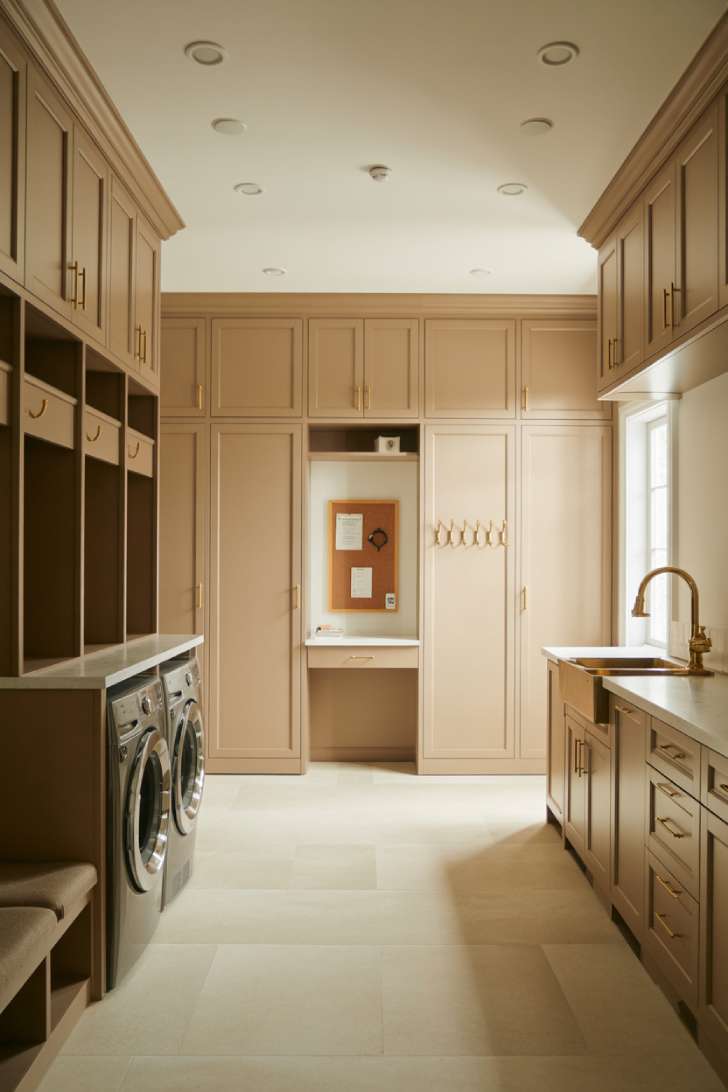
This is the one for the homeowners who want to go all-in.
The full command center mudroom laundry room takes every function covered in this article and integrates them into one wall — or one room — of custom-built cabinetry.
On one end: the laundry zone, with side-by-side appliances, a folding counter above, and upper cabinets going to the ceiling.
Moving along the wall: a full locker run, with dedicated columns for each family member.
At the center: a drop zone — a narrow desk section with a charging drawer, a small corkboard, and a row of key hooks directly at eye level.
Toward the other end: a utility sink station, followed by a pet washing nook.
Everything is built in. Everything matches. Everything has a place.
It sounds expensive — and a fully custom version is — but the same effect can be approached gradually by planning the full layout up front and building it out in phases.
What makes the command center feel luxurious isn’t the price — it’s the coherence.
Every section is planned to connect to the next, so the eye moves across the room without interruption.
That visual continuity is what gives custom built-ins their distinctive, finished quality.
It’s not something you can achieve by lining up separate pieces of furniture. It has to be designed as a whole.
Style Blueprint:
- Full-wall custom cabinetry in a consistent finish and door style
- Defined zones: laundry, locker storage, drop zone, sink station, bench seating
- Quartz or stone countertop running continuously across all base cabinets
- Recessed ceiling lighting running the full length of the room
- A consistent hardware finish throughout — satin brass, brushed nickel, or matte black
Design Pro-Tip: If a full custom build isn’t in the budget right now, start by drawing the full layout you want — every zone, every cabinet, every dimension. Then build it in phases over time using that master plan. Starting with a plan means every addition fits perfectly. Starting without one means you’re constantly working around what you already installed.
Quick Styling Tips Before You Start
A few small decisions made early can save a lot of frustration later.
Choose a scrubbable paint finish — satin or semi-gloss — on every wall surface.
Mudrooms take more wall contact than almost any other room, and flat paint won’t survive it.
Use baskets and bins in one consistent color family throughout the room.
Mixed materials and colors in open storage create the kind of visual noise that makes a room feel messy even when it’s technically tidy.
Install lighting in layers — at least a ceiling fixture, under-cabinet LED strips above the folding counter, and a decorative sconce or pendant if the ceiling height allows.
Flat, uniform light from a single overhead source flattens the room and makes it feel purely functional.
Layered lighting makes it feel like a real room.
Add a rug or runner in the bench area.
Hard floors throughout a utility space feel cold underfoot and create echo.
One textile — even a small one — brings warmth back.
And don’t skip the vertical space above the upper cabinets if there’s a gap between the cabinet top and the ceiling.
A few baskets or boxes up there, neatly labeled, can hold seasonal items that would otherwise end up in a closet somewhere else in the house.
Wrapping Up
A well-designed mudroom laundry room does two things at once: it stops disorder at the door, and it makes one of the most repetitive household tasks as seamless as possible.
Whether you’re drawn to the warmth of a farmhouse aesthetic, the sleek confidence of a minimalist layout, or the comprehensive functionality of a full command center, there’s an idea in this list that fits your home, your family, and your day-to-day life.
The best version of this room isn’t necessarily the biggest or most expensive one.
It’s the one designed around how your household actually moves — and that looks good doing it.
Save your two or three favorite ideas from this list, pull the elements you love from each, and start there.