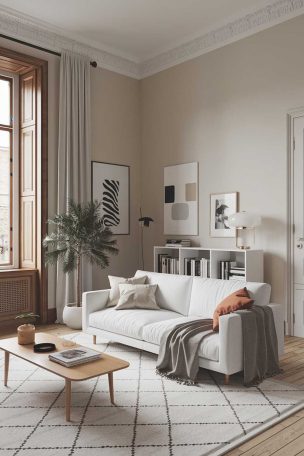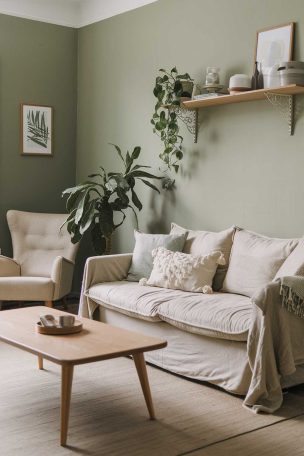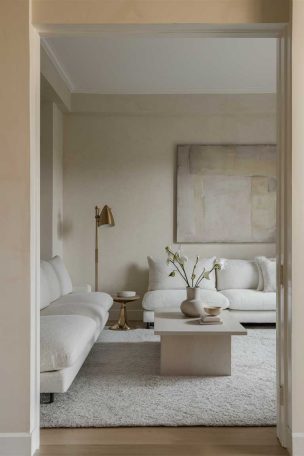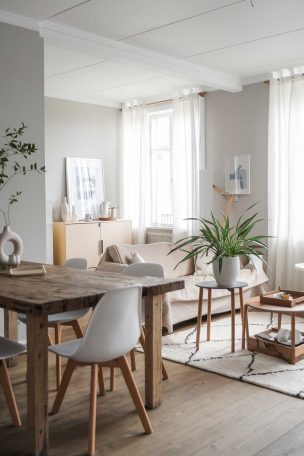
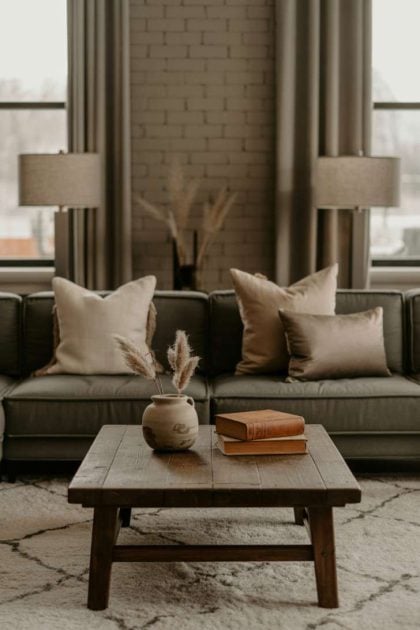
Moody neutral living rooms blend sophisticated darkness with earthy warmth to create spaces that feel cocooning rather than cold.
These interiors trade bright whites for charcoal grays, warm greiges, and deep sages.
The result? Rooms that invite you to slow down and breathe.
1. Charcoal Sophistication Meets Organic Texture
There’s something psychologically grounding about surrounding yourself with deeper tones.
Our brains interpret these rich neutrals as protective—like being wrapped in a soft blanket.
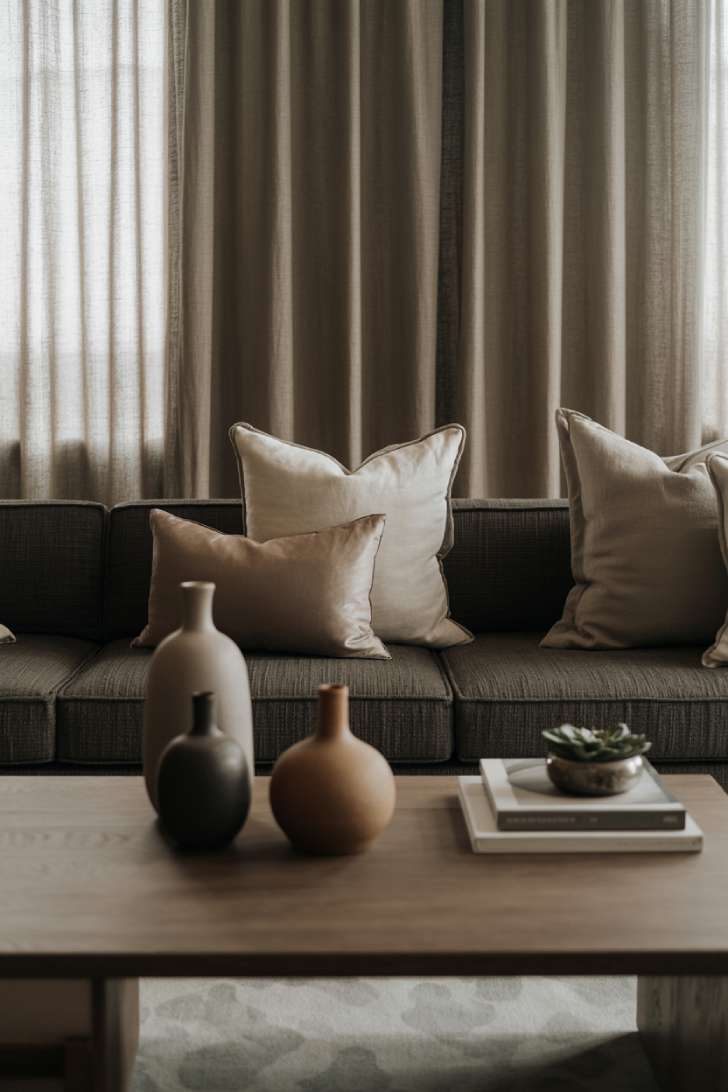
The charcoal sectional here anchors the room without overwhelming it.
Notice how the matte black ceramics create focal points against warm beige accents.
This contrast keeps your eye moving through the space rather than feeling visually heavy.
The low-profile coffee table maintains sightlines, which prevents that boxed-in feeling darker rooms can sometimes create.
Diffused lighting through sheer curtains is doing serious work here.
It softens shadows and prevents the space from reading as cave-like.
Style Blueprint:
- Charcoal gray sectional with deep seating
- Matte black ceramic vases in varied heights
- Sheer linen curtains for light diffusion
- Low walnut coffee table
2. Layered Earth Tones with Warm Ambient Glow
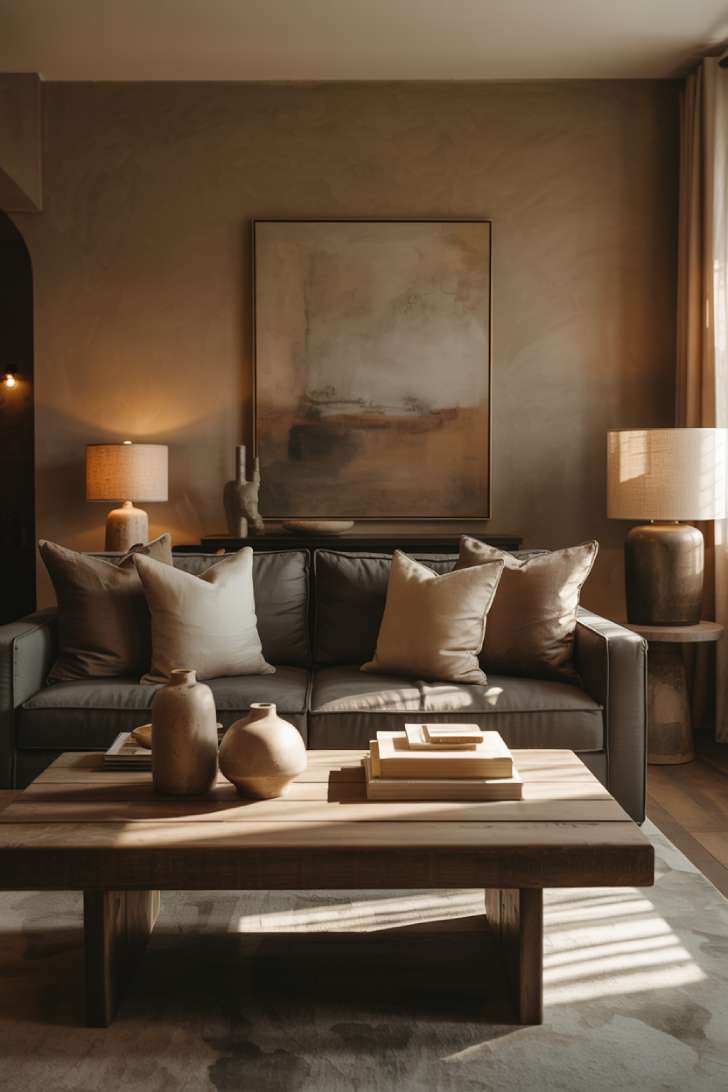
Greige walls are the unsung hero of moody neutral home decor.
They shift between warm and cool depending on the light, creating visual interest throughout the day.
This design leverages what psychologists call “biophilic design”—using earth tones that mirror natural landscapes.
Your nervous system responds to these colors by downregulating stress.
The abstract painting above the sofa introduces movement without pattern overload.
Table lamps with linen shades create what designers call “layered lighting”—multiple light sources at different heights that mimic how light behaves in nature.
This beats overhead lighting every time for creating a mood.
The rustic wood coffee table introduces organic texture that prevents the space from feeling too polished or staged.
Style Blueprint:
- Large abstract art in muted earth tones
- Table lamps with natural linen shades
- Rustic wooden coffee table with visible grain
- Warm greige wall paint
3. Minimalist Calm with Natural Fiber Accents
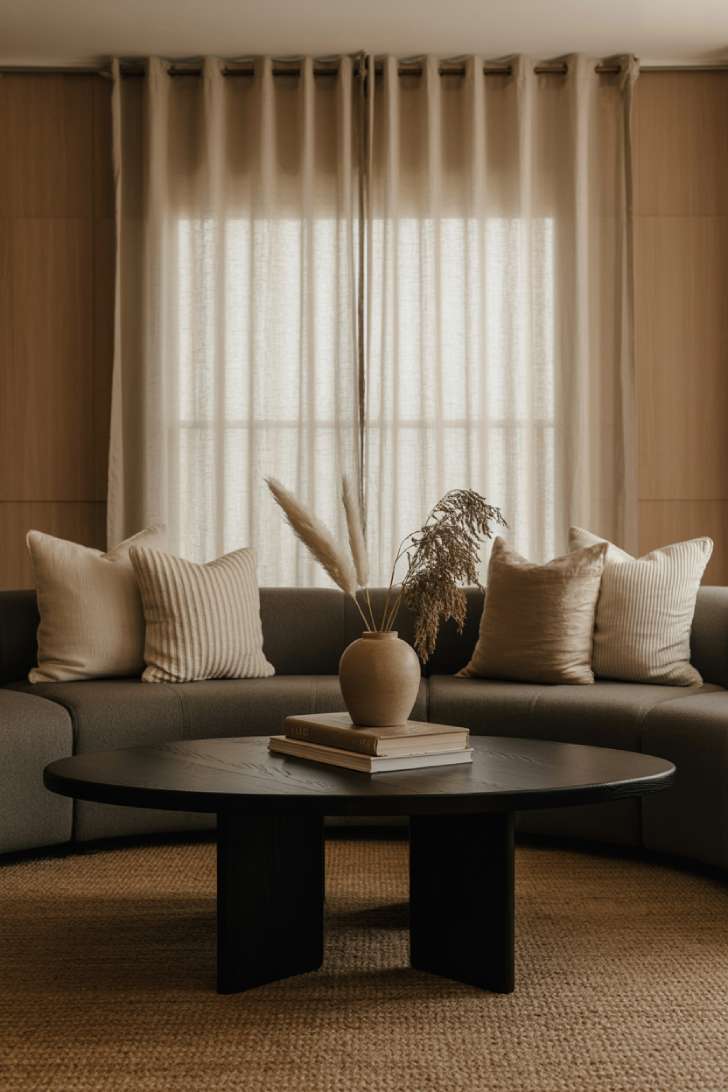
Jute rugs are a design psychologist’s dream.
Their texture provides tactile interest that smooth surfaces can’t deliver.
Your brain registers these natural fibers as calming because they connect to outdoor environments.
The beige walls with wood paneling create horizontal lines that make the room feel wider.
This is spatial psychology at work—horizontal elements expand perceived space.
The black coffee table provides just enough contrast to define the seating area without fighting for attention.
Dried pampas grass has staying power because it introduces organic movement that hard surfaces lack.
It catches light differently throughout the day, creating a living element that doesn’t require watering.
Style Blueprint:
- Large jute area rug with visible weave
- Sleek black coffee table
- Dried pampas grass in ceramic vessel
- Warm beige walls with wood accent paneling
4. Sage Green Depth with Reclaimed Wood Character
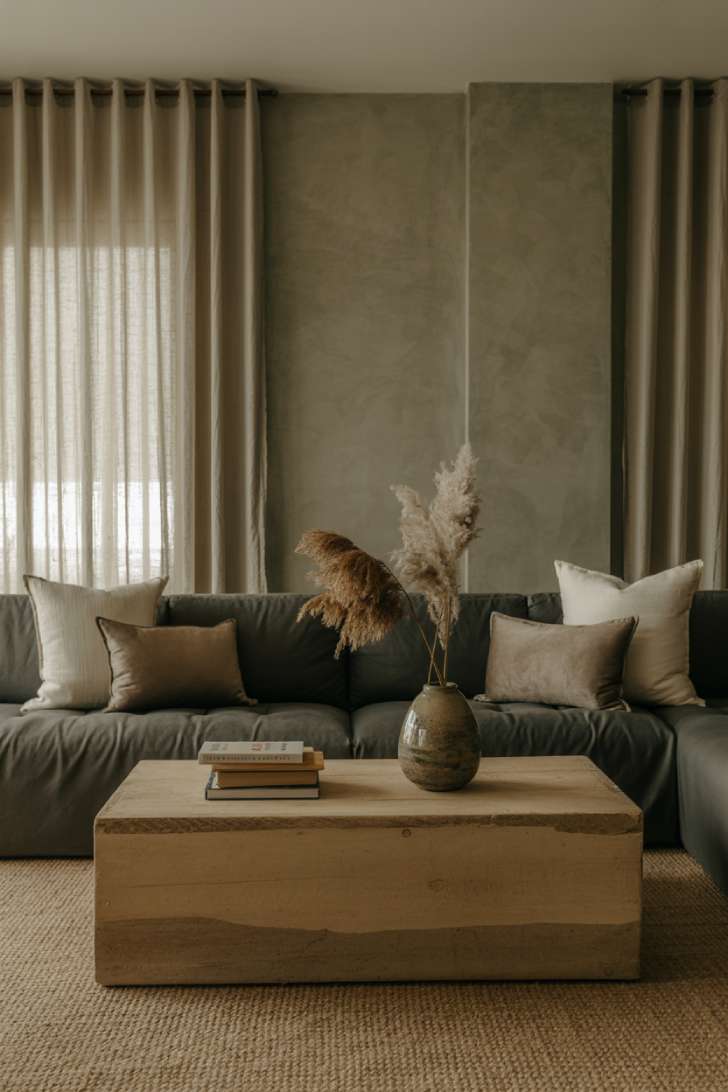
Sage green accent walls change the entire psychological temperature of a moody lounge room.
Green triggers our parasympathetic nervous system—the part responsible for rest and digestion.
That’s why this color feels so naturally calming.
The reclaimed wood coffee table introduces history and imperfection into the space.
Perfectly smooth, new furniture can feel sterile.
Wood with visible wear tells a story your subconscious picks up on.
The natural fiber rug bridges the cool sage and warm wood beautifully.
Cream and taupe pillows prevent the charcoal sofa from creating too much visual weight.
This is color balancing in action—you need lighter elements to lift darker bases.
Style Blueprint:
- Sage green accent wall paint
- Reclaimed wood coffee table with visible character
- Natural fiber area rug
- Dried pampas grass arrangements
5. Contemporary Drama with Concealed Lighting
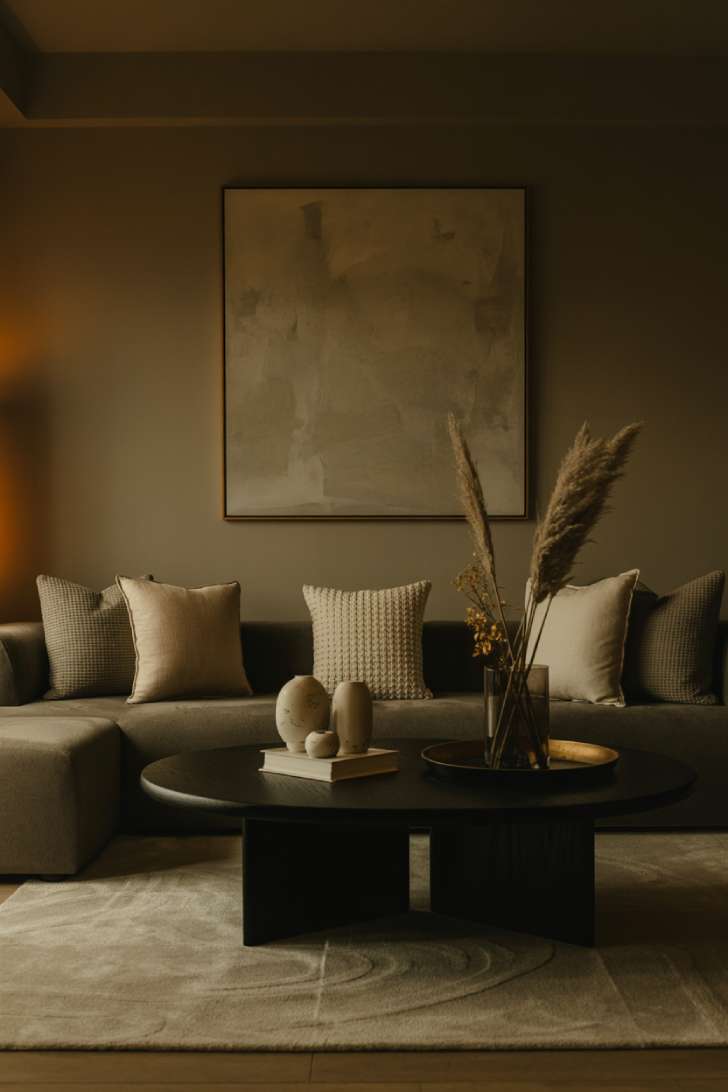
Concealed lighting is a game-changer for moody neutral living room design.
It creates atmosphere without revealing its source—your eye sees the effect but not the cause.
This triggers a subtle sense of mystery that makes spaces feel more expensive.
The mushroom gray walls read as luxurious rather than dull because of how the lighting plays across their surface.
Shadows become part of the design, not something to eliminate.
The black coffee table grounds all that atmospheric lighting with a solid, defined edge.
Large abstract art at this scale becomes architecture rather than decoration.
It changes how you perceive the room’s proportions.
Style Blueprint:
- Concealed LED lighting for wall washing
- Mushroom gray wall paint
- Large-scale abstract art
- Sleek black coffee table
Design Pro-Tip: The 60-30-10 color rule transforms good rooms into great ones. Use your dominant neutral (charcoal, greige, or sage) for 60% of the space, a secondary tone for 30%, and an accent color for the final 10%. This creates visual hierarchy your brain naturally finds pleasing.
6. Textured Luxury with Charcoal Velvet
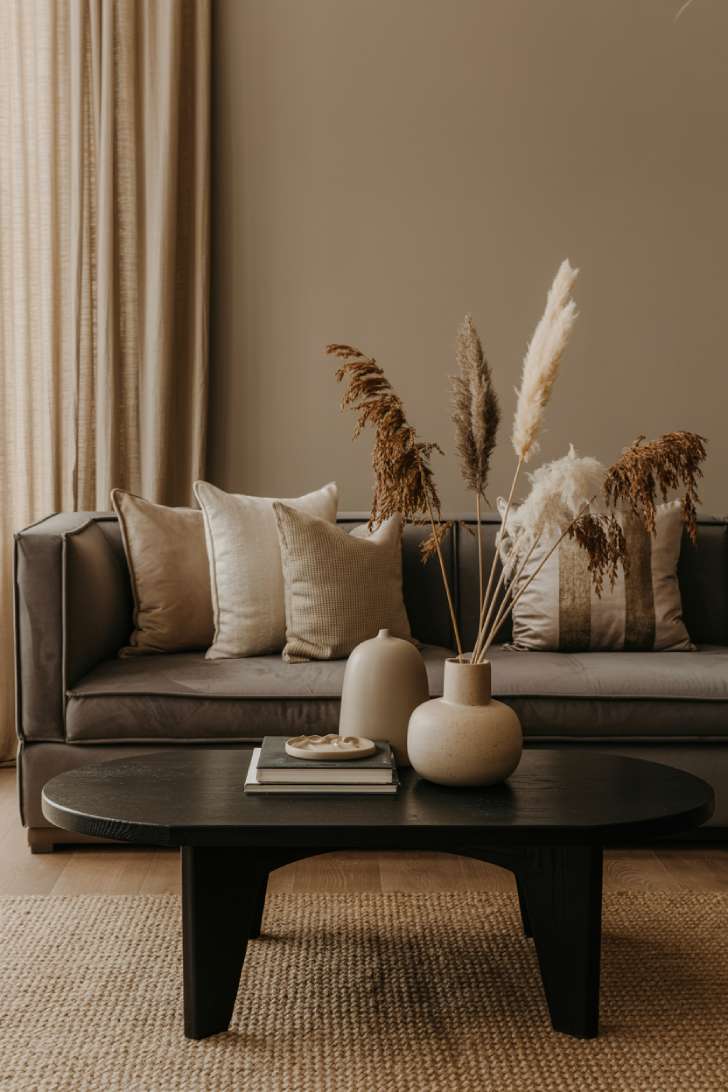
Velvet does something magical to light.
Its pile catches and reflects rays differently than flat fabrics, creating depth through shadow play.
This textural variation keeps a dark neutral living room from feeling flat or one-dimensional.
The jute rug underneath provides contrast in both color and texture.
Your feet read rough natural fiber while your eyes see soft plush velvet—this sensory contrast creates richness.
Matte white ceramics here prevent the darker elements from dominating.
They act as visual breathing room.
Greige walls shift the temperature warmer than pure gray would, preventing that cold, industrial feeling.
Style Blueprint:
- Charcoal velvet sofa
- Textured jute area rug
- Matte white ceramic vessels
- Greige wall paint
7. Brass Accents and Shadow Play
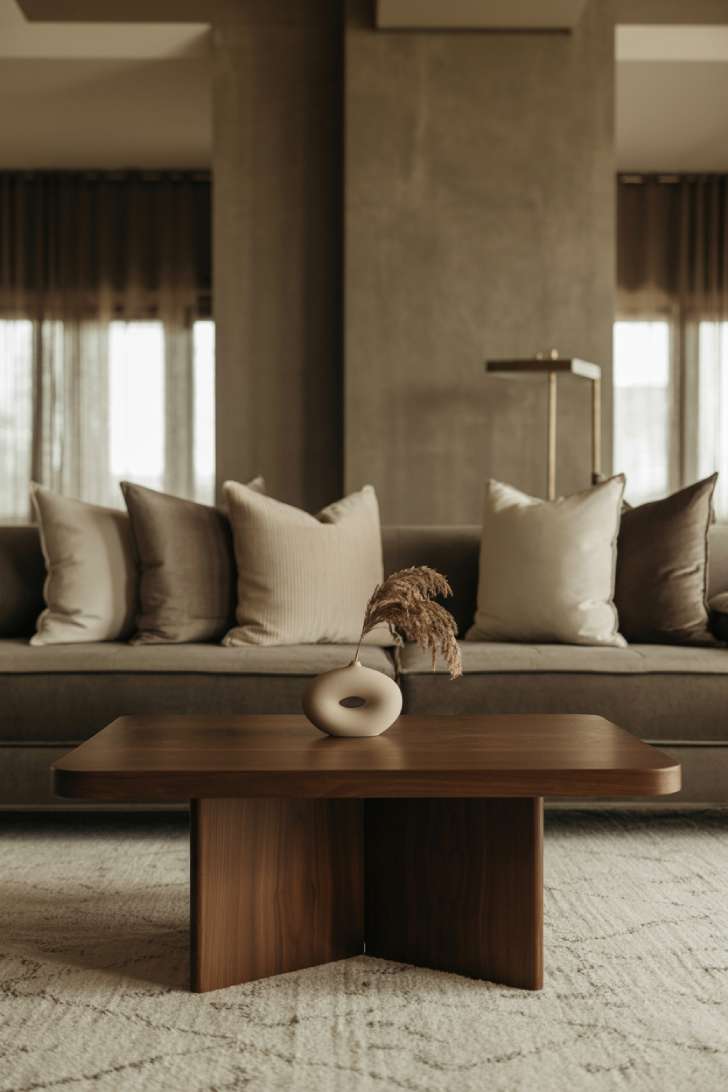
Brass floor lamps introduce warm metallics that dark neutral living rooms desperately need.
The metal reflects warm light in a way that chrome or nickel can’t match.
This creates pockets of golden glow that feel inviting rather than stark.
Dark walnut wood reads as luxurious because of its depth and grain variation.
Cheap furniture uses veneers that lack this visual complexity.
The cream area rug here serves a psychological purpose beyond aesthetics.
It defines the conversation area and signals “this is where you gather.”
Subtle wall texture catches light differently throughout the day, creating a living surface that changes with natural light shifts.
Style Blueprint:
- Modern brass floor lamp
- Dark walnut coffee table
- Luxurious cream area rug
- Textured wall treatment
8. Deep Sage Drama with Woven Naturals
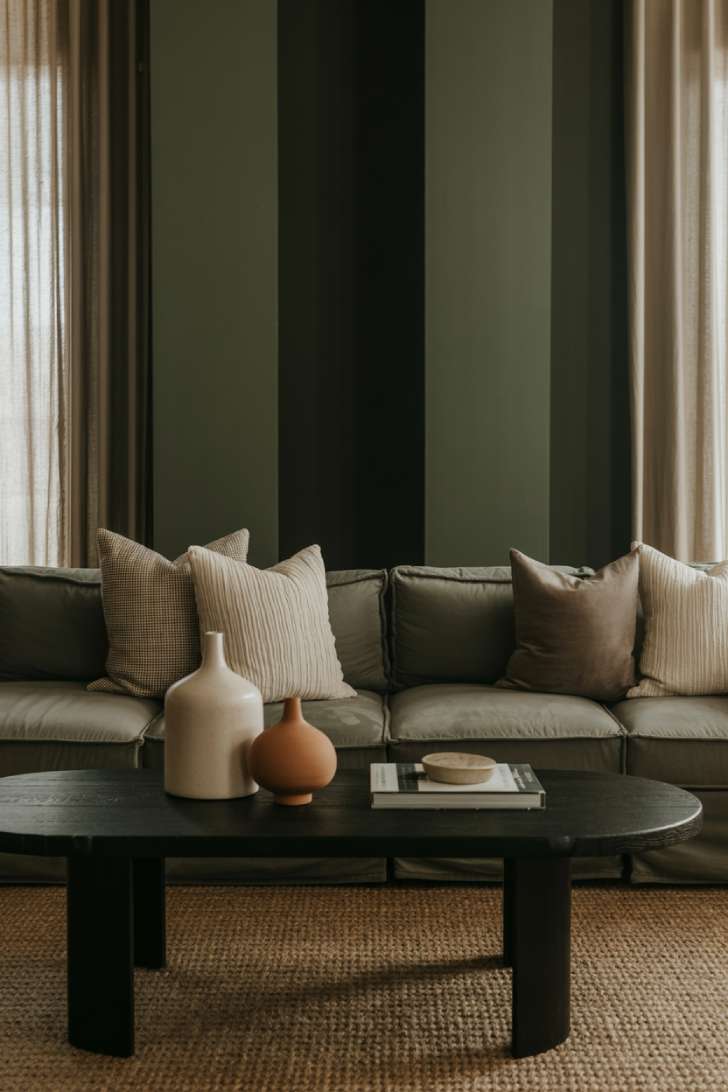
Deep sage walls create a moody lounge room that feels grounded rather than gloomy.
The color sits right at the intersection of green and gray, giving you the psychological benefits of both.
Terracotta accents introduce warmth that prevents the sage from skewing too cool.
This is temperature balancing—mixing warm and cool tones creates spaces that feel lived-in rather than staged.
The woven jute rug provides texture at foot level, which matters more than people realize.
Your peripheral vision picks up this tactile variation, signaling comfort and informality.
Sheer linen curtains filter harsh light into something gentler.
This diffusion prevents the deep walls from creating a bunker effect.
Style Blueprint:
- Deep sage green accent walls
- Woven jute area rug
- Terracotta ceramic accents
- Sheer linen window treatments
9. Fireplace Focal Point with Cream Foundation
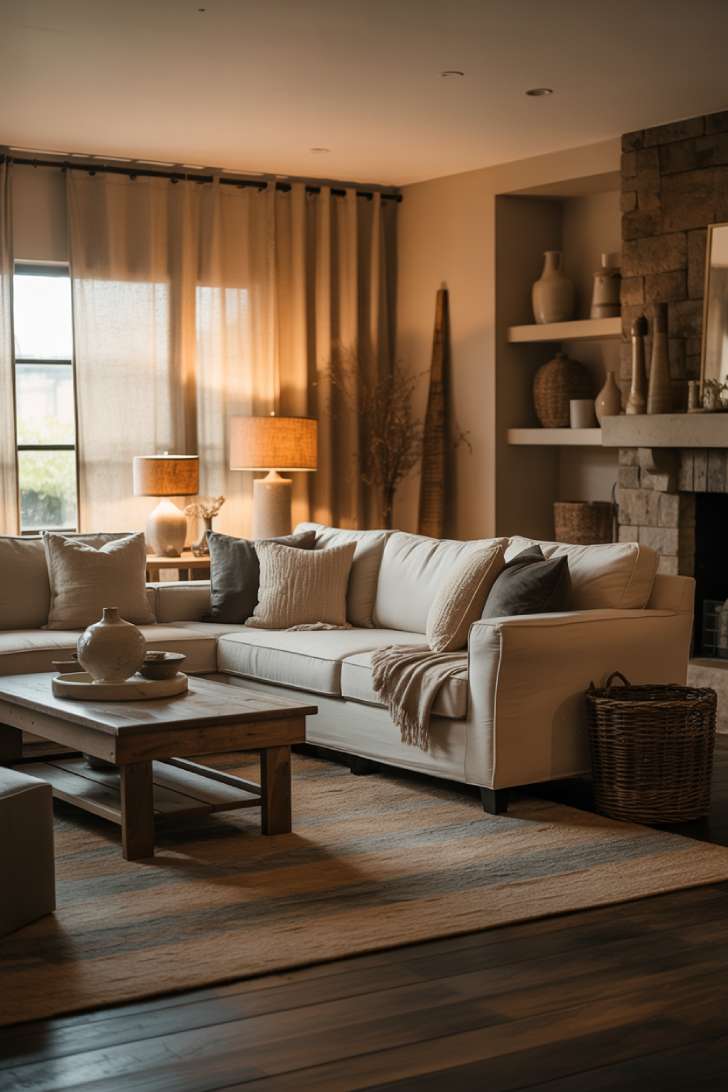
Starting with a cream sectional instead of charcoal flips the moody neutral script.
The darkness comes from accent walls, floors, and decor rather than the main seating.
This creates a different psychological effect—brightness surrounded by depth rather than darkness surrounded by light.
The stone fireplace acts as a natural focal point that grounds the entire space.
Stone connects to our evolutionary preference for shelter and protection.
Layered rugs create depth on the floor plane, which most people neglect.
This stacking technique adds visual interest where you’d otherwise just see flat surface.
Linen-shaded lamps scattered throughout create that critical layered lighting effect.
Multiple light sources prevent the harsh shadows that single overhead lights create.
Style Blueprint:
- Cream-colored sectional sofa
- Stone fireplace surround
- Layered area rugs (jute base, patterned top)
- Multiple table lamps with linen shades
Design Pro-Tip: Never underestimate the power of “light layering.” Combine three types of lighting—ambient (overhead or concealed), task (reading lamps), and accent (uplights on art or plants). This trio creates depth and prevents the flat, lifeless feeling that single-source lighting produces.
10. Floating Shelves and Chunky Textures
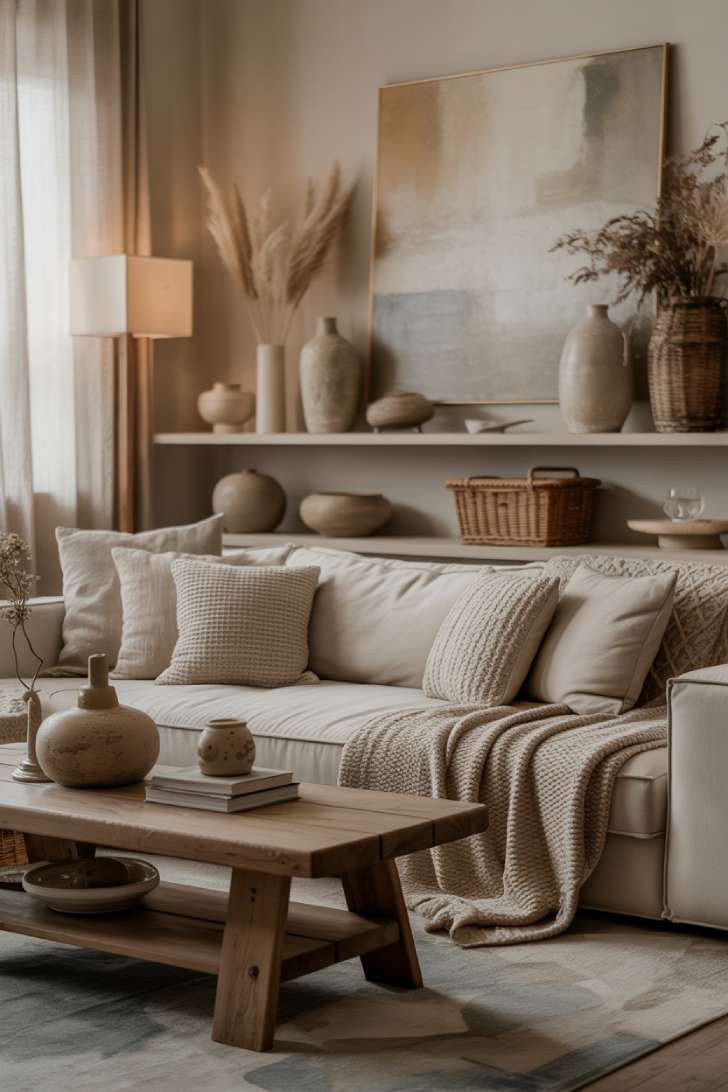
Floating shelves break up wall space without the visual weight of floor furniture.
They create horizontal lines that guide your eye across the room rather than just up and down.
This is directional design—controlling how people visually navigate your space.
The chunky knit blanket introduces tactile appeal that smoother textures can’t provide.
Your brain associates these oversized weaves with comfort and handmade quality.
Ceramic vases and woven baskets on shelves create visual rhythm through repetition.
Repeating organic shapes in different scales creates what designers call “controlled variety.”
Natural light filtering through sheers prevents the darker elements from overwhelming the space.
It’s that push-pull between light and dark that makes moody neutral home decor work.
Style Blueprint:
- Floating wall shelves in dark wood
- Chunky knit throw blanket
- Mixed ceramic vases and woven storage
- Sheer curtain panels
11. Matte Black Accent Wall with Warm Oak Floors
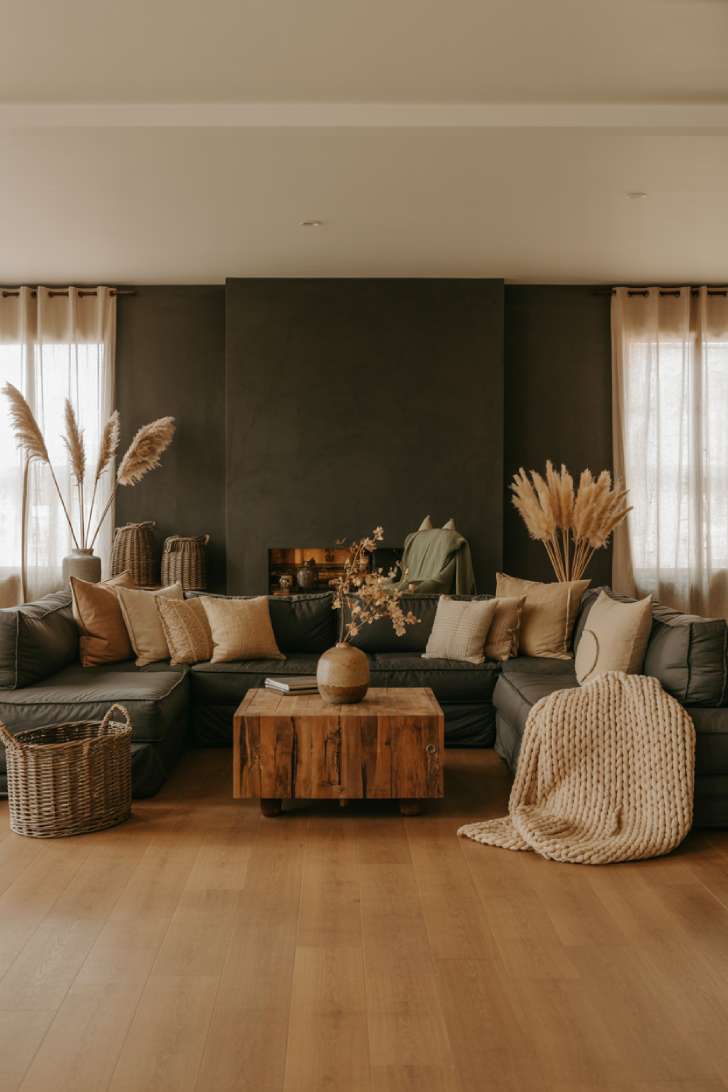
A matte black accent wall is the boldest move you can make in neutral paint colors.
It creates dramatic depth that forces every other element to pop.
The psychological effect? Your attention sharpens because your brain has to work slightly harder to perceive detail against the dark background.
Warm oak floors provide the necessary temperature balance.
Without this golden-toned wood, the black wall could feel oppressive.
Sage green pillows bridge the warm floors and dark walls beautifully.
They pull a third color into the palette that connects to both.
The reclaimed wood coffee table’s grain patterns become even more pronounced against the dark backdrop.
This is contrast at work—light and texture show up more dramatically when surrounded by darkness.
Style Blueprint:
- Matte black accent wall paint
- Warm oak hardwood flooring
- Reclaimed wood coffee table
- Sage green linen pillows
Moody Neutral Living Room Elements
| Design Element | Material/Finish | Mood Created | Maintenance Level |
|---|---|---|---|
| Charcoal Sectional | Velvet or Linen | Cocooning & Protective | Medium (spot clean) |
| Greige Walls | Matte Paint | Warm & Adaptable | Low (touch-ups rare) |
| Jute Rugs | Natural Fiber | Organic & Textural | Medium (vacuum weekly) |
| Black Coffee Tables | Wood or Metal | Grounding & Defining | Low (dust as needed) |
| Sage Accent Walls | Matte Paint | Calming & Restorative | Low (touch-ups rare) |
| Dried Pampas Grass | Natural Stems | Movement & Softness | Very Low (dust monthly) |
Conclusion
Moody neutral living rooms prove that darkness doesn’t mean dreary.
These spaces work because they balance rich depths with warm textures and strategic lighting.
Whether you choose charcoal grays, warm greiges, or deep sages, the secret lies in layering tones rather than committing to just one.
Mix your materials.
Vary your light sources.
Let shadows become part of the design rather than something to fight.
The result is a space that invites you to sink in and stay awhile.