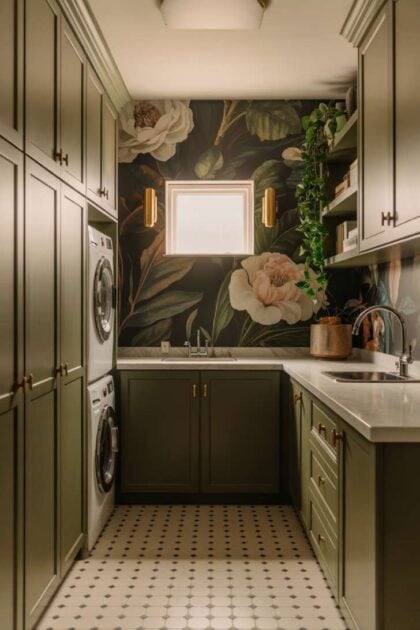
The laundry room is almost always the last space anyone thinks about when decorating a home.
It gets the leftover budget, the builder-grade cabinets, and the harsh overhead light that makes everything look clinical.
But the moody laundry room trend is changing all of that — and fast.
Dark, rich, and deeply atmospheric, a moody laundry room turns a purely functional space into something you actually want to spend time in.
Whether you’re planning a full renovation or just looking for a weekend refresh, these 11 dark laundry room ideas will give you all the inspiration you need to make it happen.
The All-Black Cabinet Moment
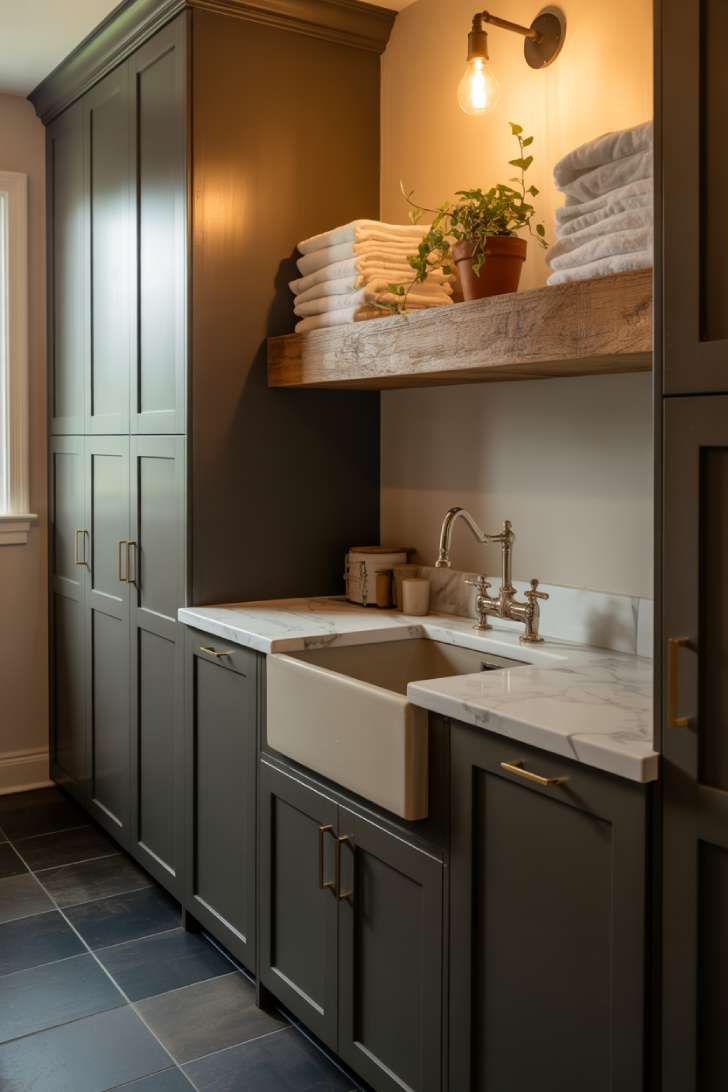
Matte black cabinetry is one of the boldest moves you can make in a laundry room — and one of the most rewarding.
The reason it works so well comes down to contrast and weight.
Dark cabinetry pulls the eye down and inward, making the room feel intentional and grounded.
When you pair it with a white or light stone countertop, that contrast creates a visual tension that feels designed rather than accidental.
The brain reads that kind of deliberate opposition as sophistication.
Add brass hardware into the mix, and suddenly you’ve introduced warmth into what could have been a very cold, flat palette.
That warmth is what stops the room from feeling like a funeral parlor and starts making it feel like a boutique hotel utility room — and yes, that is absolutely a compliment.
Style Blueprint:
- Matte black shaker-style cabinetry, floor to ceiling
- White Carrara marble or quartz countertop with subtle veining
- Brushed brass cabinet hardware and faucet
- Reclaimed wood or oak floating shelf for styling
- Warm-toned Edison bulb wall sconce or pendant
Navy Walls That Feel Like a Tailored Suit
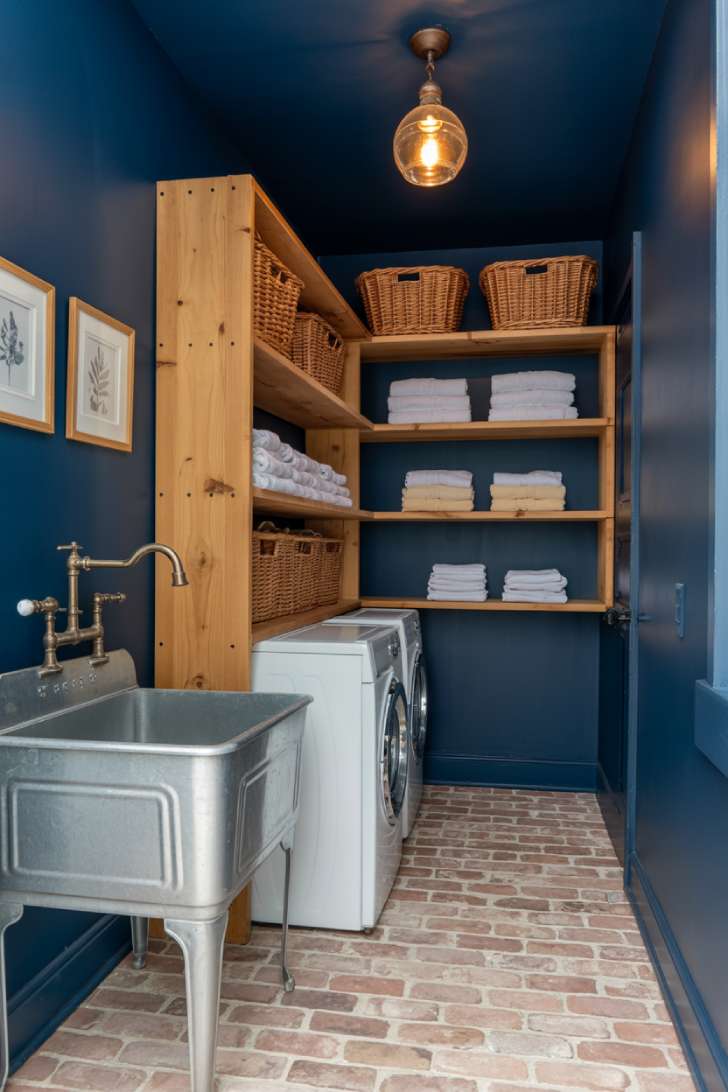
Navy blue might be the most universally flattering dark color you can put on a laundry room wall.
It reads as serious without being aggressive.
There’s a psychological reason for that — deep blue tones are associated with calm, reliability, and depth, which means a navy laundry room actually feels like a place where you can settle in and get things done.
Paired with warm brick floors and reclaimed wood shelving, the navy loses any coldness it might carry and starts to feel almost cozy.
The key is layering textures.
Smooth painted walls against rough brick against the soft weave of rattan baskets — that contrast is what gives the room its richness.
If you want a reference point for this kind of color, Benjamin Moore’s Polo Blue is a go-to among designers for its inky, saturated depth that still reads as blue rather than black.
Style Blueprint:
- Deep navy satin-finish wall paint (Benjamin Moore Polo Blue or similar)
- Vintage cast iron or fireclay utility sink with bridge-style brass faucet
- Reclaimed wood open shelving
- Brick paver or warm-toned patterned tile flooring
- Woven rattan storage baskets in natural tones
Dark Botanical Wallpaper, Full Stop
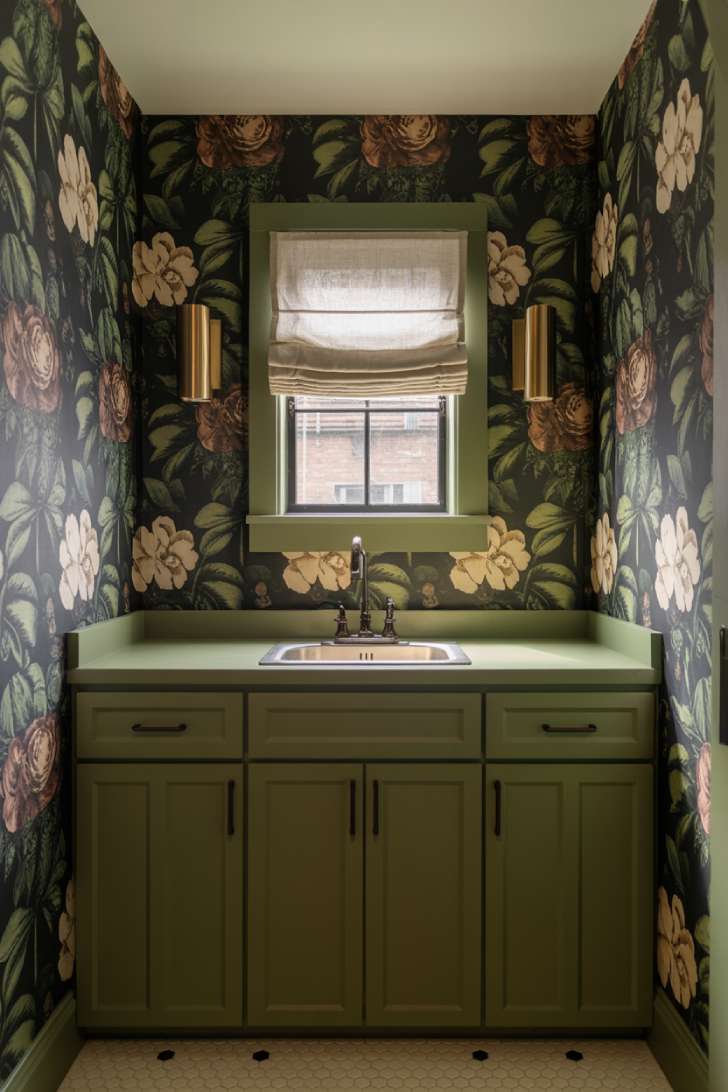
If there is one single change that can completely transform a laundry room’s personality, it’s wallpaper.
And not just any wallpaper — bold, dark, oversized botanical wallpaper that makes you feel like you’ve walked into a different world.
The reason this works so well in a small utility space is actually counterintuitive.
Busy pattern in a small room shouldn’t work — and yet it does, because the eye has so much to look at that it stops registering the size of the room and starts experiencing the atmosphere instead.
Deep background wallpaper, especially in black or forest green with large-scale floral motifs, creates an immersive quality that no paint color alone can replicate.
Paired with solid cabinetry in a complementary dark tone, the pattern and color feel cohesive rather than chaotic.
One pro tip from actual wallpaper installers: if the wallpaper has a dark background printed on a white substrate, run a thin line of dark chalk or diluted matching paint under where the seams will fall so that any shrinkage during drying doesn’t reveal white edges later.
It’s a small step that makes a huge difference in the finished result.
Style Blueprint:
- Large-scale botanical wallpaper with deep black or dark green background
- Solid cabinetry in complementary deep olive or forest green
- Matte black bar-pull hardware
- Small black and white hexagon floor tiles
- Brass wall sconces flanking a window or mirror
Design Pro-Tip: Don’t limit dark wallpaper to the walls. Papering the ceiling of a laundry room is one of the most unexpected and dramatic moves in small-space decorating — it draws the eye up, adds depth overhead, and makes the entire room feel like a considered, finished space rather than an afterthought.
Forest Green, Everywhere
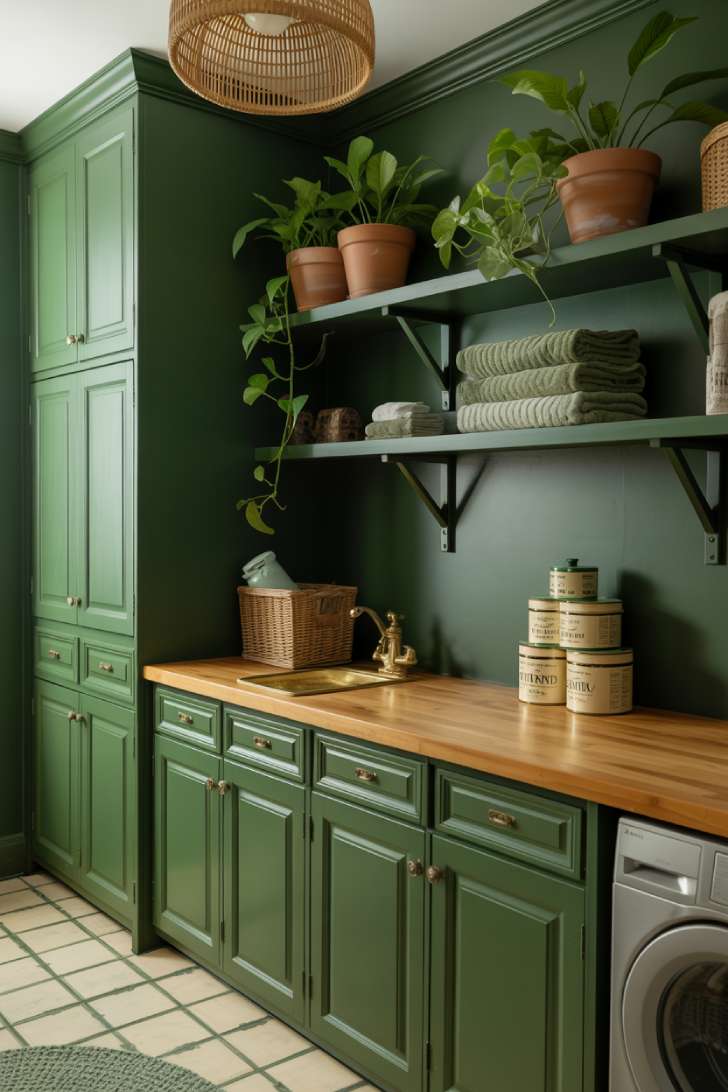
Color drenching is one of those ideas that sounds risky and turns out to be one of the best decisions you can make in a small room.
The concept is simple: paint everything — walls, cabinetry, ceiling, and trim — in the same color.
By removing all the visual interruptions that different colored surfaces create, the room suddenly feels much larger, much calmer, and intentional in a way that a standard paint job just can’t achieve.
Deep forest green is arguably the best color for this technique in a laundry room.
It has enough warmth to prevent the space from feeling cold, enough earthiness to feel organic and relaxed, and enough depth to deliver real moodiness.
Sherwin-Williams Ripe Olive and Pratt & Lambert’s Essex Deep Green are two colors that come up again and again in dark green laundry room designs for exactly this reason.
Adding actual plants — a trailing pothos, a small fern — reinforces the botanical quality and makes the green feel like a deliberate conversation with nature rather than just a paint choice.
Style Blueprint:
- Deep forest green satin paint on all surfaces, including ceiling and trim
- Butcher block or natural oiled oak countertop
- Unlacquered or aged brass hardware
- Encaustic cement patterned floor tiles
- Live trailing plants on open shelving
Teal Cabinets Meet Dark Floral Walls
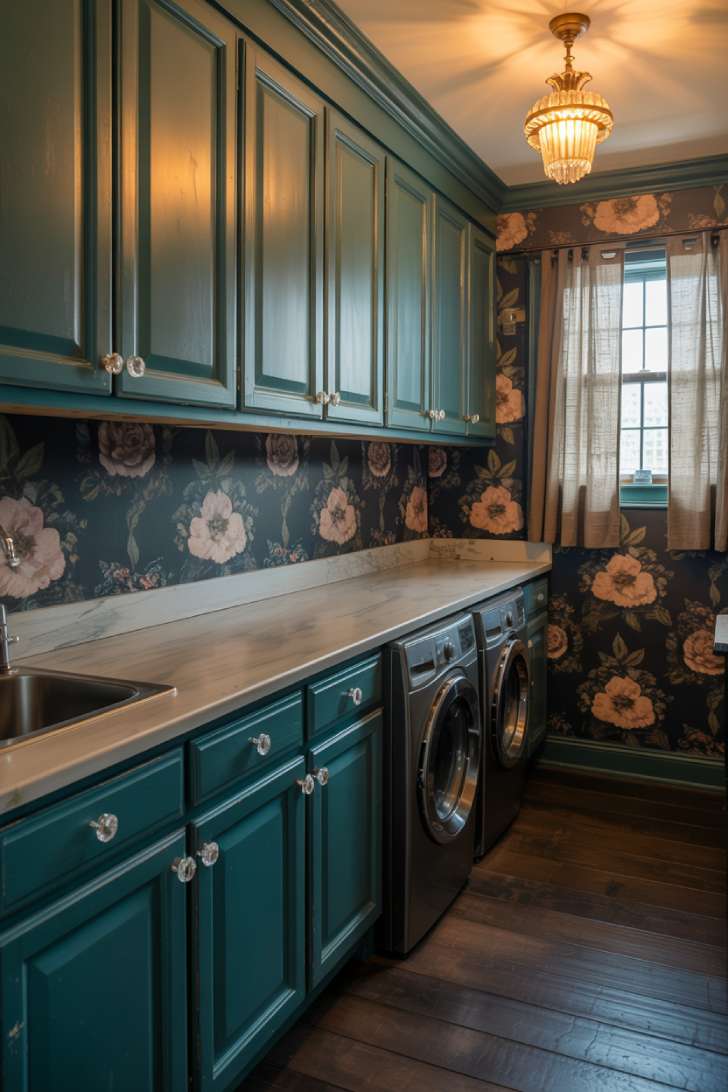
This combination is for the person who is not afraid to commit.
Teal cabinetry against dark floral wallpaper is maximalist in the best possible way — layered, romantic, and completely unexpected in a utility space.
What makes it work is the way teal functions as a bridge color.
It pulls from both the blue and green families, which means it can hold its own against almost any dark wallpaper background without clashing.
The psychological effect of jewel-toned cabinetry in a small room without much natural light is particularly interesting — rather than making the room feel smaller, the richness of the color creates an intimate, enclosing quality that feels luxurious rather than confined.
Adding a small chandelier is the detail that takes this concept from “bold design choice” to “fully realized room.”
It’s completely unexpected in a laundry room, which is exactly why it works so well — the surprise of it makes the space memorable.
Style Blueprint:
- Rich teal satin-finish cabinetry
- Dark floral or botanical wallpaper with deep background
- Crystal or ornate brass cabinet hardware
- Small chandelier or statement pendant light fixture
- Pale limestone or honed white stone countertop
Design Pro-Tip: In a laundry room with no natural light, jewel-toned cabinetry actually performs better than lighter colors. Warm artificial lighting bounces off saturated surfaces and creates a glowing, amber-lit quality that makes the room feel cozy and intentional rather than dim and depressing. Lean into the darkness — it’s an asset, not a problem.
The Bold Floor That Does All the Work
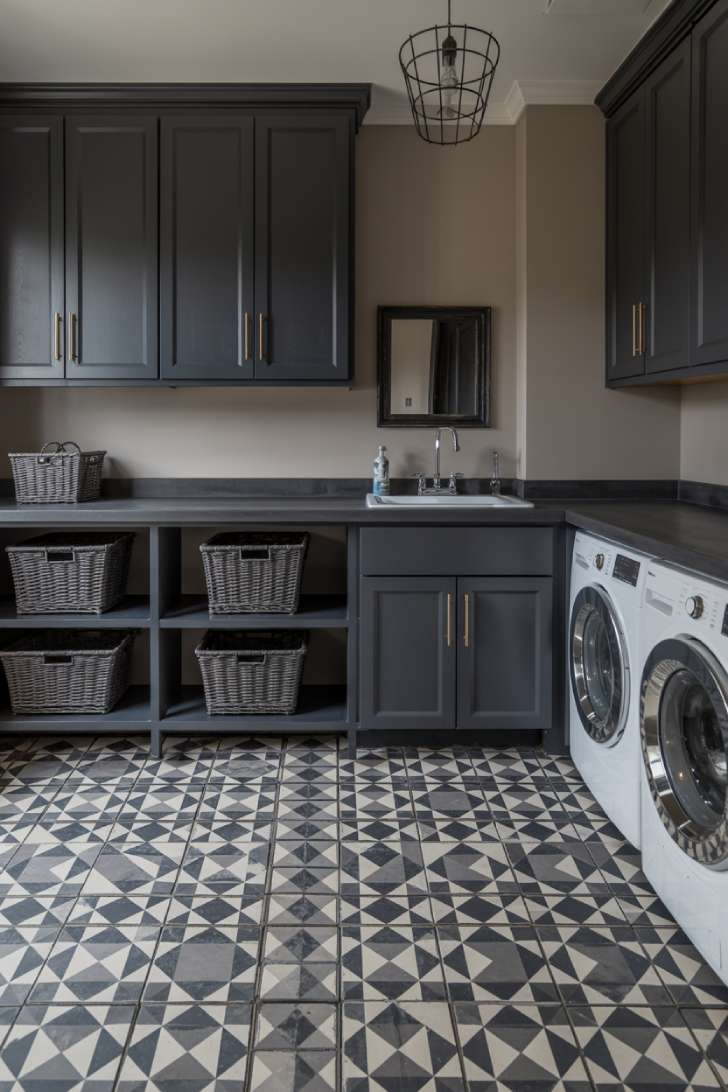
Not every moody laundry room needs to start with the walls.
Sometimes, the most powerful design move is going underfoot.
A bold, dark, patterned floor tile anchors the entire room and gives every other element something to respond to.
The way this works from a spatial perception standpoint is that strong horizontal pattern draws the eye across the floor, which actually makes a narrow or small room feel wider and more expansive.
Encaustic cement tiles with deep geometric patterns in black, navy, and charcoal are durable enough for a high-traffic utility space and beautiful enough to be the room’s defining feature.
Keeping the walls in a softer, more neutral tone here is a deliberate choice — it lets the floor breathe and prevents the room from feeling overwhelmed by pattern.
This is the approach to take if you want dramatic laundry room design but aren’t ready to commit to dark walls or dark cabinetry across the board.
Style Blueprint:
- Encaustic cement or porcelain geometric floor tiles in dark tones
- Deep charcoal cabinetry with simple bar-pull hardware
- Honed black granite or dark stone countertop
- Cage-style iron pendant light
- Matching woven or canvas storage bins in dark neutral tones
Soft Charcoal With Black Trim — The Quiet Moody
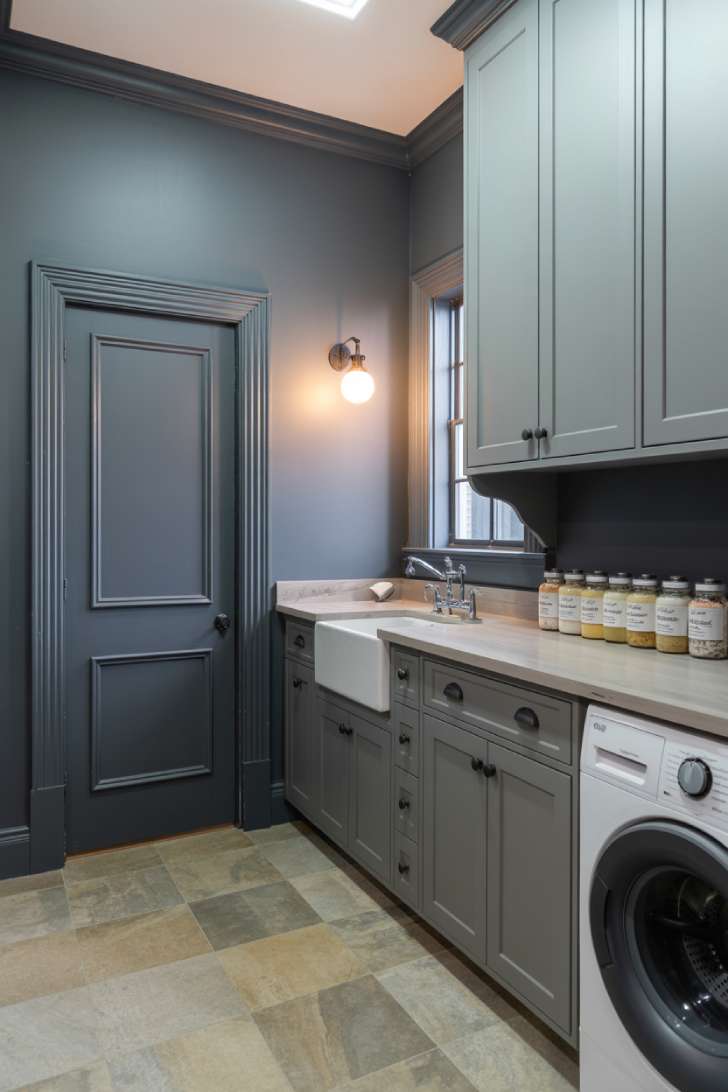
This is the moody laundry room for someone who wants sophistication without full commitment to darkness.
Charcoal gray walls with matte black trim is a layering technique — the trim acts as a framing device that gives the room definition and sharpness without relying on an all-dark palette.
The effect is something like a pencil drawing: the darker lines define the shapes, and the softer gray fills in the space between.
From a practical standpoint, this approach is also incredibly forgiving.
Charcoal walls hide marks and scuffs better than white but are far less unforgiving about lighting conditions than full black or very deep navy.
Farrow & Ball’s Downpipe is the color that comes up most often in this category — a deep charcoal with enough blue undertone to feel refined and interesting rather than flat.
It’s the kind of room that looks effortlessly put together whether the lighting is bright and task-oriented or dimmed down for the end of the day.
Style Blueprint:
- Soft warm charcoal wall paint (Farrow & Ball Downpipe or similar)
- Matte black door trim, window casing, and cabinet detailing
- Pale soapstone or light-veined quartz countertop
- White apron-front farmhouse sink
- Simple black iron wall sconce with frosted or clear globe shade
Deep Plum — The Unexpected Choice
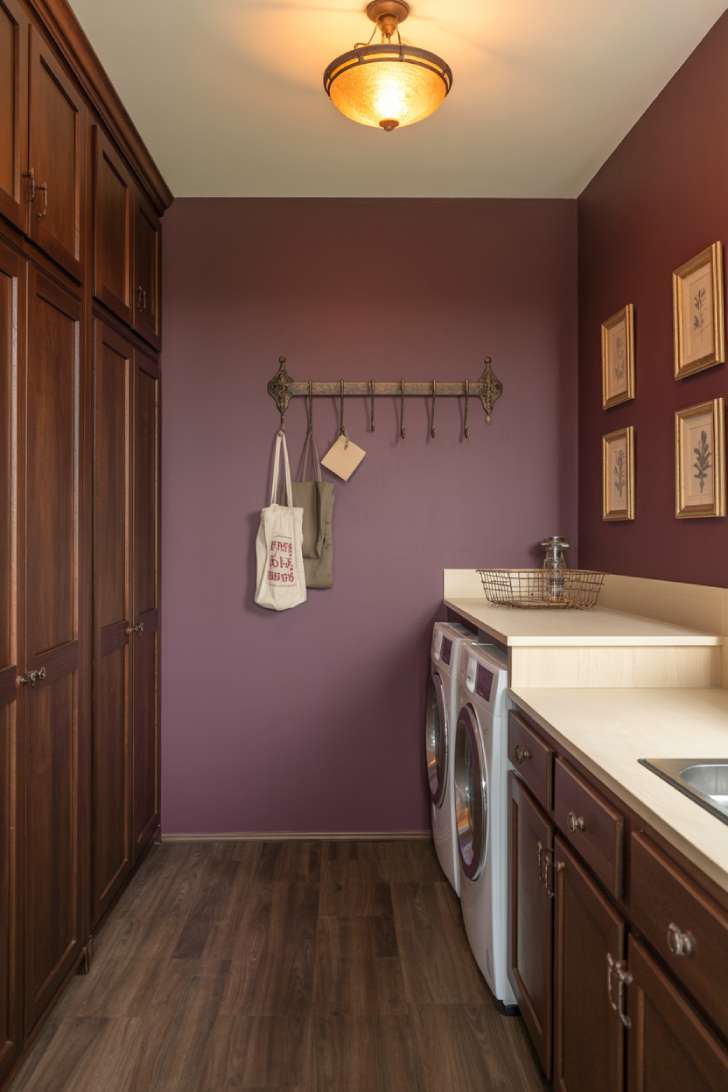
Plum is the color that nobody expects to see in a laundry room, and yet it might be the most emotionally satisfying choice on this list.
There’s something about deep, wine-adjacent colors that feel inherently indulgent.
Color psychology research consistently shows that warm dark tones — especially those with red or brown undertones — create feelings of warmth, intimacy, and comfort.
In a room where you’re doing a repetitive chore, that kind of emotional atmosphere actually makes the task feel less tedious.
Farrow & Ball’s Pelt is the reference point here: a deep plum with such a velvety undertone that it almost reads as a very sophisticated neutral.
The key to making plum work in a laundry room is warmth in everything surrounding it — warm wood cabinetry, warm white countertops, amber-toned lighting.
Cool accents in a plum room will make the color feel stark. Warm ones make it feel like a cocoon.
Style Blueprint:
- Deep plum or aubergine satin-finish wall paint (Farrow & Ball Pelt or similar)
- Espresso or dark walnut stained cabinetry with aged bronze hardware
- Warm white or cream quartz countertop
- Vintage-inspired aged brass light fixture
- Small framed botanical or vintage prints in antique gold frames
Design Pro-Tip: Warm-toned light bulbs (2700K–3000K color temperature) are non-negotiable in a moody laundry room. Cool or daylight bulbs wash out dark colors and make rich jewel tones look flat and dull. The right bulb temperature can make the difference between a room that looks stunning and one that just looks dark.
Dark Subway Tile From Floor to Ceiling
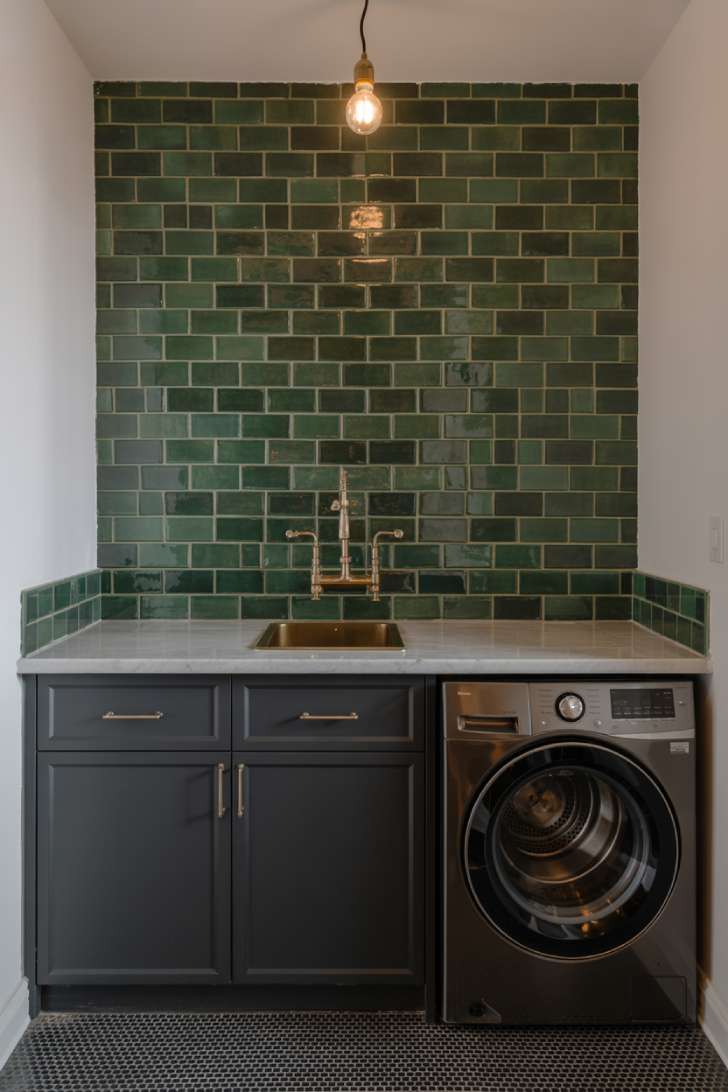
Taking subway tile from backsplash height to full ceiling height is one of the most impactful decisions you can make in a small laundry room.
The visual effect of a fully tiled wall is completely different from a standard backsplash — it feels architectural and permanent in a way that paint or a partial tile treatment simply can’t replicate.
Deep colored subway tile — forest green, navy, or black — has a reflective quality that actually helps distribute light in a room that might otherwise feel dim.
The glossy finish bounces warm light around the space, which means the room stays moody without ever feeling dark in a problematic way.
Brass fixtures against dark green tile is a combination that has been around in high-end interior design for years because it works so reliably — the warm metal against the cool, deep tile creates a perfect balance of richness and warmth.
White grout, rather than matching dark grout, is the choice that keeps the tile looking crisp and intentional rather than heavy.
Style Blueprint:
- Deep-colored glossy subway tile, floor to full ceiling height on accent wall
- Matte black flanking cabinetry with slim brass bar pulls
- White marble slab countertop
- Brushed brass wall-mounted faucet and fixtures
- Black hexagon mosaic floor tile with white grout
The Moody Farmhouse With History Built In
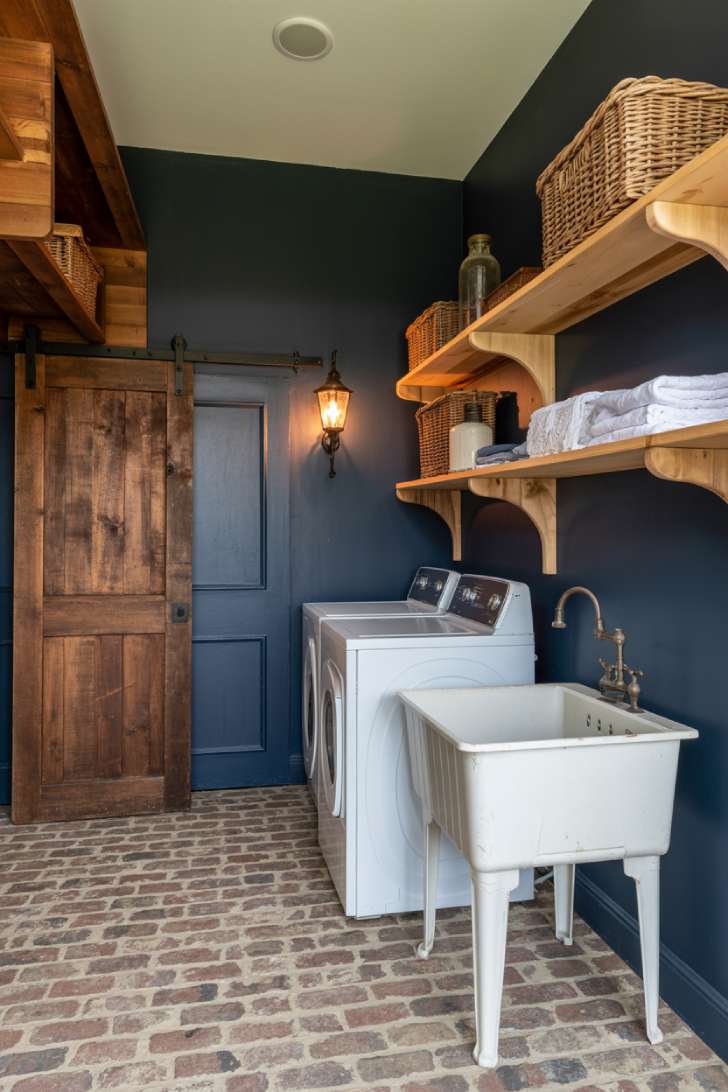
A moody farmhouse laundry room doesn’t look designed — it looks collected.
That’s the whole point.
The character in this kind of space comes from layers of organic, aged, and reclaimed materials that feel like they’ve accumulated over time rather than been sourced all at once from a big box store.
Brick floors are the single most effective move for this aesthetic.
Real brick pavers have an inherent warmth and texture that no tile can fully replicate, and against a deep navy or near-black wall, they create a combination that feels rooted and historic.
Reclaimed wood shelving — particularly heart pine or oak with visible grain and age — brings the same quality of accumulated history.
The cast iron utility sink is the finishing detail that sells the whole story.
Old-fashioned, deep, and practical, it looks like it belongs in the room rather than having been installed yesterday.
Style Blueprint:
- Deep inky navy or near-black satin wall paint
- Real brick paver flooring in a running bond or herringbone pattern
- Reclaimed heart pine or oak open shelving on iron brackets
- Vintage-style cast iron double utility sink with aged brass bridge faucet
- Black iron sliding barn door hardware with antique wood door panel
One Dark Wall Is All You Need
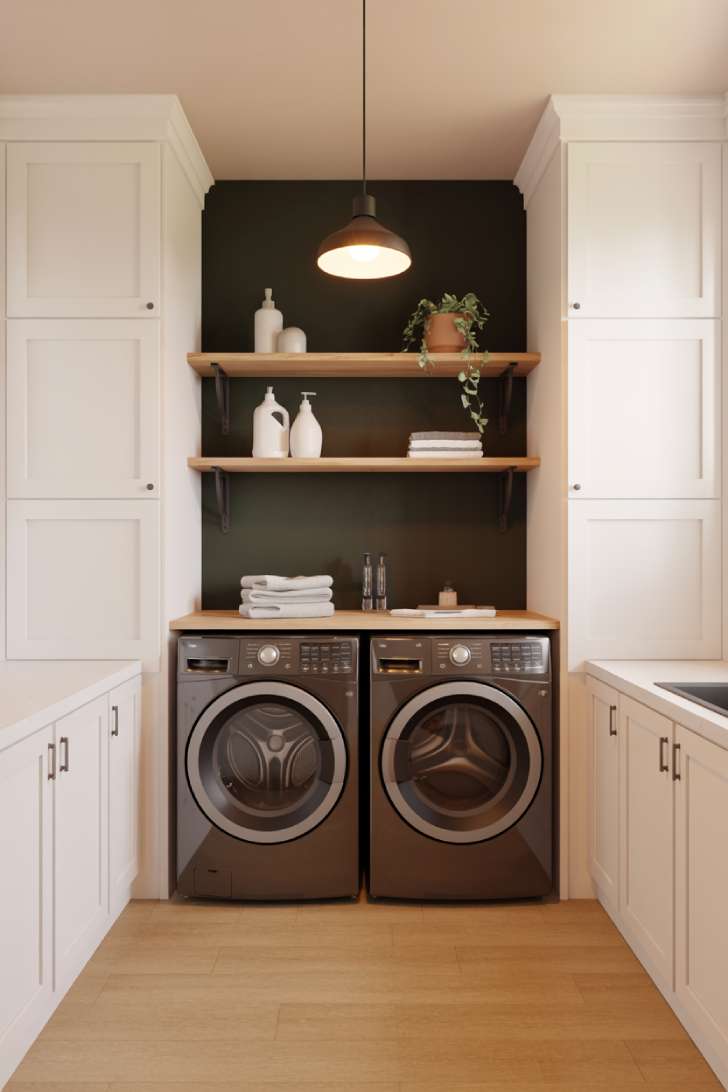
Not every moody laundry room transformation requires painting every wall or ripping out the cabinetry.
Sometimes, one wall is all it takes.
A single dark accent wall — especially placed directly behind the washer and dryer — acts as a natural backdrop that frames the appliances and makes the entire room feel considered.
The reason this works so well is framing.
The human eye naturally looks for points of reference in a room, and a dark wall behind the machines gives the eye exactly that — a defined, deliberate focal point that pulls the whole space together.
Layering simple white floating shelves on the dark wall is the move that completes it.
The contrast between white shelves and a near-black or deep green wall is crisp and graphic, and it gives you a styled surface to display a few carefully chosen objects.
This is the version of the moody laundry room that works for renters, for small budgets, and for anyone who wants to test the waters before fully committing to a darker palette throughout.
It’s low risk and high reward — and it almost always makes people wish they’d gone darker sooner.
Style Blueprint:
- One accent wall in deep black-green, navy, or charcoal satin paint
- Simple white floating shelves with black iron brackets on accent wall
- White shaker cabinetry with matte black hardware on surrounding walls
- Warm-toned light oak or natural wood flooring
- Single matte black pendant light centered over the appliances
The Takeaway
A moody laundry room is proof that no room in the house is too small or too functional to be beautiful.
Dark colors, rich textures, layered lighting, and considered hardware choices can completely reframe how you experience a space you used to dread walking into.
You don’t need a major renovation or an unlimited budget to pull it off.
A single wall, a new cabinet color, or a roll of dramatic wallpaper can shift the entire atmosphere of a laundry room in a weekend.
Pick the idea that made you stop scrolling, save it, and start planning.
Your laundry room deserves a little drama — and honestly, so do you.