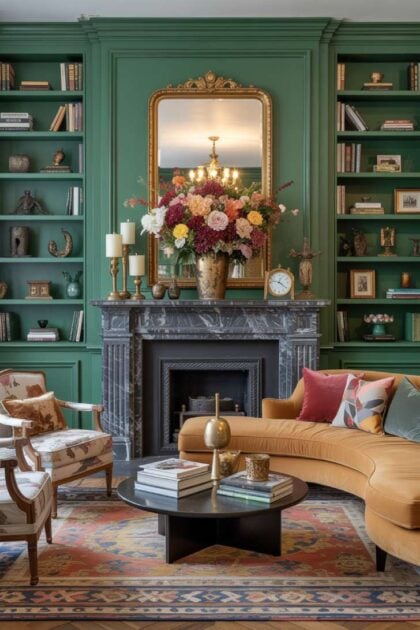
More is more.
That’s the guiding principle behind maximalist home decor — and honestly, it’s one of the most liberating design philosophies out there.
Where minimalism strips things back, maximalism layers them up.
Think rich colors, bold patterns, collected objects, and rooms that feel like they have a story to tell.
The result is a space that feels genuinely personal — warm, textured, alive.
Maximalism isn’t about clutter.
It’s about intentional abundance, where every object earns its place and contributes to a larger, cohesive visual story.
If you’ve ever walked into a room and felt immediately wrapped in comfort and personality, you’ve experienced maximalism at its best.
A Living Room That Reads Like a Well-Loved Library
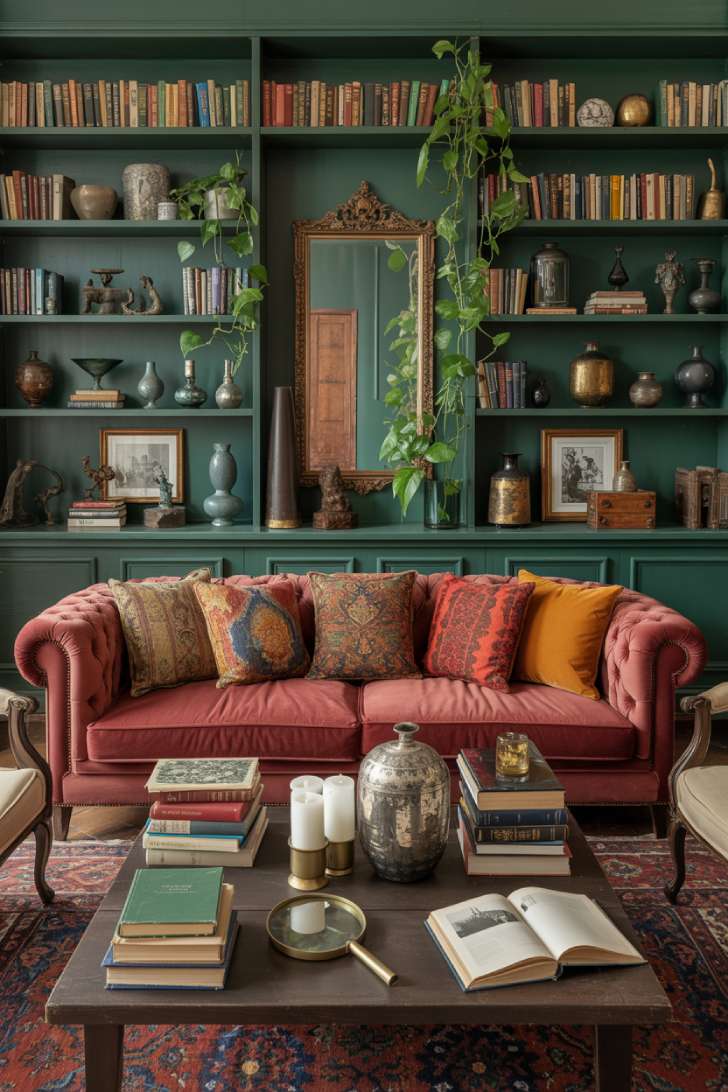
There’s something about a room like this that immediately slows you down.
The floor-to-ceiling shelves, packed with hundreds of books and ceramic objects, create a sense of enclosure — the brain reads this as shelter, which is why deeply layered spaces tend to feel so emotionally safe.
The warm amber light filtering through emerald velvet drapes does the heavy lifting here.
Warm lighting triggers relaxation responses that cooler, brighter light simply can’t match.
Pair that with the deep oxblood sofa and a Persian rug anchoring the center of the room, and you have a space that feels like it’s been lived in — lovingly — for decades.
The clashing-but-harmonious pillow patterns are doing something clever, too.
When pattern combinations share a consistent color temperature (mustard, rust, jade), the eye reads them as one unified gesture rather than visual noise.
That’s the secret behind eclectic interiors that feel collected rather than chaotic.
Style Blueprint:
- Floor-to-ceiling built-in bookshelves in a deep forest green
- Tufted Chesterfield sofa in velvet (oxblood, navy, or emerald)
- A large Persian or Turkish rug in reds and navy
- Mixed throw pillows in ikat, chinoiserie, and embroidered floral patterns
The Boudoir Bedroom That Turns Rest Into Ritual
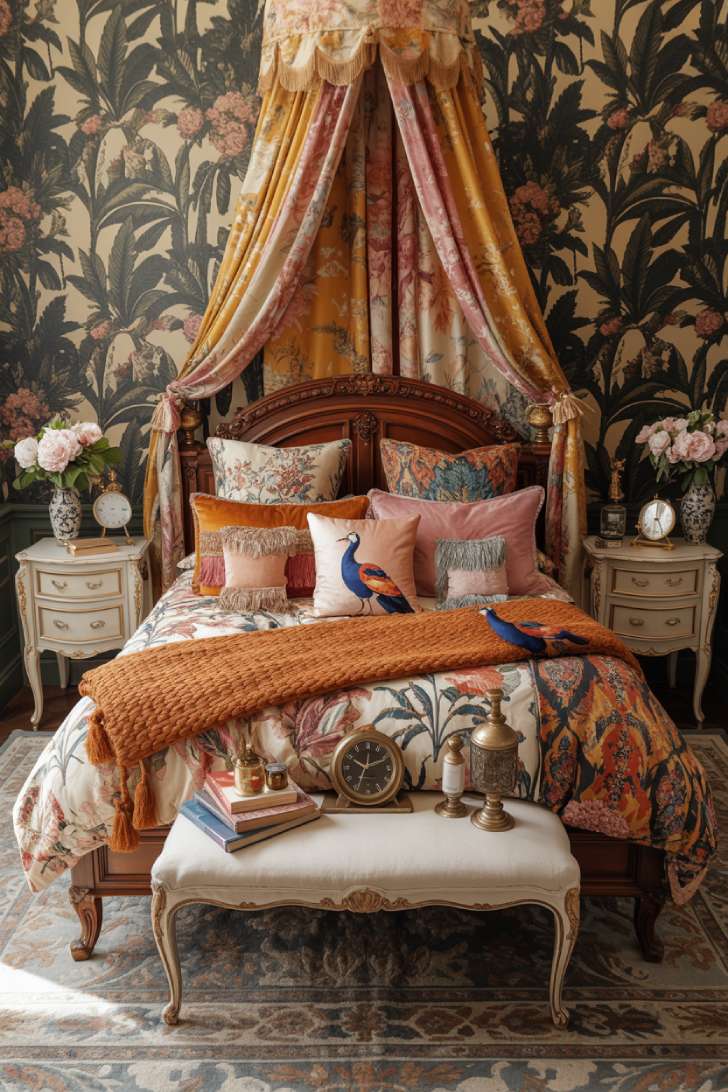
This kind of bedroom doesn’t just invite sleep — it commands it.
The four-poster bed draped in golden silk creates a room within a room, a concept borrowed from canopy architecture that signals the brain to switch into rest mode before you’ve even pulled back the covers.
That oversized tropical leaf wallpaper in dark green and black? It’s doing something brilliant.
Large-scale patterns on all four walls create an immersive effect, where the room feels more like an environment than a backdrop.
You stop seeing the walls and start feeling the space.
Layering five different types of bedding — from chunky knit throws to embroidered velvet pillows — is a masterclass in mixed textures.
Each material engages a different sensory response, which is part of why this kind of room feels so satisfying to sink into.
Style Blueprint:
- Ornate dark-wood four-poster bed with sheer canopy fabric
- Bold tropical wallpaper covering all four walls
- At least five distinct bedding layers in jewel tones (aubergine, rust, deep rose)
- Crystal chandelier as the overhead focal point
A Dining Room Set for a Feast That Never Ends
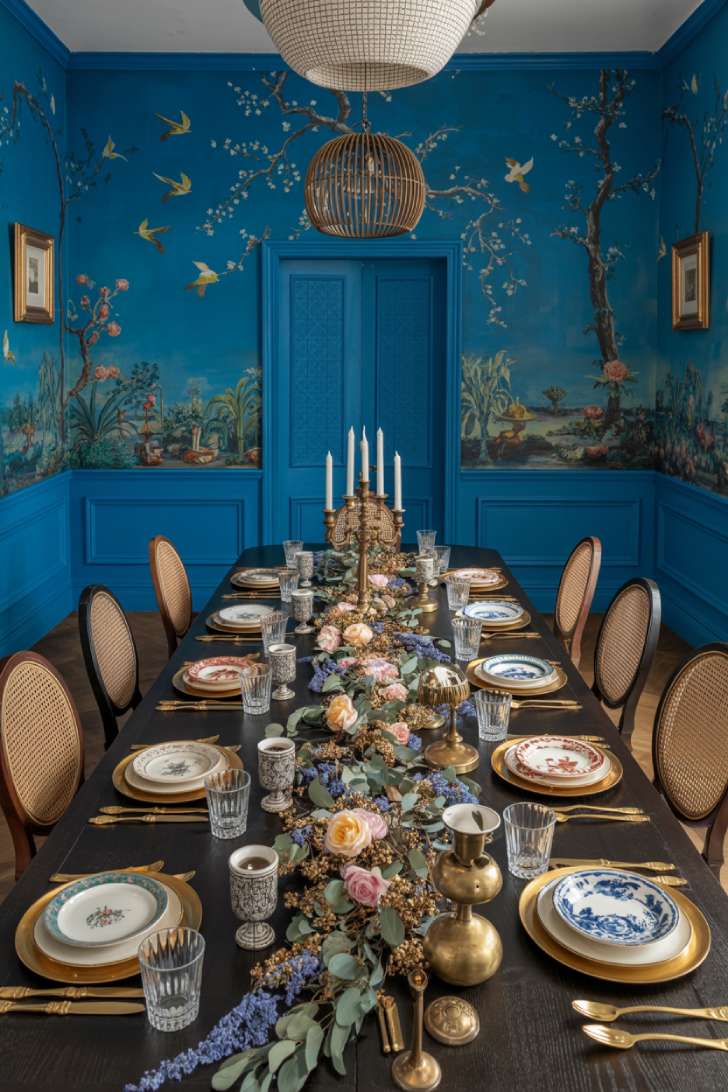
Some dining rooms are made for quick meals.
This one is made for lingering.
The midnight blue chinoiserie wallpaper sets an immediate theatrical tone — deep, jewel-toned walls absorb light and create intimacy, which is exactly what you want in a space meant for conversation and connection.
Three overlapping chandeliers hung at different heights are a genuinely inspired move.
Varying the heights of light sources draws the eye upward and downward simultaneously, creating a sense of dynamic vertical rhythm that a single centered fixture simply can’t achieve.
The mismatched chairs — velvet, rattan, carved wood — are a great example of how colorful spaces avoid feeling sterile.
No two chairs are the same, yet the cohesive table setting unifies them all.
Contrast is what makes a maximalist dining room feel curated rather than assembled.
The layered centerpiece of brass candelabras, dried botanicals, and fresh flowers is another smart layering trick: mixing living and dried materials creates textural depth that a purely fresh arrangement never quite achieves.
Style Blueprint:
- Dramatic wallpaper (chinoiserie, damask, or botanical) covering all walls
- Mismatched dining chairs in at least three different materials
- Three overlapping pendant lights or chandeliers at varying heights
- An elaborate table centerpiece mixing brass, fresh florals, dried botanicals, and candles
Design Pro-Tip: When mixing patterns across a room, limit your color palette to three or four hues and let them repeat across every pattern. The eye will read cohesion, not chaos — no matter how many prints are competing for attention.
The Home Library That Makes You Want to Stay Forever
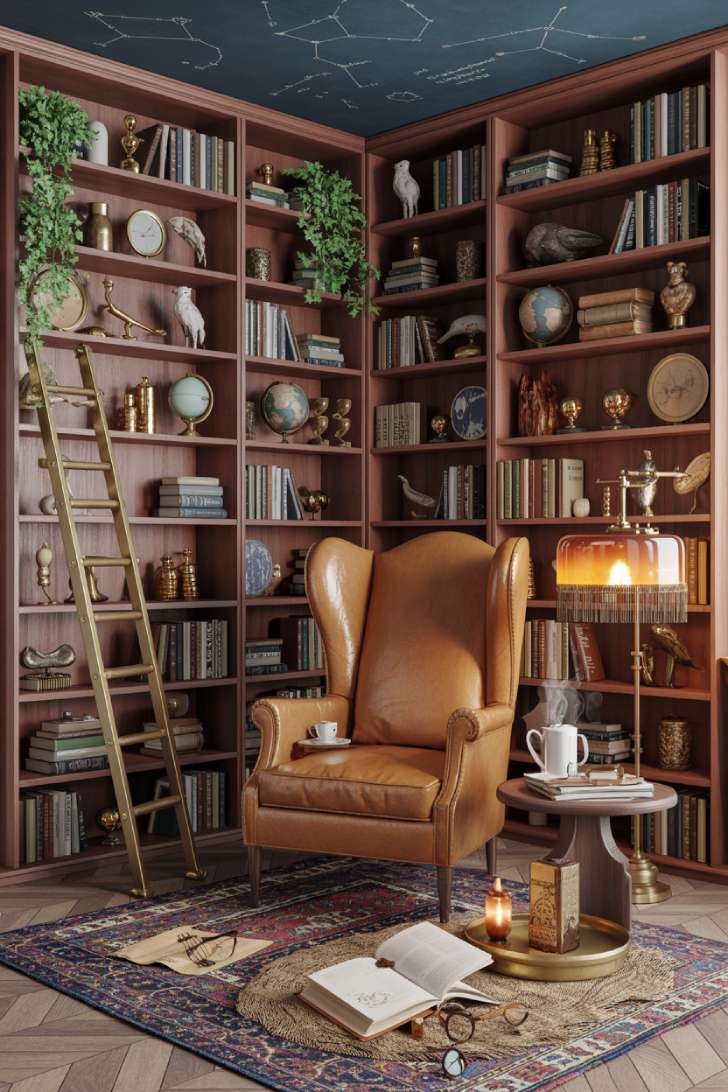
Few rooms feel as emotionally satisfying as a well-designed home library.
And this one is layered with intentional decision-making from floor to ceiling — literally.
That navy ceiling with hand-painted gold constellations is a masterstroke.
Dark ceilings lower the perceived height of a room, which creates a sense of compression and coziness.
In a library, where the point is to feel completely enclosed in your own world, that’s exactly the effect you want.
The layered rug arrangement — a large Persian base under a smaller Moroccan kilim — is a go-to move in cozy maximalism.
Multiple rug layers break the visual monotony of a single flat surface and add warmth underfoot that no single rug can replicate.
The cognac leather wingback chair is doing more than just looking good.
Its high back and deep seat create a physical sense of being held, which is the kind of visceral comfort that turns a reading chair into a destination.
Style Blueprint:
- Double-stacked floor-to-ceiling built-in shelving filled with books and decorative objects
- A deep wingback chair in leather or velvet in a rich warm tone
- Two layered rugs (Persian base with a smaller kilim or Moroccan on top)
- A navy or dark-painted ceiling with metallic detailing
A Kitchen That Tastes Good Just to Look At
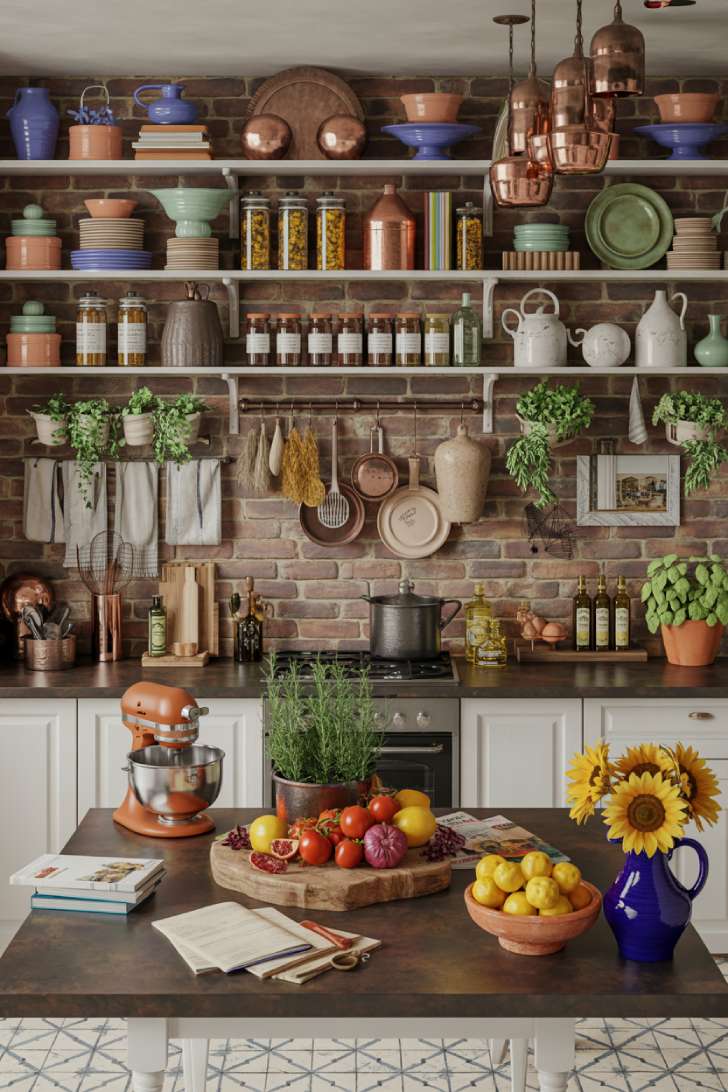
Kitchens tend to default to function over feeling.
This one refuses to choose.
Open shelving is the cornerstone of this maximalist kitchen aesthetic, and it works because visibility is inherently inviting.
When you can see the cobalt ceramics, the copper pots, and the amber spice jars all at once, the room communicates abundance — and abundance feels generous.
The dark marble countertops serve as a grounding visual anchor.
Without them, all those warm, earthy tones on the shelves could start to feel untethered.
Dark horizontal surfaces pull the eye down and stabilize a busy room.
Patterned cement floor tiles in blue, white, and terracotta add a layer of visual interest without requiring a single additional object.
When your floors are already doing the decorative work, everything above them feels intentional rather than excessive.
Style Blueprint:
- Open shelving on exposed brick or painted walls stacked with colorful ceramics and glass jars
- Dark marble or stone countertops as a visual anchor
- Copper or brass hanging pot rack overhead
- Hand-painted or encaustic cement floor tiles in a bold geometric pattern
The Bathroom That Feels Like a Private Ceremony
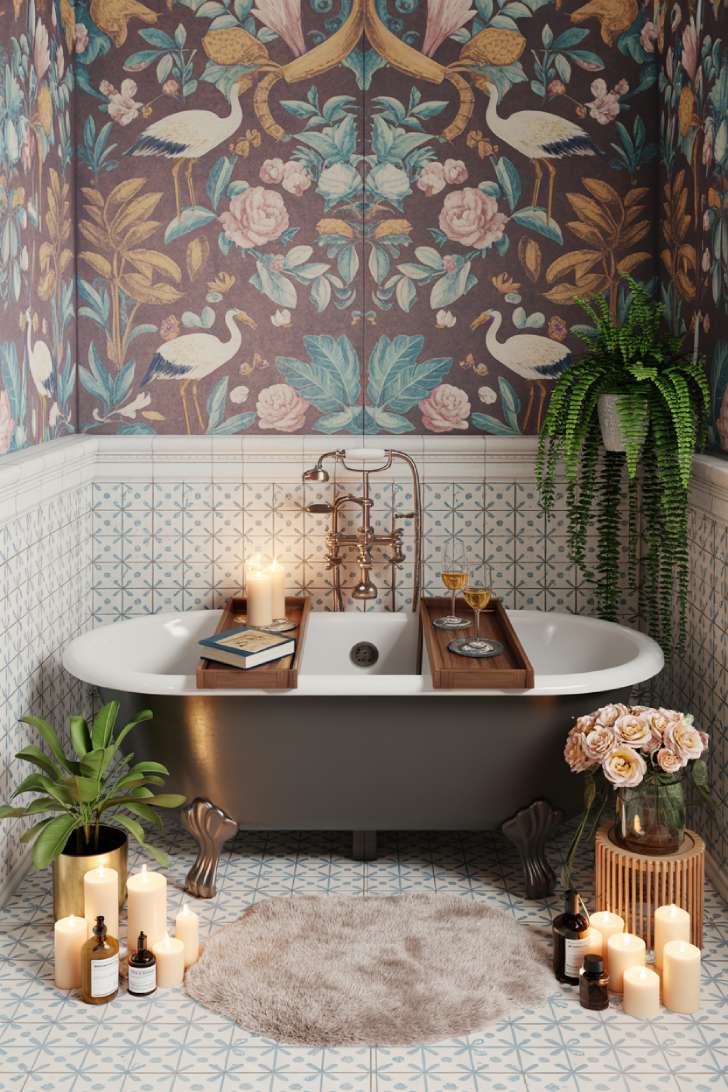
A bathroom shouldn’t feel like an afterthought.
This one feels like an event.
The decision to use two different wall treatments — azulejo tiles on the lower half and richly patterned wallpaper above — is a smart visual move.
The tile-to-wallpaper transition creates a horizontal line that functions like a chair rail, grounding the room and making the ceiling feel higher without any structural changes.
The matte black clawfoot bathtub is the undisputed focal point.
Dark objects in pale or neutral surroundings carry disproportionate visual weight, which is why a single black tub can anchor an entire room full of pattern and color.
The surrounding arrangement of candles, tropical plants, and vintage perfume bottles speaks to something deeper than just aesthetics.
Sensory layering — candlelight, texture, scent, greenery — transforms a functional room into something that actively soothes the nervous system.
That’s the real power of statement pieces in a maximalist bathroom.
Design Pro-Tip: In pattern-heavy rooms, always include at least one large matte or dark object as a visual “rest point.” It stops the eye from running out of energy trying to process everything at once.
Style Blueprint:
- Freestanding clawfoot tub in matte black or classic white as the room’s focal point
- Two-tone wall treatment: tile below, dramatic wallpaper above
- Layered candlelight in varying heights surrounding the tub
- Large tropical plants (bird of paradise, fiddle leaf fig, or trailing vines) in brass planters
A Living Room That’s Traveled the World
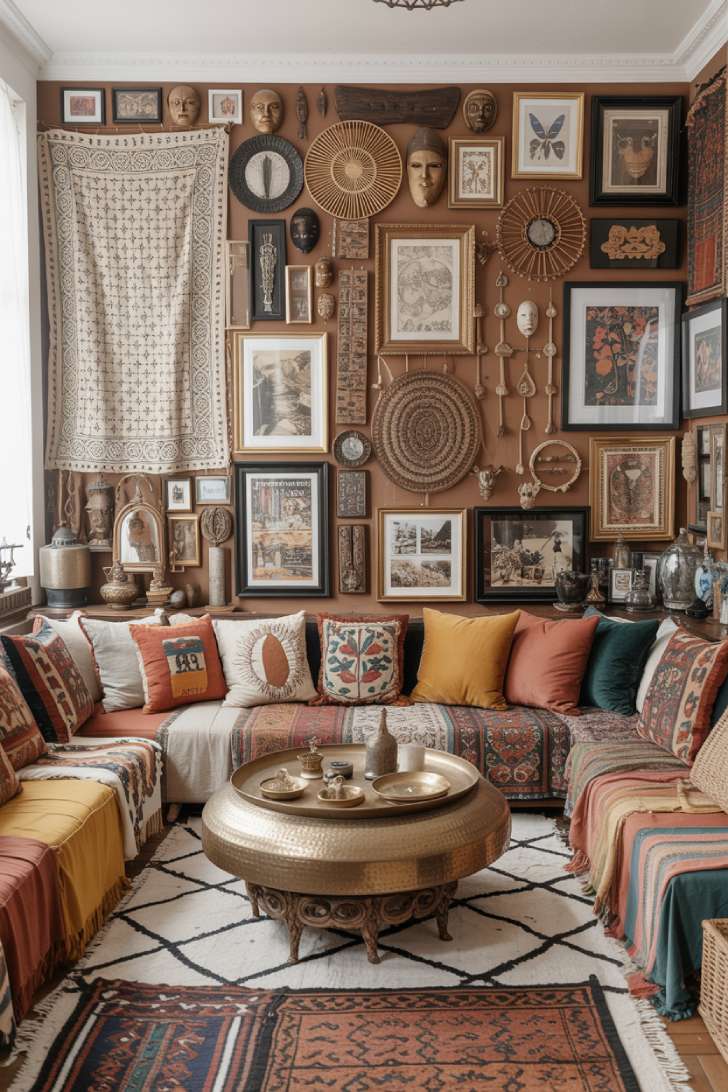
This room tells a story — and you get the feeling it’s still being written.
The global collected aesthetic is one of the most personally expressive forms of layered decor.
Every object carries a provenance, and that sense of history is immediately readable to anyone who enters.
The Moroccan wedding blanket hung as a wall tapestry is doing double duty: it adds extraordinary texture to the wall surface and softens acoustics at the same time.
Textile wall hangings are one of the most underused tools in interior design.
The layered rug situation — a white and black Beni Ourain under a Turkish kilim runner — demonstrates a classic rule of maximalist decor: rugs should build a foundation, not just fill a floor.
Two rugs with different scales and textures create a visual layering effect that reads as intentional depth.
The brass hammered tray table scattered with crystals, incense, and art books grounds the seating area without competing with the walls.
Low furniture with collected objects keeps the visual weight balanced between high and low.
Style Blueprint:
- A large textile wall hanging (Moroccan blanket, suzani, or kilim) as a statement backdrop
- Low-slung sectional sofa in linen or cotton in a muted tone, covered in global textile pillows
- Two layered rugs in contrasting scales and origins
- A brass or hammered metal tray table as the coffee table anchor
A Foyer That Leaves a First Impression and Keeps It
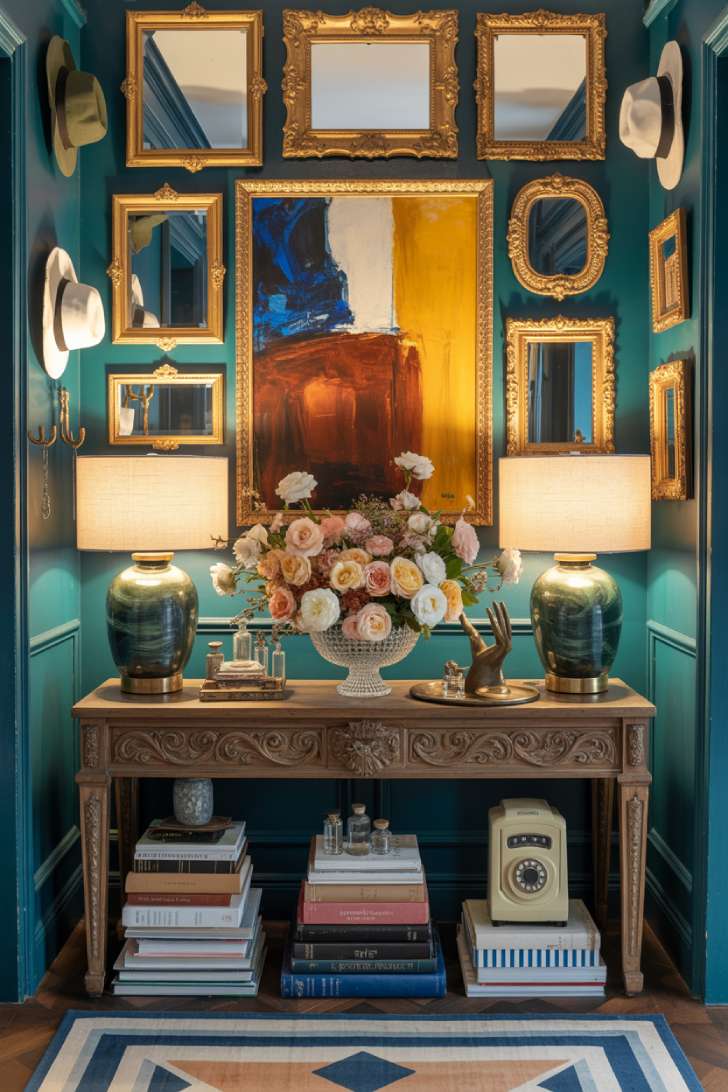
First impressions in interior design work the same way they do in life — fast, emotional, and lasting.
An entryway layered like this communicates personality before a single word is spoken.
The deep teal lacquered walls are a confident choice.
High-sheen, saturated walls reflect light in ways that matte paint can’t, creating a luminous quality that makes a relatively small space feel expansive and rich.
Overlapping gilded mirrors in varying sizes and shapes is a maximalist gallery wall move that solves two problems at once: it adds drama and it bounces light around a space that often gets very little of it.
The console table arrangement is maximalism in concentrated form.
Layering objects of varying heights — tall lamps, stacked books, a bowl of flowers, a sculptural bronze hand — creates a rhythmic visual ascent that the eye wants to trace upward.
That rhythm is what separates a carefully designed console table from a surface that’s just covered in stuff.
Design Pro-Tip: When building a gallery wall around a mirror, let the mirror be the largest piece — then build outward from it asymmetrically. The reflection will multiply the surrounding art, creating the illusion of even more depth and objects than you’ve actually placed.
Style Blueprint:
- Deep jewel-toned lacquered walls (teal, emerald, or navy)
- A collection of overlapping gilded mirrors in at least four different sizes and shapes
- A large carved dark-wood console table with a layered arrangement of lamps, flowers, and objects
- A crystal chandelier with a visible ceiling medallion
A Home Office Where Ideas Feel Inevitable
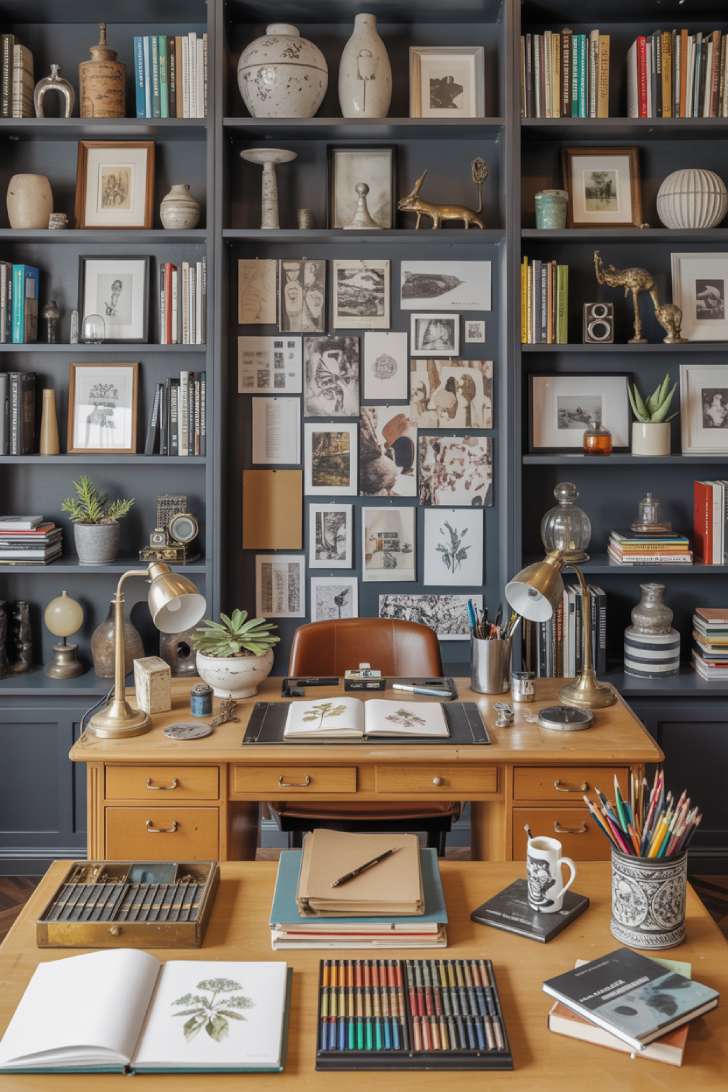
Not every home office needs to be a sleek, minimal box.
Some of the most productive creative environments are the richest, most visually stimulating ones.
There’s solid thinking behind this.
When a space is filled with meaningful objects, every glance away from the screen becomes a moment of passive inspiration rather than a distraction.
The floor-to-ceiling matte black built-ins create an immediate sense of enclosure and focus — darker shelving recedes visually, letting the collected objects pop forward without the shelving itself becoming the main event.
The roll-top desk covered in open sketchbooks, watercolor pans, and stacked folders is an honest workspace.
It communicates that real work happens here.
Rooms that look too pristine can actually suppress creative behavior — when a space already has permission to be imperfect, the person working in it tends to feel more free.
The inspiration wall — layered with tear sheets, Polaroids, fabric swatches, and postcards — functions as an ongoing external memory bank.
Visual thinkers, particularly, benefit enormously from having physical reference material permanently in their sightline.
Style Blueprint:
- Matte black or dark green floor-to-ceiling shelving on at least two walls
- A vintage roll-top or writing desk with an actively curated, layered surface
- An inspiration wall mixing pinned images, sketches, swatches, and postcards
- Layered rugs in jewel tones to anchor the workspace with warmth
A Sunroom That’s Half Interior, Half Wild Garden
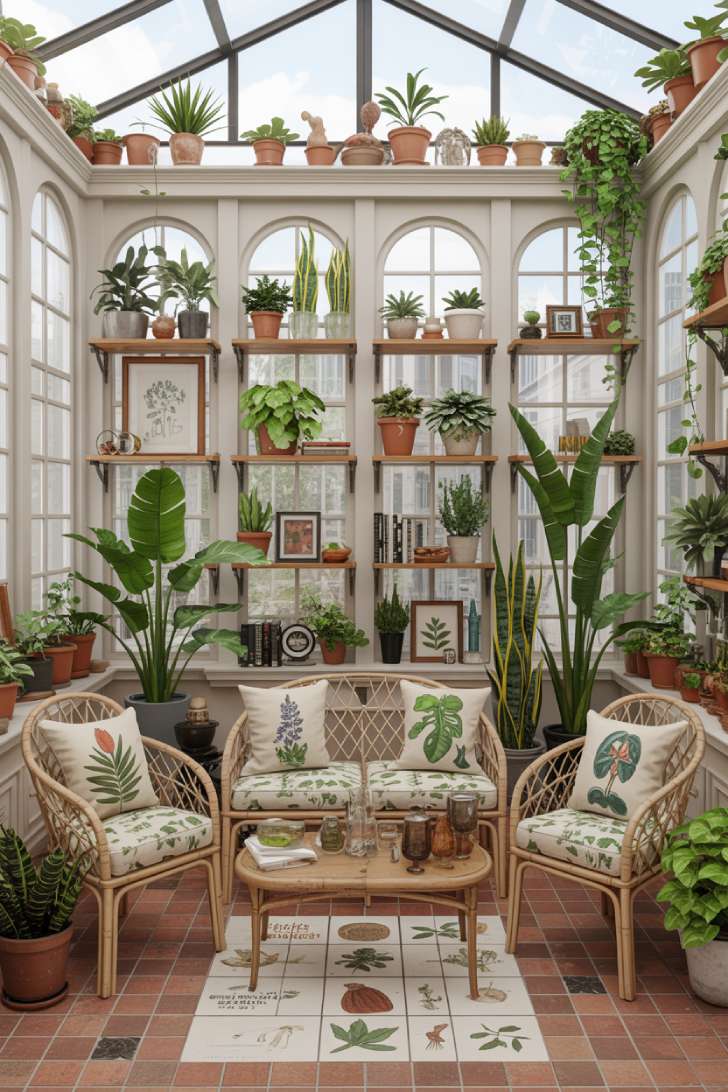
Plants change rooms in ways that objects simply can’t.
A space filled with living greenery operates at a different frequency.
There’s a reason people feel calmer and more clear-headed surrounded by plants — living things introduce an organic unpredictability to a room that manufactured objects never quite replicate.
In a sunroom like this one, that principle is taken to its logical extreme.
Monstera leaves, banana plants, trailing pothos, and bird of paradise fill every corner, every sill, every ledge.
The result isn’t overwhelming — it’s enveloping.
The hand-painted botanical tile floors in terracotta and white tie the design concept down to the ground level, which means the plant theme runs from the ceiling beams all the way to your feet.
Consistency of theme at every vertical layer is what makes colorful spaces feel intentional rather than accidental.
The rattan peacock chairs and wrought iron loveseat with botanical-print cushions keep the furniture choice light and organic — heavy, upholstered furniture would have competed with all that greenery.
Style Blueprint:
- A mix of large floor plants (monstera, fiddle leaf fig, bird of paradise) and small-surface plants at every height level
- Rattan or wicker seating with botanical-print cushions
- Hand-painted or patterned tiles with a botanical or geometric motif
- Climbing vines trained along walls and ceiling beams
Design Pro-Tip: When mixing large and small plants in one space, vary the leaf shape as much as the size. Big round leaves next to narrow upright ones next to trailing vines keeps the greenery arrangement looking considered rather than like a collection of whatever was at the nursery.
The Moody Bedroom That Makes Darkness Feel Like Luxury
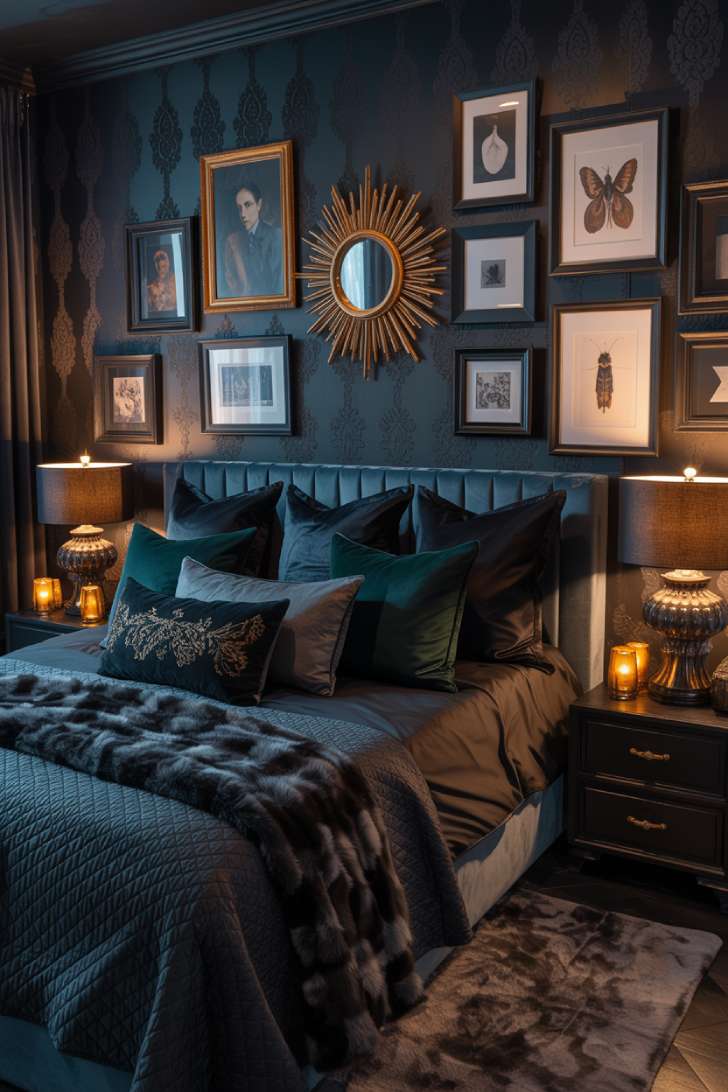
Dark bedrooms have a reputation problem.
People assume they’ll feel oppressive.
Done right, they feel like the most luxurious sleep you’ve ever had.
The shimmering charcoal damask wallpaper is a sophisticated foundation for the whole room.
A tonal wallpaper — where the pattern and background share similar values — adds texture and interest without visual loudness.
You sense it more than see it, which creates a subliminal richness that a flat painted wall can never achieve.
The sapphire velvet headboard anchors the bed as a piece of bold design rather than just a functional object.
In a dark room, saturated jewel tones read differently than they do in a light-filled space.
Emerald, amethyst, and midnight blue glow against dark surroundings, which is why moody rooms can actually make colors feel more intense, not less.
The amber table lamps at varying heights are doing essential work here.
Multiple light sources at low levels create warmth and intimacy that overhead lighting destroys.
Every lamp is an invitation to slow down.
Style Blueprint:
- Tonal damask or velvet wallpaper in deep charcoal, slate, or near-black
- A large upholstered headboard in sapphire, forest green, or deep plum velvet
- Multiple bedside lamps at different heights casting low amber light
- Floor-to-ceiling curtains in deep burgundy or forest green velvet
A Children’s Room That Takes Joy Seriously
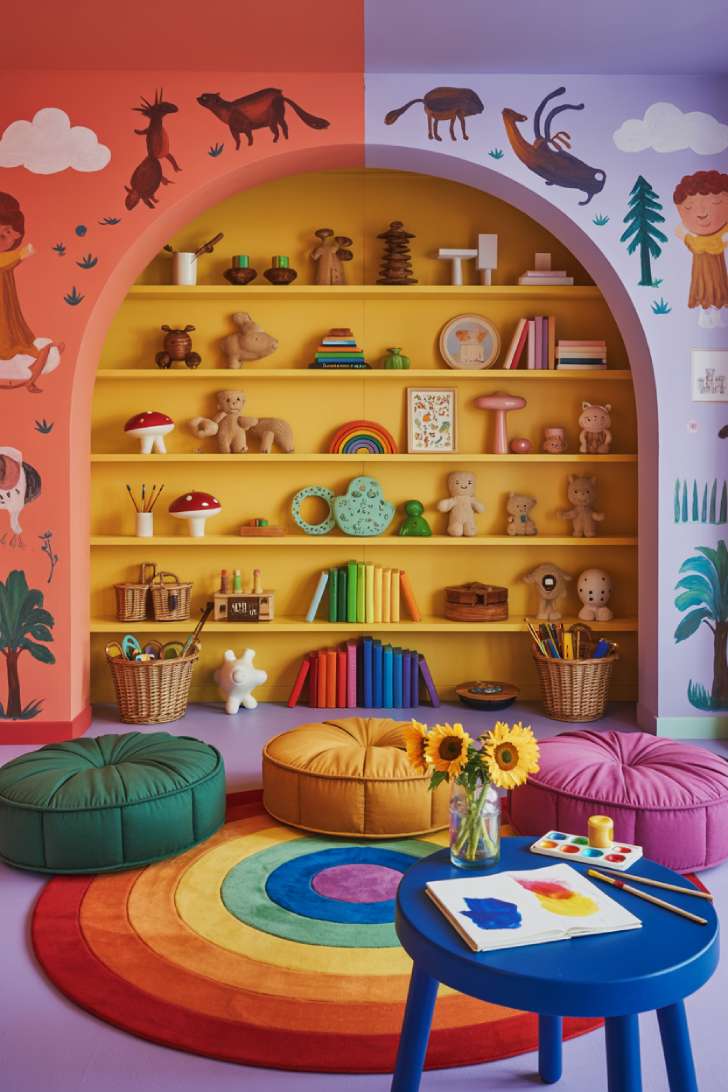
Children are natural maximalists.
They’re drawn to color, texture, abundance, and stimulation — which is exactly what this room provides without sacrificing design intelligence.
The rainbow gradient wall, running from coral at the floor to lavender at the ceiling, is a gentle, sophisticated take on bold design that avoids the cartoonish feeling of literal rainbow striping.
Gradients feel more organic, more grown-up, and more lasting.
The built-in reading nook is arguably the most important element in the whole room.
Recessed, enclosed spaces trigger a sense of safety in children — small, contained environments encourage concentration and imaginative play in ways that open floor plans don’t.
String lights inside the nook add a layer of magical intimacy.
The bookshelves stacked in rainbow color order turn a storage solution into a visual display.
It also teaches color awareness passively — children who grow up surrounded by thoughtfully arranged objects tend to develop a more intuitive visual sense.
Style Blueprint:
- Rainbow gradient painted walls (coral to lavender, yellow to sky blue, or any progression)
- A built-in reading nook with cushions, string lights, and dedicated book shelving
- Floor cushions in at least four jewel tones as primary seating
- Color-ordered bookshelves mixed with toys, ceramics, and art supplies
An Outdoor Terrace That Refuses to Be an Afterthought
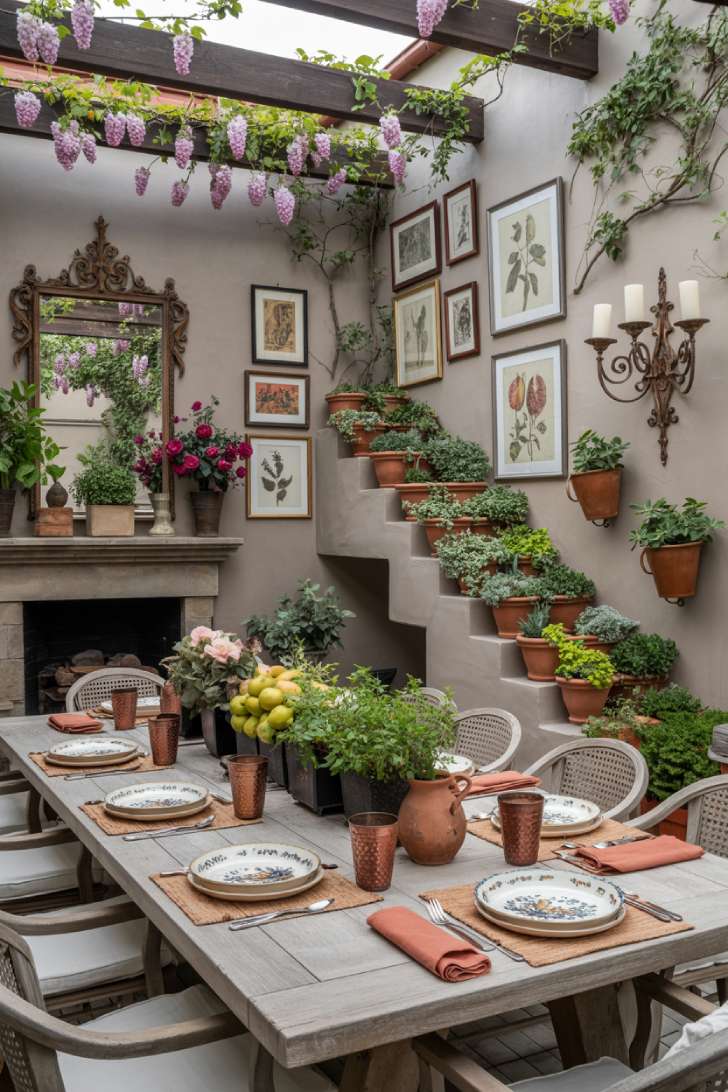
Outdoor spaces deserve the same level of thought and layering as any interior room.
This terrace proves it.
The climbing wisteria and roses covering the stone walls do something that no painted surface or wallpaper can: they create a living backdrop that changes with the seasons.
There’s an inherent emotional warmth to walls that grow.
They signal care, permanence, and deep connection to a place.
The elaborate tablescape — mismatched hand-painted Portuguese and Mexican ceramics, hammered copper goblets, fresh herbs alongside actual food — turns an outdoor dining table into a vintage accents showcase that rivals any indoor dining room.
The key is treating outdoor entertaining with the same decorative seriousness as indoor hosting.
Most people under-dress their outdoor tables.
The Edison string lights wound through the jasmine overhead create a canopy of warm light that no outdoor fixture can replicate.
String lighting at a low overhead level essentially lowers the perceived ceiling height of an open-air space, creating enclosure and intimacy where none structurally exists.
Style Blueprint:
- Climbing flowering vines (wisteria, roses, or jasmine) trained along walls and pergola beams
- A teak or stone farmhouse table with a full maximalist tablescape of mismatched ceramics and fresh botanicals
- Edison bulb string lights wound through overhead beams or pergola
- Large aged terracotta planters overflowing with lavender, rosemary, and geraniums
Conclusion
Maximalist home decor isn’t for everyone — and that’s exactly the point.
It’s a design philosophy built on personal expression, collected experience, and the refusal to leave anything meaningful behind.
From the layered textures of an eclectic living room to the moody candlelit drama of a dark bedroom, these spaces share one thing: they feel lived in and loved.
The maximalism aesthetic rewards the patient designer.
Start with one room, one wall, one layer — then build from there.
Trust your eye, collect slowly, and don’t be afraid to fill the room.
The spaces that feel the most personal are always the ones that take the longest to get right.