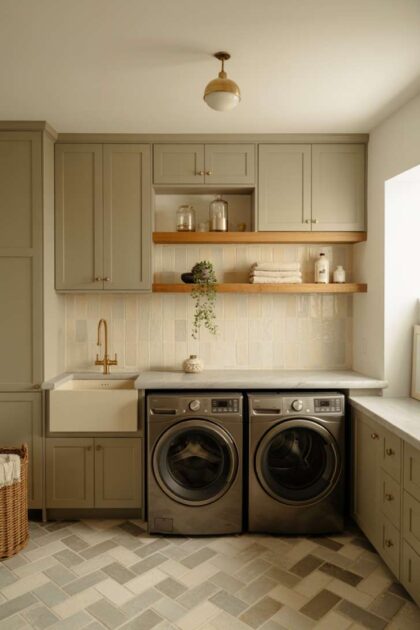
Laundry day doesn’t have to feel like a punishment.
More and more homeowners are waking up to the idea that the laundry room deserves just as much attention as the kitchen or the primary bathroom.
When this hardworking space is thoughtfully put together, it stops feeling like a chore zone and starts feeling like a retreat.
These 13 luxury laundry room ideas cover a wide range of styles and room sizes, so whether you’re working with a generous layout or a compact footprint, there’s something here to spark your next redesign.
Where Storage Meets Style
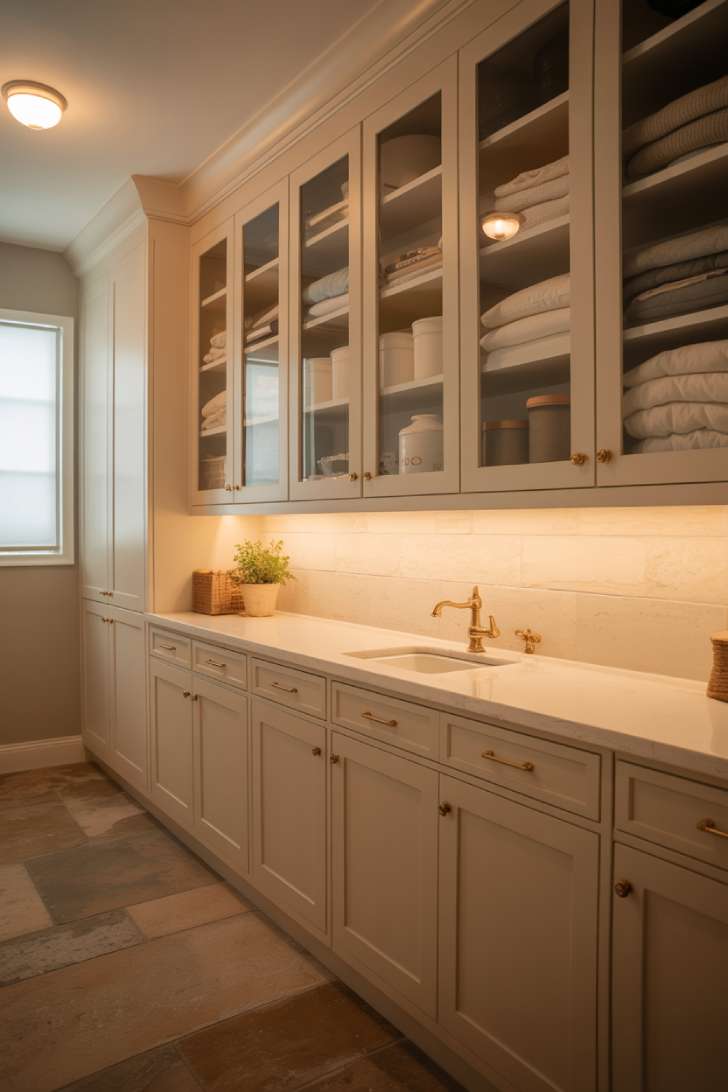
There’s a reason floor-to-ceiling cabinetry appears in almost every high-end laundry room design.
It commands the room.
By filling the wall from floor to ceiling, every inch of vertical space gets put to work, and the visual result is a space that feels finished and intentional rather than thrown together.
The closed lower cabinets hide the everyday clutter — detergents, cleaning products, random odds and ends — while glass-front uppers let you display the things worth looking at.
Shaker-style doors bring a classic warmth that reads as timeless rather than trendy, and the hardware does a lot of the heavy lifting here.
Brushed brass pulls against a soft white cabinet finish create a quiet tension that makes the whole room feel collected.
Tall cabinetry also draws the eye upward, which makes even a modest room feel much larger than it actually is.
Style Blueprint:
- Floor-to-ceiling shaker or flat-panel cabinets in a warm white, greige, or soft sage finish
- Mix of closed lower cabinets and glass-front upper cabinets
- Brushed brass, polished nickel, or matte black hardware throughout
- Thick quartz or marble countertop spanning the full width of the appliances
- Under-cabinet LED lighting strips for both task lighting and ambiance
The Countertop That Does It All
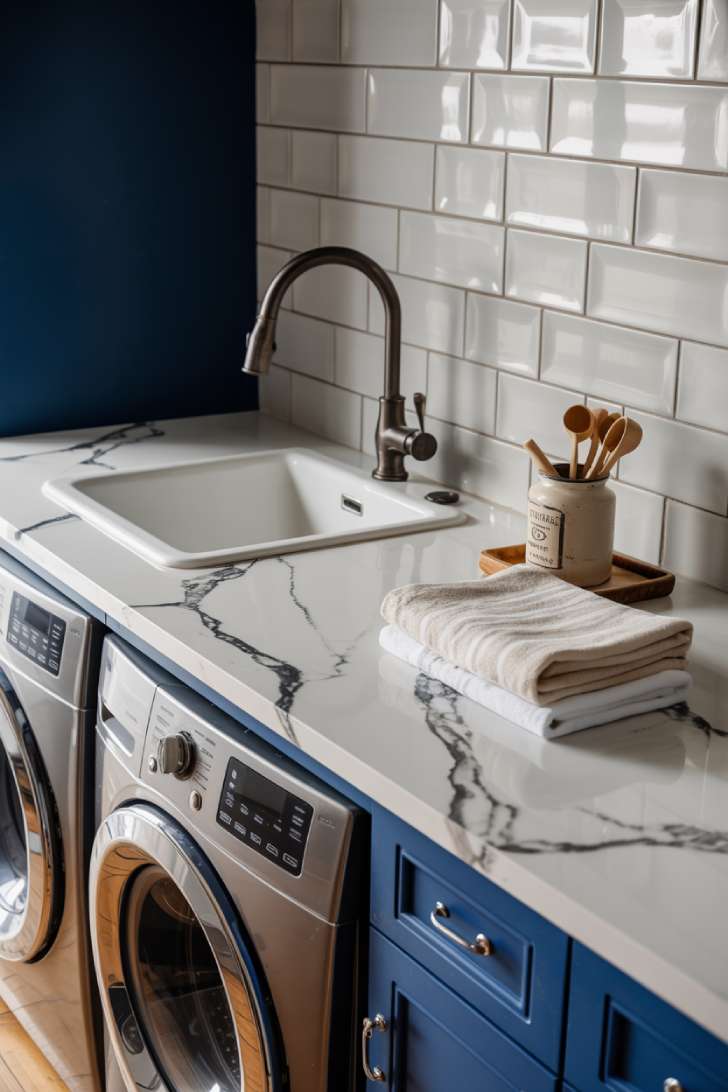
A great countertop changes everything.
It’s the surface where you fold freshly dried linens, treat stubborn stains, and sort through the pile you’ve been putting off all week.
In luxury laundry room design, the countertop is one of the first places to invest well.
Marble is the most visually striking option.
The natural veining in Calacatta or Carrara marble makes every installation genuinely one of a kind, and that sense of uniqueness is exactly what gives a space its high-end character.
If the maintenance concerns feel like too much, engineered quartz delivers a very similar aesthetic with far fewer demands.
It’s non-porous, resistant to bleach and detergents, and never needs sealing — which makes a lot of sense in a room that sees daily spills and splashes.
Running the countertop across the full width of the machines creates a seamless horizontal line that grounds the whole room and gives you a generous working surface that actually gets used.
Style Blueprint:
- Calacatta marble, engineered quartz, or honed granite countertop
- Undermount sink at one end for a clean, easy-to-wipe surface
- Pull-out spray faucet in a complementary metal finish
- Countertop spanning the full width of both appliances
- Thick edge profile — waterfall, ogee, or beveled — for a premium look
Walls With Personality
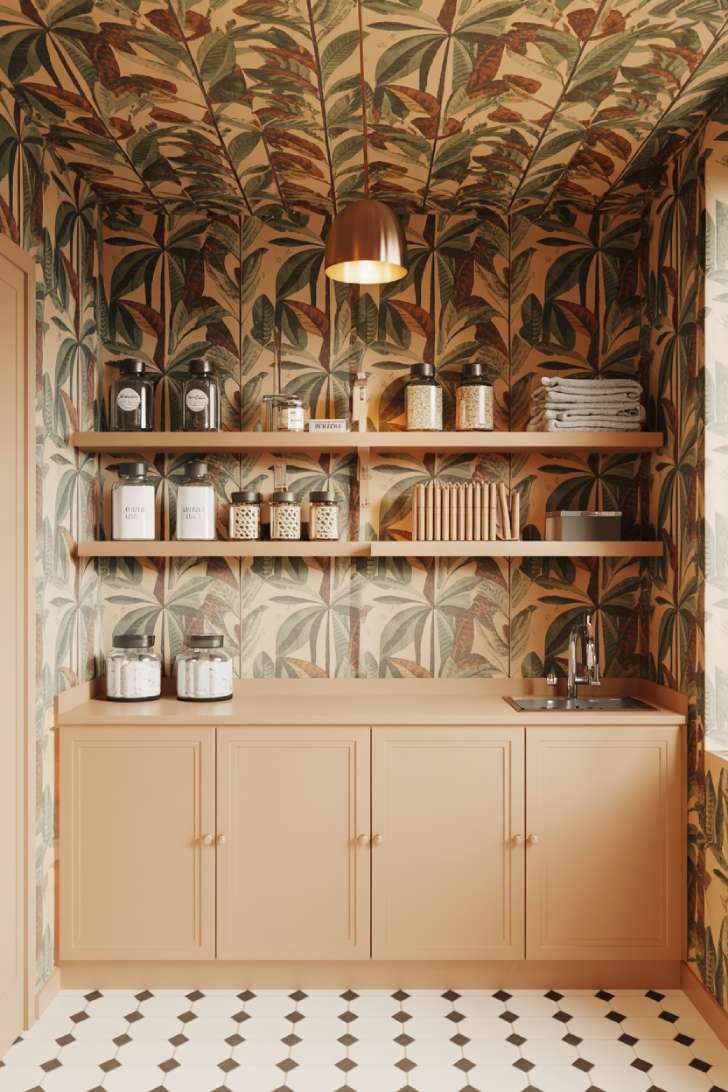
This is the one room in the house where you can go as bold as you want.
Because the laundry room isn’t a public space, it’s the perfect place to try that print you’ve been too nervous to commit to anywhere else.
Botanical patterns, classic toile, vintage-inspired florals, and graphic geometric designs all work beautifully here.
High-humidity-rated wallpapers are now widely available and are specifically made to hold up in moisture-prone spaces, so the technical concerns that used to hold people back are no longer a real issue.
The key to making wallpaper work in this room is restraint everywhere else.
Plain-colored cabinetry, a simple floor tile, and unfussy lighting let the pattern take center stage without the room feeling chaotic.
The botanical print in this example does something interesting with the mood.
Green and organic shapes subconsciously connect to the feeling of clean air and natural freshness — which is oddly perfect for a room built around clean laundry.
Style Blueprint:
- High-humidity-rated wallpaper in a botanical, geometric, or classic print
- Flat-panel cabinetry in a solid muted tone to balance the pattern
- Simple hex or cement tile flooring that complements without competing
- One statement light fixture — brass pendant or semi-flush mount
- Open wood or floating shelves to display curated laundry accessories
A Floor Worth Noticing
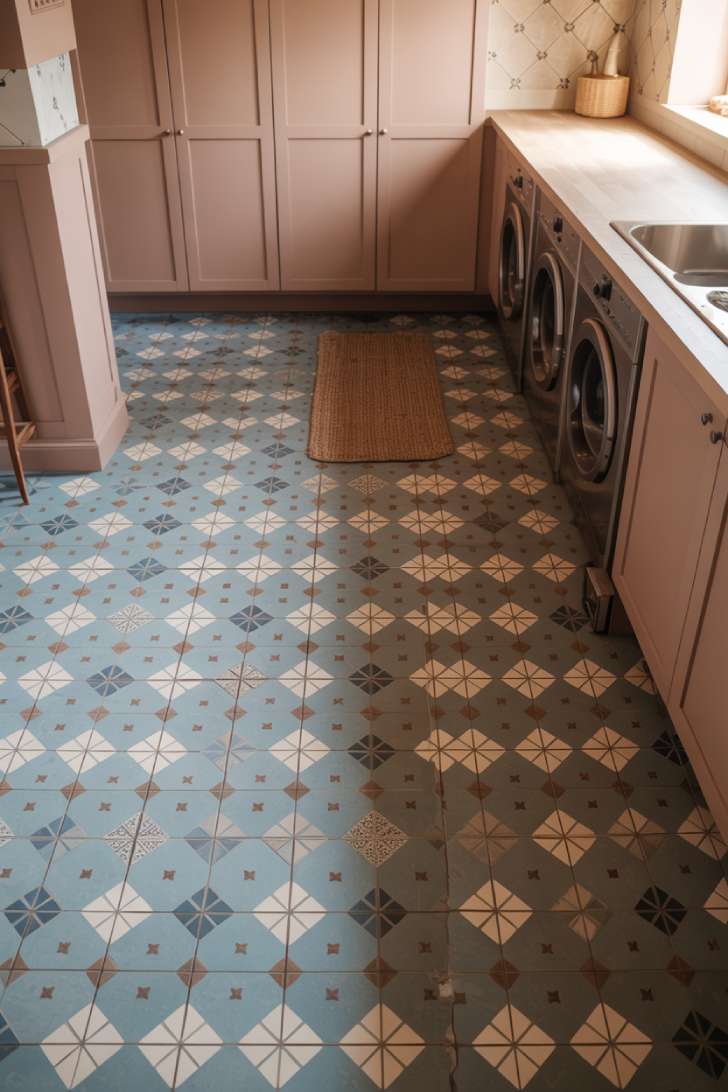
The floor is the first thing that sets the tone in a room where walls and cabinets often take up most of the surface area.
And in a space with relatively limited square footage, a great floor tile makes a disproportionately large impact.
Encaustic cement tiles, herringbone-laid natural stone, Moroccan star patterns, and large-format marble slabs are all popular choices in luxury laundry room design.
They’re durable, water-resistant, and they bring the kind of craftsmanship that instantly separates a designed space from a standard utility room.
The patterned floor in this example does something specific: it anchors the room without requiring the walls, cabinets, or lighting to work harder.
When the floor is this interesting, the rest of the room can afford to be quieter.
Patterned tile also has a practical advantage — it hides minor dirt and scuff marks far better than a plain solid tile, which is no small thing in a room that sees muddy boots, pet fur, and spilled detergent.
Design Pro-Tip: Choose your floor tile before committing to cabinet color. The tile pattern and tone should drive the palette for the rest of the room — not the other way around. This one decision will make your material selections feel cohesive from the start.
Style Blueprint:
- Encaustic cement, Moroccan-inspired, or herringbone natural stone tile
- Grout color selected to complement, not contrast, the tile pattern
- Crisp white or warm wood baseboards for a clean edge
- A woven or cotton runner for texture and warmth underfoot
- Heated flooring system beneath tile for year-round comfort
The Sink That Earns Its Place
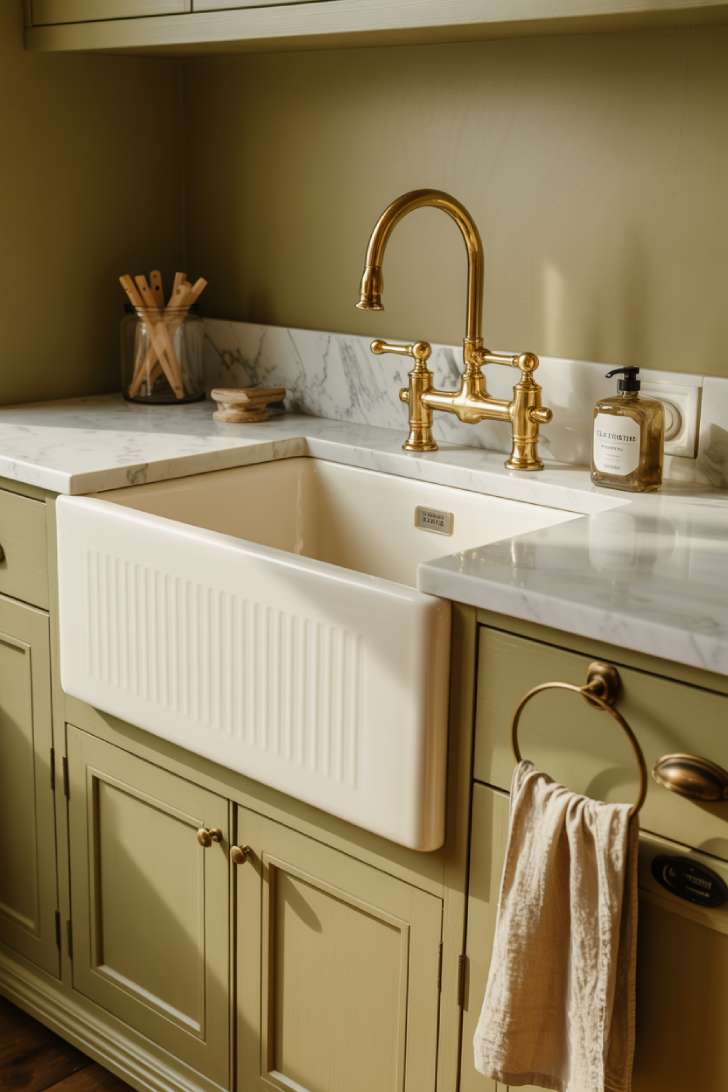
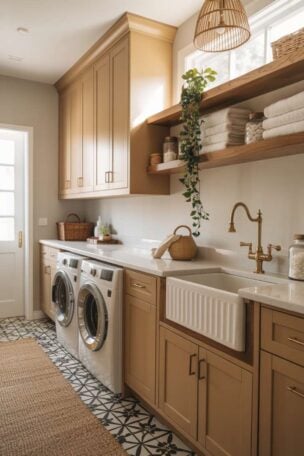
A deep farmhouse sink is one of those additions that earns its place immediately.
It’s where the delicates get hand-washed, where soaking stains are left to work overnight, and where muddy sports gear gets rinsed before it goes in the machine.
The apron-front design — where the front face of the sink is exposed rather than hidden by a cabinet door — gives the room an architectural quality that feels deliberate and high-end.
Fireclay and cast iron are the preferred materials for this style of sink.
Both are durable, chip-resistant, and carry a satisfying weight that signals quality.
The sage green cabinetry in this example does something clever.
Warm, organic color tones put people at ease without being as demanding as a bold jewel tone.
It feels approachable and sophisticated at the same time — exactly the kind of balance you’re looking for in a room where you spend real time.
Style Blueprint:
- Apron-front fireclay or cast iron farmhouse sink
- Tall wall-mounted or deck-mounted faucet with pull-out spray
- Cabinet finish in a warm, muted tone — sage, putty, warm white, or soft navy
- Brass, nickel, or matte black fixtures in a consistent finish throughout
- Hand towel ring or hook mounted directly on the cabinet door
Drying Solutions That Disappear
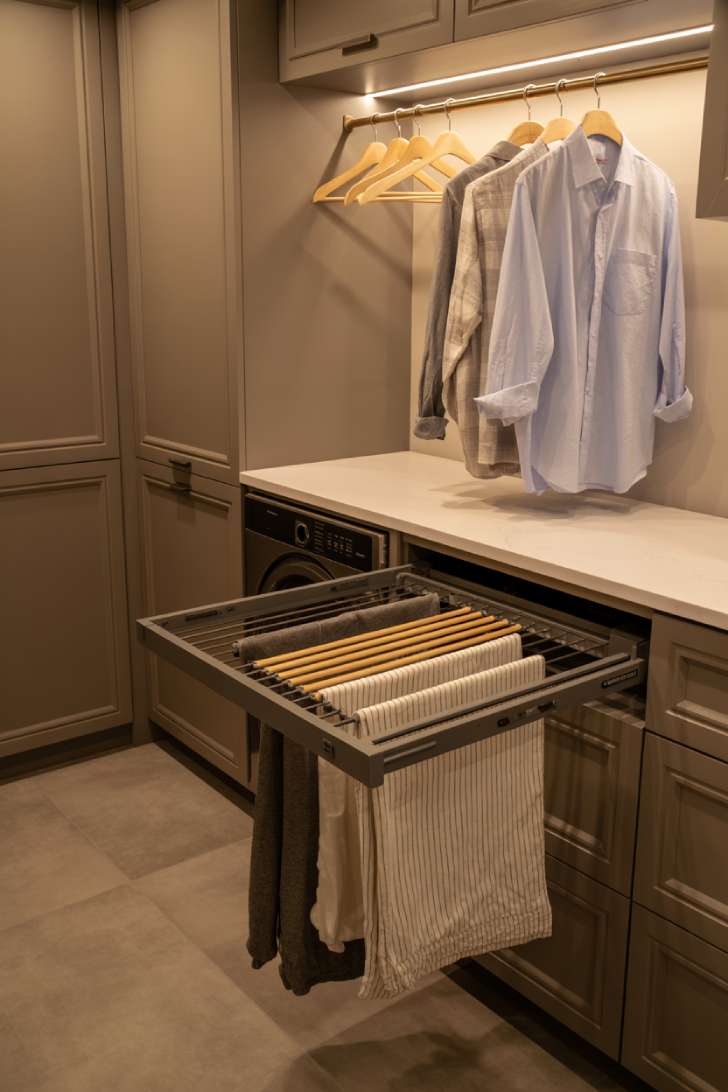
Not everything can go in the dryer.
Wool sweaters, silk blouses, structured blazers, and athletic gear all need to air dry — and if there’s no dedicated place for that, they end up draped over chairs or bathroom doors.
That’s not exactly the luxury experience.
Built-in pull-out drying racks solve this problem by integrating directly into the cabinetry.
When you need them, they extend outward to hold flat-drying items.
When you don’t, they slide back in and vanish completely.
Retractable hanging rods mounted above the appliances or from the ceiling serve the same purpose for garments on hangers.
The real benefit here goes beyond aesthetics.
Having a specific, designated place for air-drying clothes changes your laundry behavior.
When the system exists, you use it.
And using it means fewer ruined garments and a much better-organized room.
Style Blueprint:
- Pull-out wooden or metal drying rack integrated into lower or full-height cabinetry
- Ceiling-mounted or wall-mounted retractable hanging rod
- Wooden or velvet hangers stored nearby for immediate use
- Dedicated flat-drying zone with mesh inserts for sweaters and knitwear
- Cabinet finish that matches or complements the surrounding cabinetry for a seamless look
Design Pro-Tip: Mount your retractable hanging rod directly above the dryer. The warm air rising from the machine gently speeds up the drying process for garments on the rod — no extra energy required.
Appliances Worth Showing Off
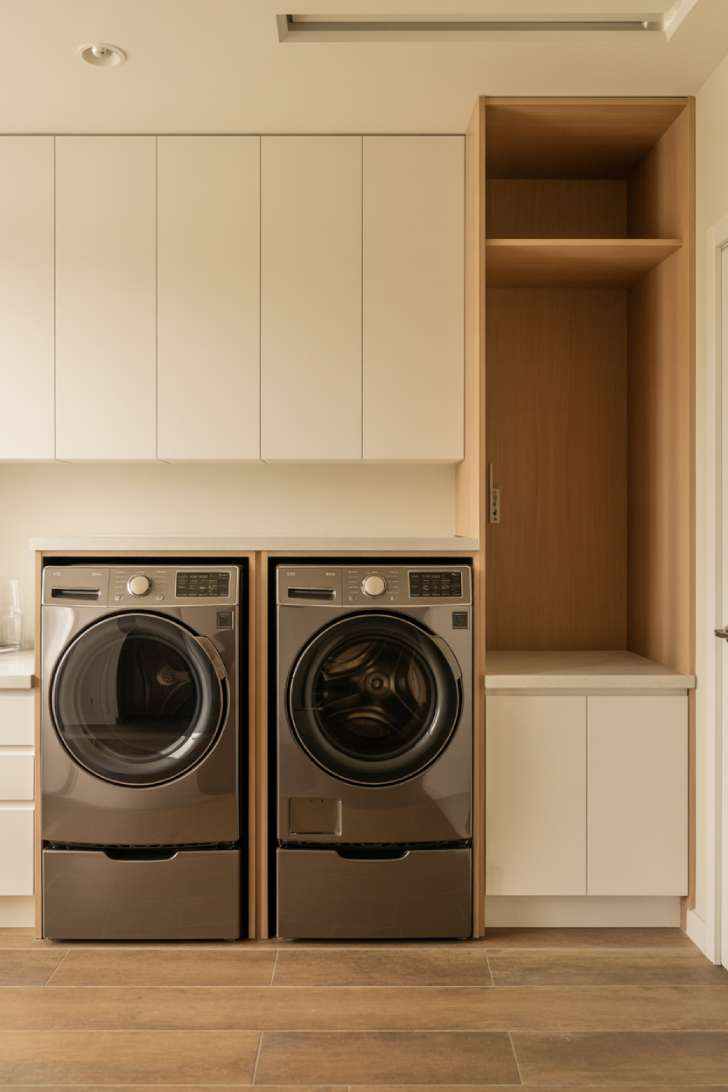
The appliances are the heart of this room.
And yet in so many laundry rooms, they’re treated as an afterthought — tucked in, switched on, and ignored from a design standpoint.
In a luxury laundry room, that changes.
High-end washers and dryers in refined finishes — brushed graphite, matte white, or deep charcoal — function as design elements in their own right.
Wi-Fi connectivity lets you start a cycle from the couch, receive an alert when the load is done, and monitor energy usage over time.
Steam cycles refresh garments between washes, saving time and reducing dry-cleaning trips.
Auto-dosing detergent dispensers remove the guesswork entirely, measuring the precise amount of product for each load.
The drying cabinet to the right in this example is worth a special mention.
It’s the appliance most luxury laundry rooms are missing.
Originally popularized in Scandinavia, drying cabinets circulate warm air gently around clothing without tumbling, making them ideal for everything that can’t go in a conventional dryer.
Style Blueprint:
- Wi-Fi-enabled front-loading washer and dryer in a premium matte or brushed finish
- Raised pedestal installation with pull-out drawer storage beneath
- Integrated Scandinavian-style drying cabinet for delicates and wool
- Coordinated appliance and cabinet finishes for a built-in look
- Noise-reduction technology — check the decibel rating before purchasing
The Warmth of a Well-Chosen Palette
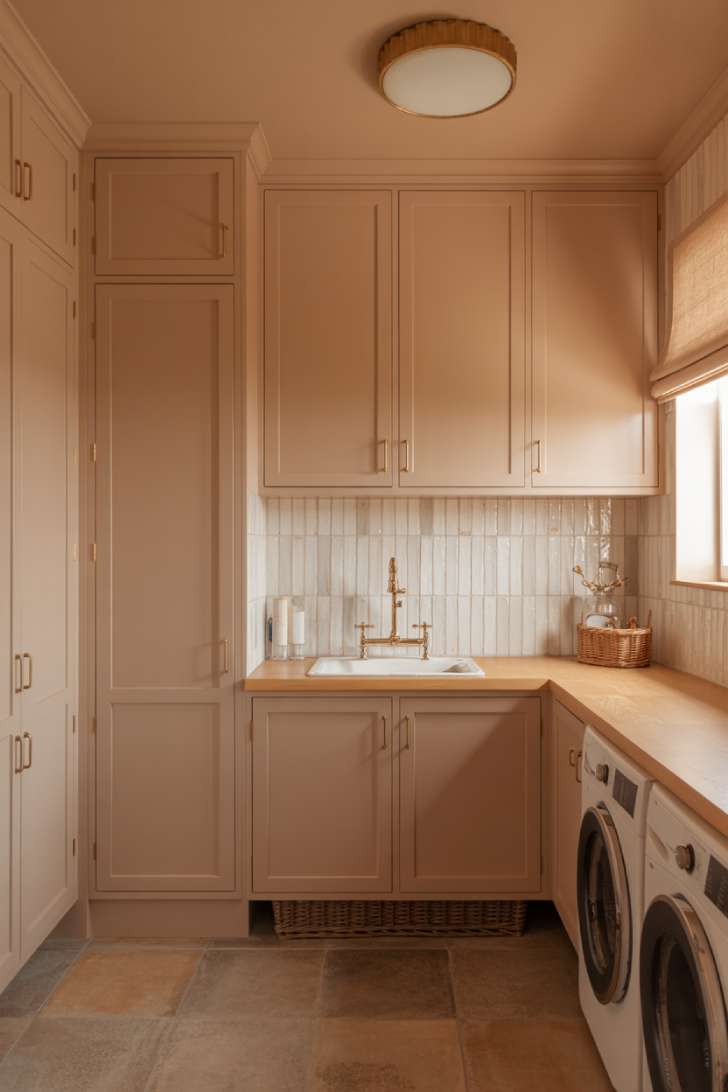
There’s been a quiet but unmistakable shift in luxury laundry room design.
The stark all-white rooms that dominated for years are giving way to warmer, more grounded palettes.
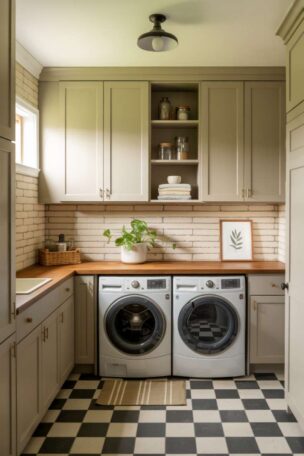
Mushroom, putty, warm greige, and creamy off-whites are now the go-to cabinet tones for homeowners who want a space that feels both high-end and genuinely livable.
The reason this works so well in a laundry room comes down to how color affects your state of mind during repetitive tasks.
Warm neutrals create a low-stimulation, calming environment.
When the background of a space is quiet and settled, the task at hand feels less like an obligation and more like a routine.
Pair those warm cabinet tones with aged brass hardware, natural stone, and a zellige or handmade tile backsplash — both of which reflect light in an organic, non-uniform way — and the result is a room that genuinely feels good to be in.
Style Blueprint:
- Cabinet paint in mushroom, warm greige, putty, or creamy off-white
- Aged brass or unlacquered brass hardware in an oval or cup-pull shape
- Zellige, handmade ceramic, or soft stone tile for the backsplash
- Honed (not polished) natural stone or large-format terracotta-look tile for the floor
- Linen or cotton roman shade at the window for softness and warmth
Bold Goes Beautiful
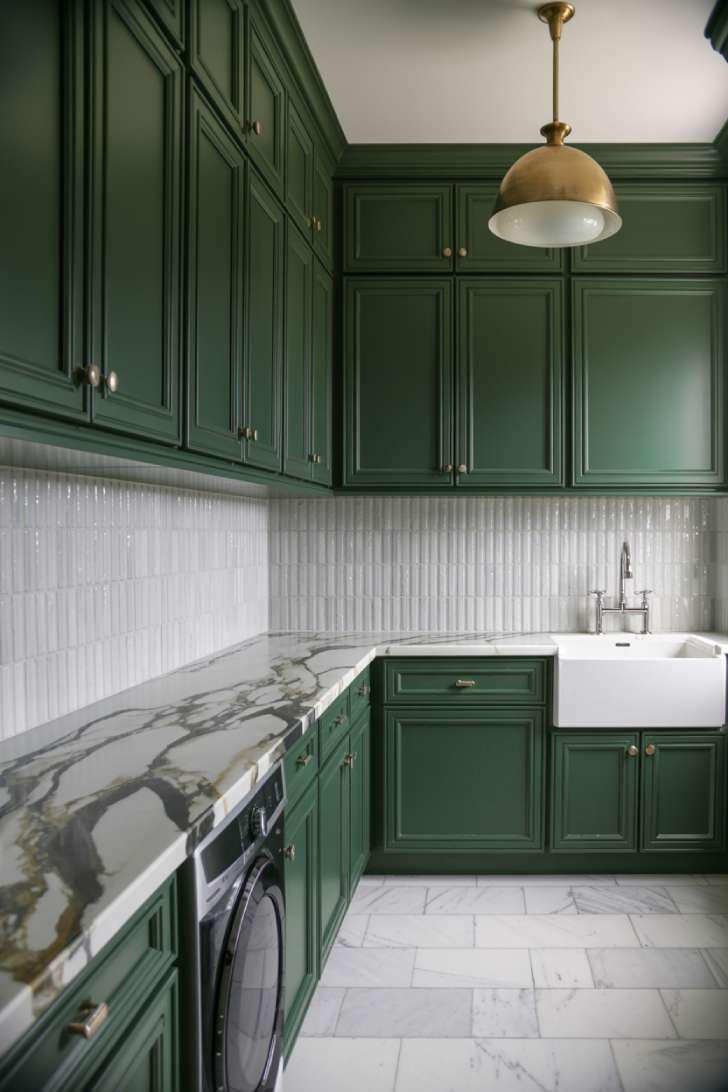
Not everyone wants quiet.
Some of the best luxury laundry room designs lean hard into contrast and color — and the result is a room that stops you in your tracks.
Deep forest green, navy, charcoal, and matte black cabinetry are all strong choices that communicate sophistication without apology.
The secret to making dark cabinetry work without the room feeling heavy is counterbalancing it with plenty of light surfaces.
White marble countertops, bright tile backsplashes, and pale stone or large-format white tile floors give the eye somewhere to rest.
The green in this example does something specific to the atmosphere.
Deep, saturated greens have a grounding quality — they feel rich without being aggressive — and against a white marble surface, the contrast reads as genuinely luxurious rather than simply dark.
The polished nickel hardware brings a brightness that keeps the room from tipping into moodiness.
Design Pro-Tip: If you’re going dark on the cabinets, go light on everything else — floor, countertop, backsplash, and walls. The contrast is the whole point. Mixing two dark elements kills the drama.
Style Blueprint:
- Floor-to-ceiling cabinetry in deep green, navy, charcoal, or matte black
- White or light-veined marble countertop for maximum contrast
- Polished nickel, chrome, or brushed brass hardware for brightness
- Pale stone or large-format white tile flooring
- One statement overhead light — brass dome pendant or semi-flush mount
Light as a Design Statement
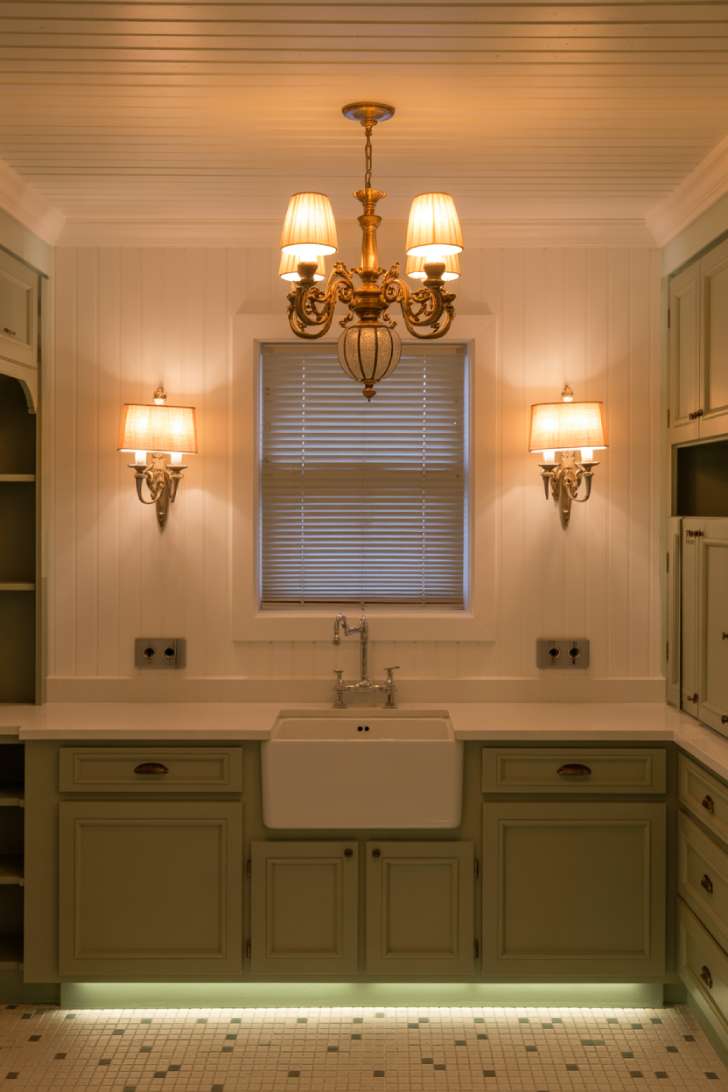
Lighting is the detail that separates a decorated room from a truly designed one.
Most laundry rooms settle for a single overhead fixture — functional, forgettable, and completely lacking in personality.
A luxury laundry room layers light from multiple sources, and each one plays a specific role.
The chandelier or statement flush-mount overhead sets the aesthetic tone of the room.
It’s the piece you’d be surprised to find in a laundry room, and that surprise is exactly what makes the space memorable.
Wall sconces flanking the sink add warmth and character at eye level, making the space feel considered from every angle.
Under-cabinet strips are the workhorses of the group.
They light up the countertop surface directly, which is where you actually need clarity when you’re treating a stain or reading a care label.
They also highlight the texture of the backsplash tile and the edge of the countertop in a way that no overhead light can replicate.
Style Blueprint:
- Statement chandelier, pendant, or decorative flush-mount as the primary overhead fixture
- Wall sconces positioned at eye level flanking the sink or window
- Under-cabinet LED strips for task lighting and ambient warmth
- Frosted or opaque window treatment to soften incoming natural light
- Dimmer switches on all overhead fixtures for adjustable ambiance
The Hardest-Working Room in the House
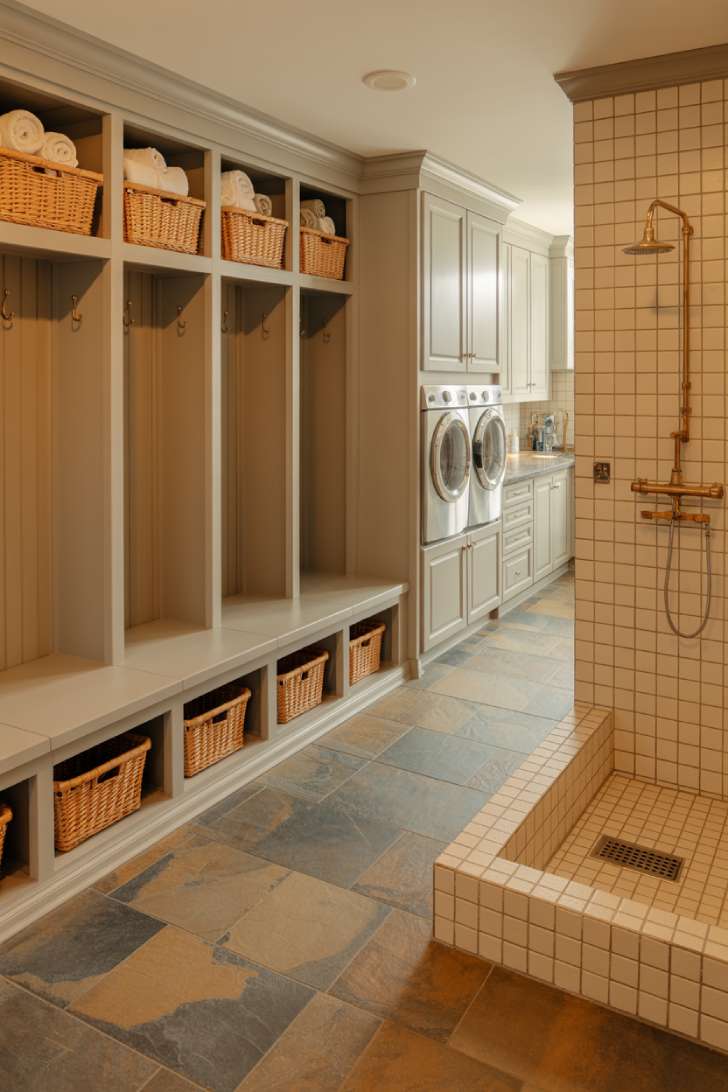
This is where luxury laundry room design gets genuinely exciting.
When you combine the laundry area with a mudroom, you’re creating what designers call a command center — a single, organized space that handles the messiest parts of daily household life in one go.
The built-in locker system handles coats, bags, shoes, and sports gear so none of that chaos migrates into the rest of the house.
Lift-top bench storage adds another layer of hidden organization without taking up additional floor space.
The pet washing station at floor level is one of the most requested features in high-end laundry room designs right now.
It makes complete practical sense.
The tiled floor, the utility sink, and the proximity to the rest of the household cleaning zone make this room the obvious place to give the dog a bath — and designing it specifically for that purpose means the rest of the house stays clean and dry.
Style Blueprint:
- Built-in locker or cubby system with individual bays per family member
- Lift-top bench seat with hidden storage inside
- Brass or brushed nickel coat hooks mounted at varying heights
- Dedicated floor-level pet washing station with a handheld showerhead on a sliding rail
- Large-format, non-slip porcelain or slate-look tile across the full floor area
Shelves That Look Like They Were Styled
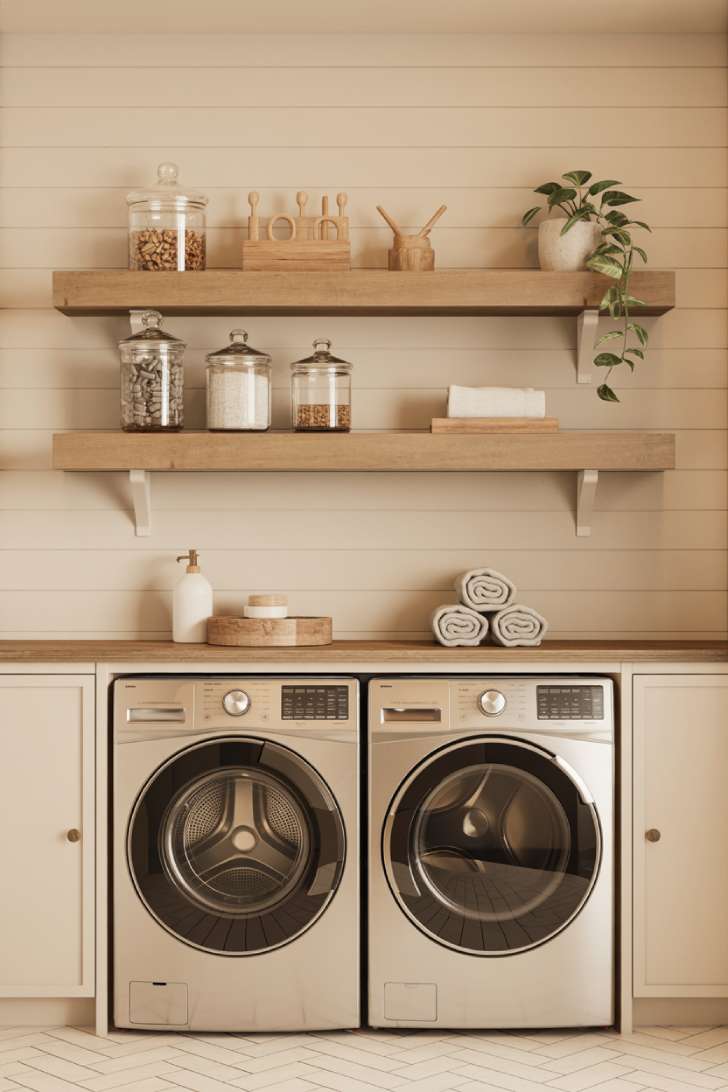
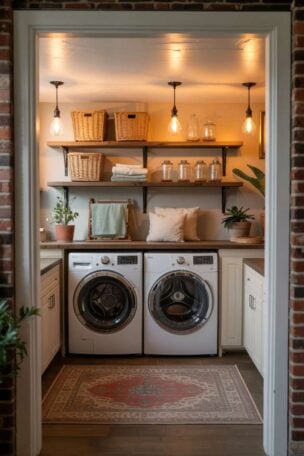
Open shelving in a laundry room divides opinion.
Some people see it as an invitation for clutter.
Others see it as an opportunity to bring warmth and personality into a space that can easily feel cold.
The difference between a shelf that looks cluttered and one that looks curated almost always comes down to the containers.
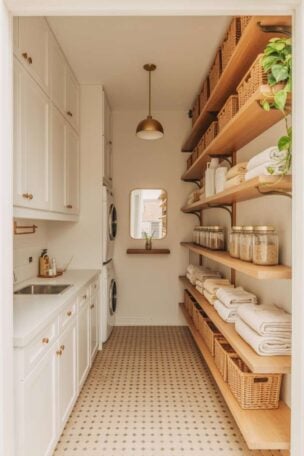
When everyday products are decanted into glass apothecary jars, ceramic vessels, or woven baskets, they stop looking like grocery store packaging and start looking like intentional design choices.
A trailing plant or two does the same thing — it brings life and softness into a room that’s otherwise full of hard surfaces and mechanical equipment.
The floating wood shelf in this example works so well partly because of the material contrast it creates.
The warm oak grain set against flat white cabinetry and white tile adds a layer of natural texture that the eye reads as comfort.
Texture is often what separates a room that looks like a showroom from one that looks like a home.
Style Blueprint:
- Floating shelves in natural oak, walnut, or white-painted wood
- Glass apothecary jars in two or three sizes for decanted laundry products
- One or two small potted plants — trailing varieties like pothos work well
- Woven or rattan baskets for linen storage and visual warmth
- Consistent container style and color family for a cohesive display
Design Pro-Tip: Limit your open shelf display to three “ingredient” types: one functional item (jars or containers), one natural element (plant or wood object), and one soft item (folded towels or linen). More than three types and it starts to look like accumulation rather than curation.
When the Laundry Room Disappears
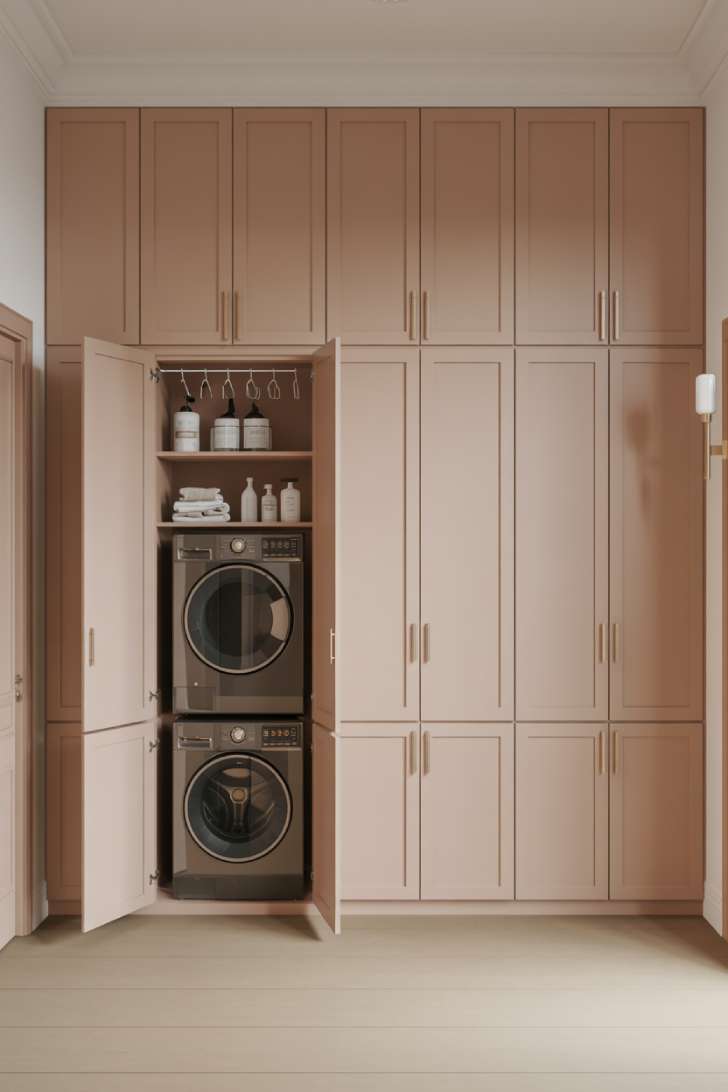
This is the ultimate expression of luxury laundry room design.
Not just a beautiful space — but a space that ceases to exist when you don’t need it.
The invisible laundry room concept uses floor-to-ceiling custom joinery fitted with pocket doors or bi-fold “bus doors” to conceal the entire laundry station behind a seamless wall.
From the outside, it looks like a built-in architectural feature — a wall of cabinetry that belongs exactly where it is.
Open the doors, and a fully functional laundry station is right there: stacked machines, pull-out drying rack, organized storage, hanging rod.
Close the doors, and it’s gone.
This design works especially well in homes without a dedicated utility room, where the laundry needs to live in a hallway, a kitchen alcove, or a living space without announcing itself visually.
There’s something that happens psychologically when a messy or utilitarian function is hidden from view.
The surrounding space feels calmer, more controlled, and more luxurious — not because anything was removed, but because it was simply tucked out of sight.
Style Blueprint:
- Floor-to-ceiling flat-panel cabinetry with integrated push-to-open handles or recessed pulls
- Pocket doors or bi-fold bus doors that open fully without obstructing the workspace
- Stacked washer and dryer to keep the footprint compact inside the cabinetry
- Interior cabinet finish that matches the exterior for a clean, considered look
- Interior lighting that activates when the doors open for full visibility
A Few Final Thoughts
Luxury laundry rooms are really about one thing: treating a daily task with the same respect you’d give any other part of the home.
It doesn’t require every idea on this list.
Sometimes it’s a set of custom cabinets and a good countertop.
Sometimes it’s a bold wallpaper and a statement light.
Pick the ideas that speak to the way you actually use the space, and start from there.
Save the looks that resonate with you, note the materials and finishes that keep reappearing in your favorites, and let that pattern guide your decisions.
The most personal rooms are always the most beautiful ones.