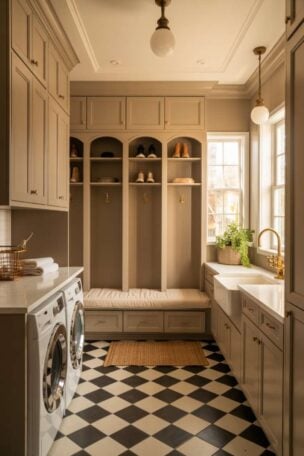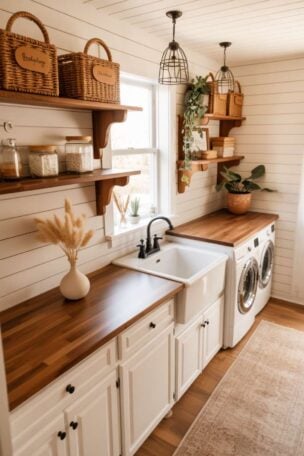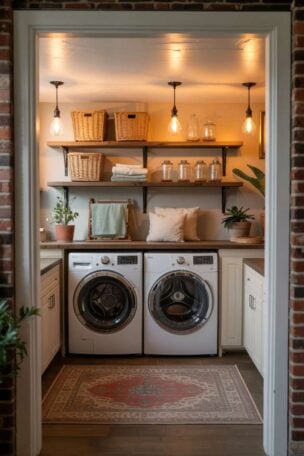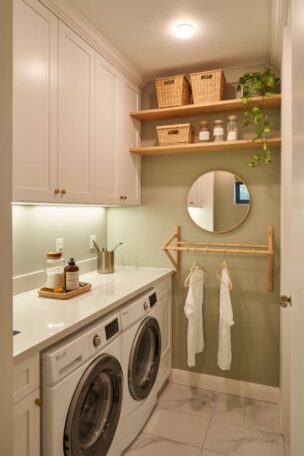
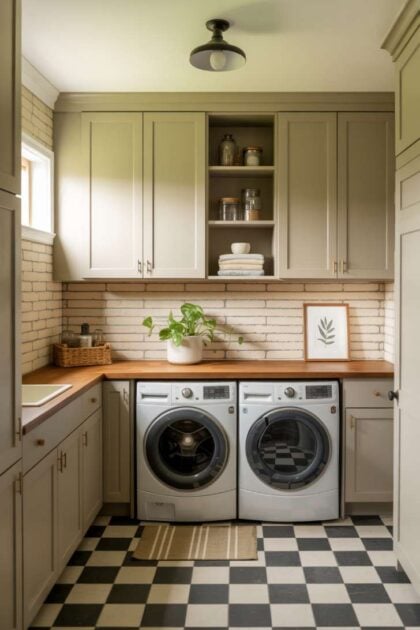
The laundry room is probably the most used room in your home.
And yet, it’s almost always the last one to get any attention.
Most people spend years tolerating a dark, cluttered, uninspiring space — piling detergent bottles on top of the dryer, tripping over laundry baskets, working under a single, sad overhead bulb.
Here’s the thing, though: a laundry room makeover doesn’t have to cost a fortune or take weeks to complete.
Whether you’re working with a narrow closet, a compact utility room, or a full dedicated space, the right updates can completely change how the room looks, feels, and functions.
This article walks through 13 real, visual-first laundry room makeover ideas — from quick, budget-friendly updates to more considered renovations — covering every style and every budget.
There’s something here for everyone.
Before You Start: A Few Things Worth Thinking About
Before you start buying anything or tearing anything out, take ten minutes to honestly assess your space.
Ask yourself:
- What’s the actual size and layout? A laundry closet needs a completely different approach than a dedicated laundry room or a mudroom combo.
- What’s your budget? Knowing whether you’re working with $200 or $2,000 shapes every decision that follows.
- What’s bothering you most? Is it the clutter? The lack of folding space? The lighting? The ugly floor? Start with the problem that frustrates you every single day.
- What style direction do you want? Farmhouse, modern, coastal, moody, Scandinavian — picking a direction before you shop prevents expensive, mismatched mistakes.
With those answers in mind, let’s get into the good stuff.
The Case for Going Floor-to-Ceiling with Cabinets
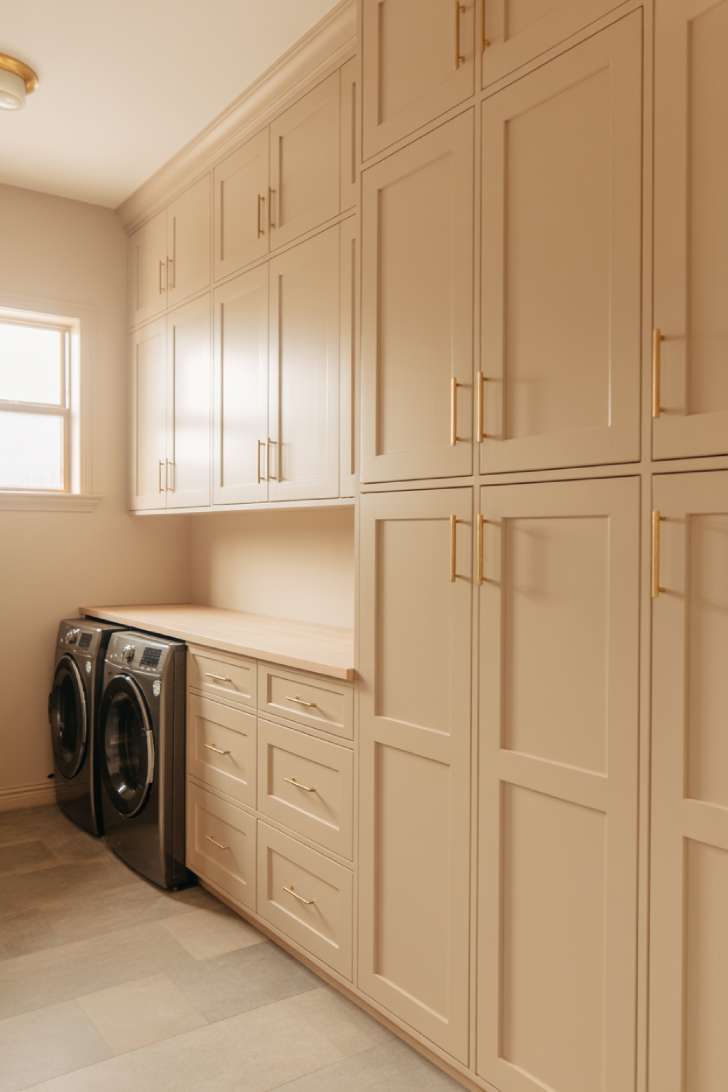
Cabinets are the single most transformative upgrade you can make to a laundry room — full stop.
Not because they look good (though they do), but because they solve the root problem: there’s nowhere to put anything.
Wire shelving gets the job done, but open storage in a laundry room almost always ends up looking chaotic.
Cabinets contain the mess.
Upper cabinets store detergents, dryer sheets, and cleaning products out of sight.
Lower cabinets handle bulkier items — extra supplies, cleaning tools, even a hidden hamper on pull-out rails.
Going floor-to-ceiling is a particularly smart move in small laundry rooms.
It draws the eye upward, which makes the ceiling feel higher and the room feel less cramped.
Light-colored cabinets — soft white, warm cream, pale sage — bounce light around a small space in a way that dark tones simply can’t.
That said, if the rest of your home leans darker, don’t be afraid of navy or forest green here. The contrast reads as intentional, not heavy.
The light matters more than the color in a compact space. Pale finishes reflect what little light is available, making the room feel airy rather than boxed in. It’s one of the most straightforward ways to add perceived square footage without moving a single wall.
Style Blueprint:
- Floor-to-ceiling shaker or flat-front cabinets in a light neutral
- Brushed brass or matte black bar handles
- Soft-close hinges and drawer slides for a polished feel
- Large-format porcelain tile flooring in a warm neutral
- A single countertop spanning the full width of the cabinets
The Countertop That Changes Everything
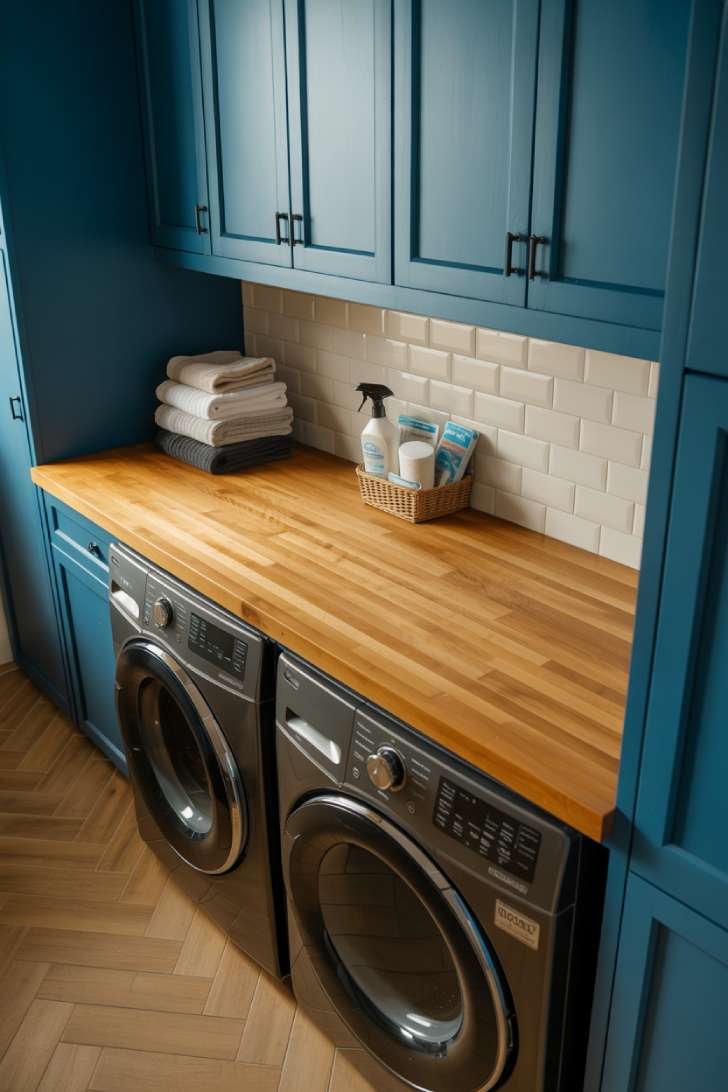
If there’s one upgrade that completely changes how a laundry room functions, it’s this one.
A countertop built across the top of the washer and dryer gives you a proper workspace.
No more folding on the bed.
No more dumping clean clothes on the couch and leaving them there for three days.
Butcher block is the most popular choice right now, and it’s easy to see why.
It’s warm, it’s tactile, it photographs beautifully, and it can be cut and installed as a DIY project over a weekend.
Quartz is the more durable, moisture-resistant option — great if your laundry room sees a lot of steam or splash.
Laminate works just fine for budget makeovers and comes in finishes that convincingly mimic stone or wood.
The key detail most people miss: extend the countertop a few extra inches on either side if the space allows.
That extra surface becomes the most useful stretch of counter in your entire house on laundry day.
There’s something about having a proper, level workspace that changes the whole feel of doing laundry. It shifts the space from reactive chaos to something organized — a place where you actually have room to work. That psychological shift is real and it happens fast.
Style Blueprint:
- Butcher block, quartz, or laminate countertop cut to span the full machine width
- Vertical-stack subway tile backsplash behind the counter
- Cabinetry above in a contrasting color to the countertop
- Matte black or brushed brass cabinet hardware
- A small woven basket or tray to corral everyday supplies on the counter surface
Wallpaper: The Shortcut to a Room With Soul
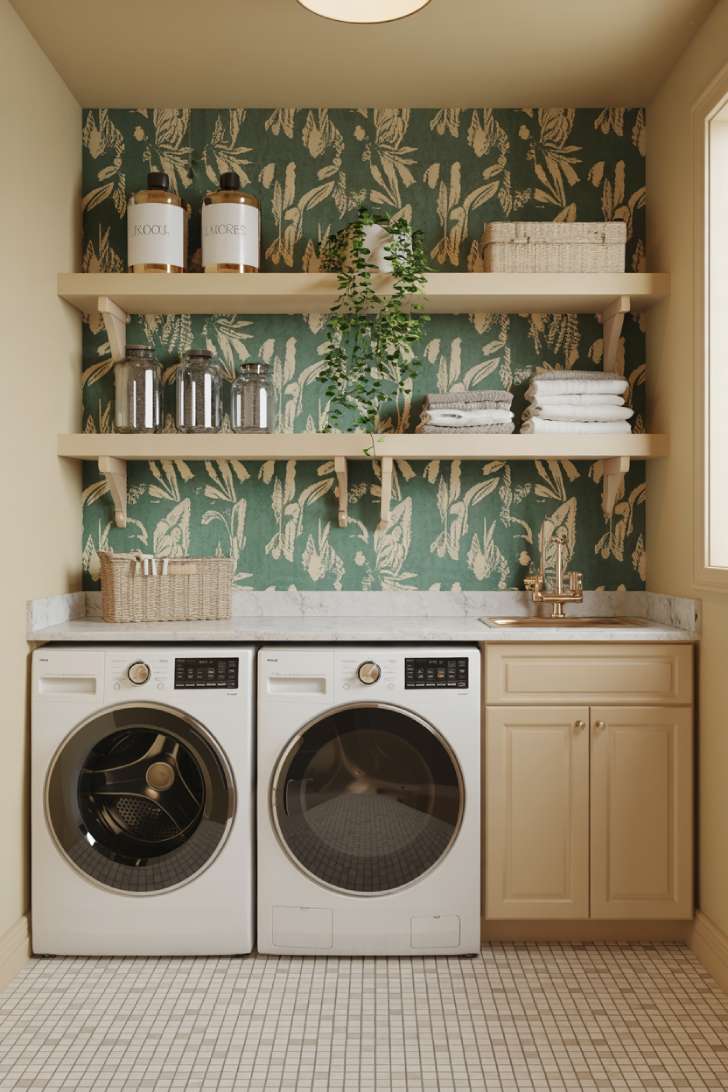
Wallpaper in a laundry room sounds extra.
It’s not.
A laundry room is one of the best places in your home to try a bold pattern, precisely because the room is small.
A single roll — sometimes less — covers the whole space.
The cost stays manageable even with premium wallpaper, and the impact is enormous.
Botanical prints, vintage florals, geometric patterns, and maximalist prints all work exceptionally well here.
The small scale of the room means the pattern doesn’t overwhelm — it fills.
Peel-and-stick wallpaper has made this upgrade accessible to renters and commitment-phobes alike.
It goes up without paste, comes down without damage, and looks remarkably close to traditional wallpaper in photographs.
If full wallpaper still feels like too much, try papering a single accent wall — the one visible from the doorway tends to have the most visual impact.
A patterned wall behind open shelving does something clever: it makes the shelving look styled even when it’s purely functional. The pattern acts as a backdrop that elevates everything in front of it — even a row of detergent bottles looks intentional when there’s beautiful wallpaper behind it.
Style Blueprint:
- Bold or botanical peel-and-stick wallpaper on the primary wall
- Open white floating shelves mounted in front of the wallpapered wall
- Checkerboard ceramic tile on the floor for graphic contrast
- Polished brass hardware on cabinets and fixtures
- Glass canisters or labeled ceramic jars for countertop storage
Design Pro-Tip: In a small laundry room, pick ONE statement element — wallpaper, a bold floor, or colorful cabinets — and keep everything else neutral. Competing statements cancel each other out and make a small space feel restless rather than stylish.
Flooring That Does the Heavy Lifting
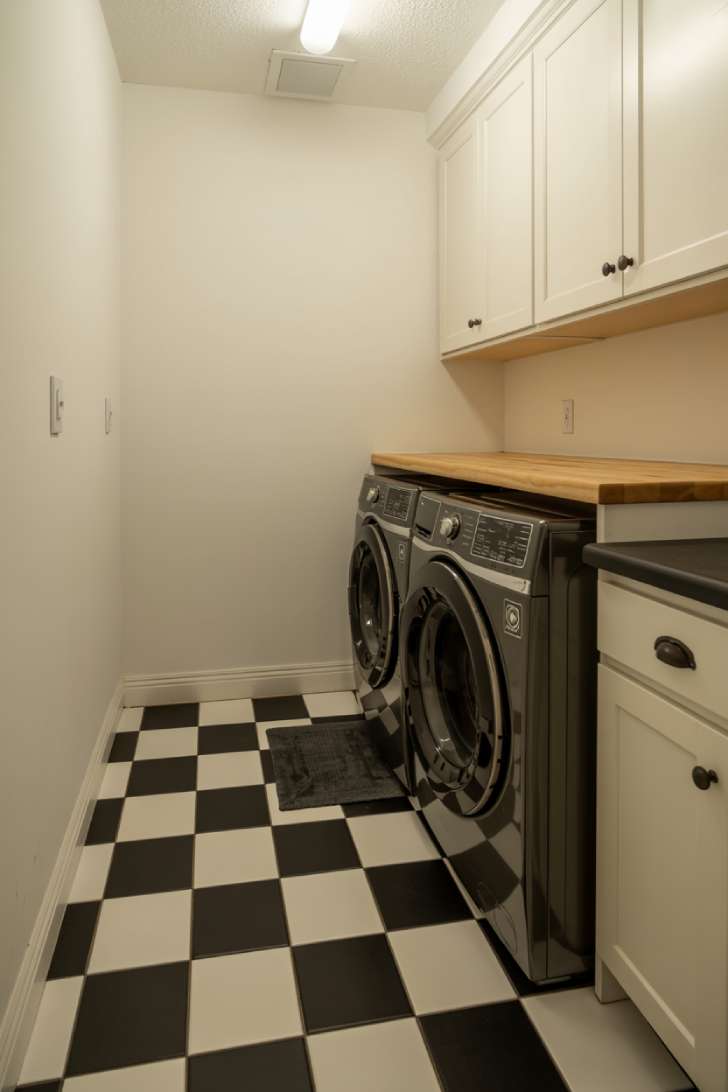
Bad flooring drags down even the most carefully designed laundry room.
Old vinyl sheet flooring, stained concrete, or chipped laminate — it doesn’t matter how nice the cabinets are if the floor looks tired.
Replacing the floor is one of the highest-impact, relatively affordable upgrades you can make.
Porcelain tile is the top pick for laundry rooms.
It handles moisture, it handles heavy appliance feet, it handles spills without staining, and it comes in every size and pattern imaginable.
Checkerboard tile — classic black and white — has had a massive resurgence and it works in almost every style of laundry room, from farmhouse to modern.
Luxury vinyl plank is the best option for anyone who wants wood-look flooring in a wet-prone environment.
It’s waterproof, it’s comfortable underfoot, and it installs as a straightforward DIY project.
For renters or anyone on a tight timeline, peel-and-stick tile panels can be installed over existing flooring in an afternoon.
Floors carry a lot of visual weight in a small room. A graphic, high-contrast floor like checkerboard immediately makes the space feel more designed and less utilitarian. It also draws the eye downward and out, which can make a narrow room feel wider than it actually is.
Style Blueprint:
- Large-format checkerboard porcelain tile or patterned ceramic tile
- Matte black or brushed brass cabinet hardware to echo the floor contrast
- A small washable cotton or jute runner rug in front of the machines
- Consistent grout color that complements — not fights — the tile pattern
- Waterproof threshold strip if the flooring transitions to an adjacent space
Floating Shelves: Storage You Can Actually Style
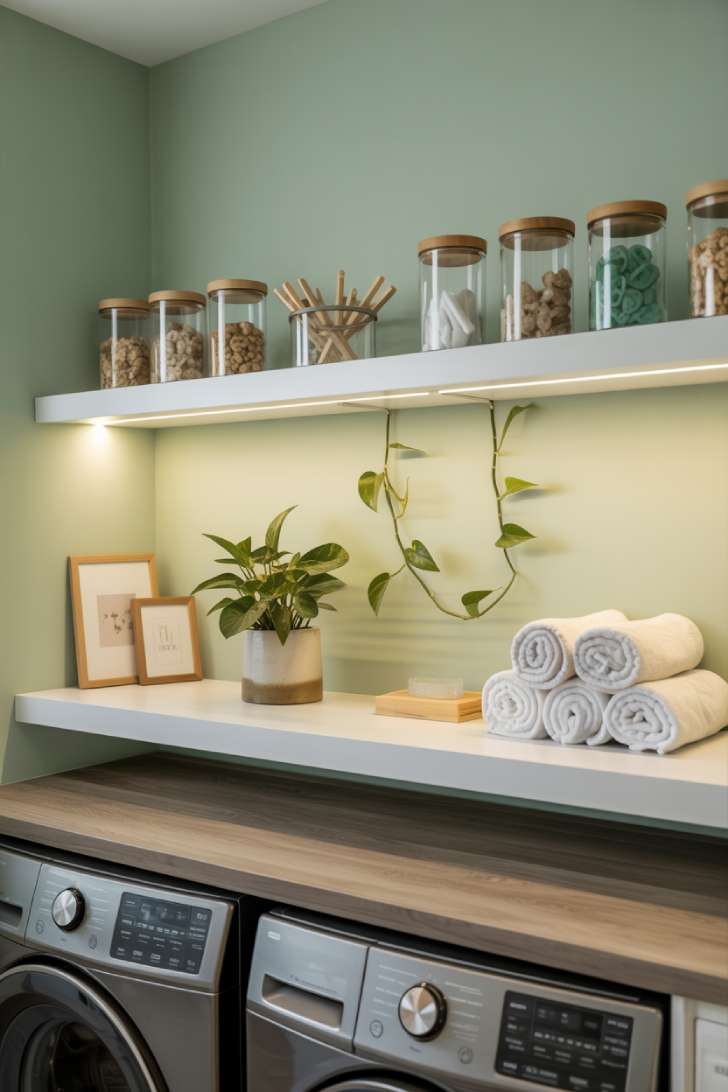
Floating shelves are the most versatile storage upgrade in a laundry room makeover.
They’re affordable, they install in a few hours, and they serve double duty: storage and styling surface.
The secret to making floating shelves look good rather than cluttered is editing.
Not everything needs to be on display.
Move the ugly, mismatched bottles into a cabinet or a basket.
Keep the shelves for things that either look good or get used constantly — ideally both.
Decanted detergents in glass canisters, a small trailing plant, a stack of folded linen, a labeled basket or two.
That’s enough.
Placement matters too.
Shelves mounted directly above the washer and dryer put your most-used supplies within arm’s reach without consuming any floor space.
Adding under-shelf LED strip lighting is a small upgrade that pays off enormously in both function and atmosphere.
It improves visibility for reading labels and spotting stains while creating a warm, layered glow that makes the whole room feel more intentional.
The height at which shelves are mounted changes how the room feels. Shelves installed higher than eye level draw attention upward and make a low-ceilinged room feel taller. Mount them too low and you lose the sense of openness — and the visual breathing room — above the machines.
Style Blueprint:
- Two or three floating shelves in white, wood, or a color that complements the wall
- Under-shelf LED strip lighting in warm white
- Clear glass canisters for decanted laundry supplies
- One small trailing or potted plant for softness
- A few labeled baskets or bins to contain smaller, less attractive items
A Fresh Coat of Paint Goes Further Than You Think
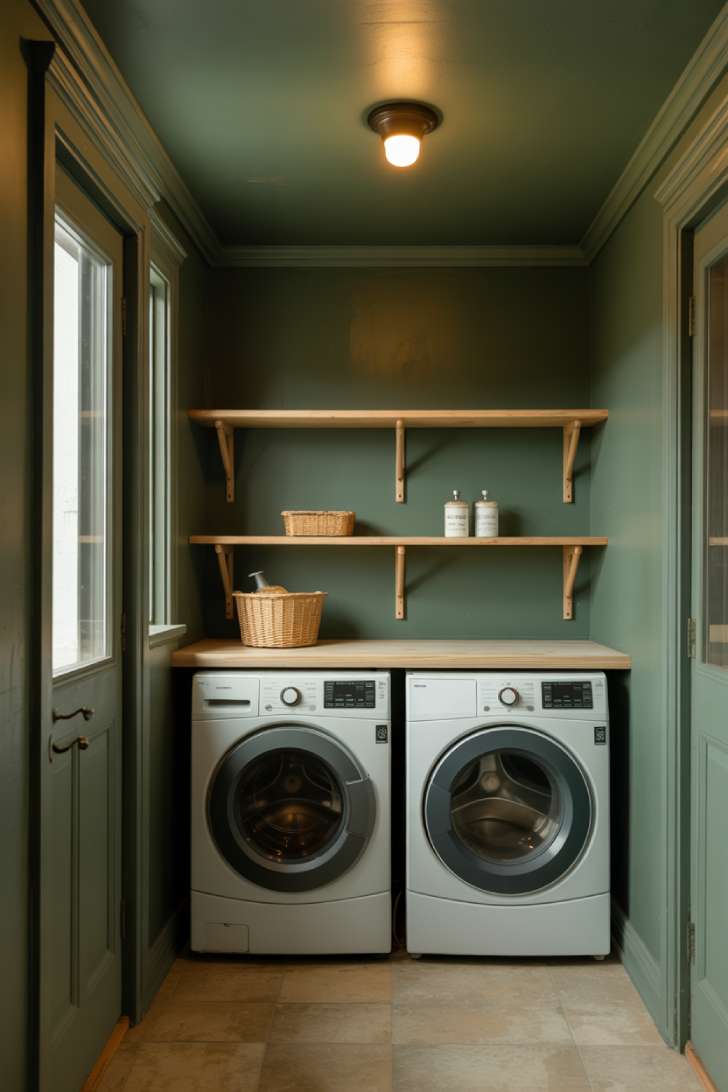
Paint is the most accessible laundry room makeover tool available.
One gallon, one afternoon, and the room can look completely unrecognizable.
Most people default to white, and white is a perfectly solid choice — it reads as clean, it brightens a dark space, and it makes everything else pop.
But going bolder with paint is one of the most rewarding decisions you can make in a laundry room.
Deep sage, forest green, dusty navy, warm terracotta — these colors work especially well here because they create a sense of enclosure that feels intentional rather than cramped.
One technique worth trying: paint the ceiling the same color as the walls.
In a small room, matching the ceiling to the walls removes the visual interruption at the ceiling line, making the space feel more expansive and deliberately designed.
It sounds counterintuitive, but it works every time.
If bold color still feels like a risk, try it on a single accent wall — the one directly behind the washer and dryer is usually the best candidate.
Color on the walls changes the psychological character of a room faster than almost any other update. Warm, muted tones like sage and terracotta reduce the feeling of being in a functional utility space and replace it with something that feels more like a room you chose to design. That shift in perception genuinely makes the time spent in the space feel less like a chore.
Style Blueprint:
- One full gallon of quality interior paint in a muted, earthy tone
- Matching ceiling paint for a wrapped, cocoon-like effect
- White trim and door frames to create contrast
- Simple, unfussy shelving in natural wood or white to keep the focus on the wall color
- Matte black fixture and hardware to anchor the color palette
Design Pro-Tip: Paint the ceiling the same color as your walls in a small laundry room. It removes the visual “lid” effect and makes the space feel taller and more cohesive — no crown molding or expensive finish work required.
Organization That Actually Sticks
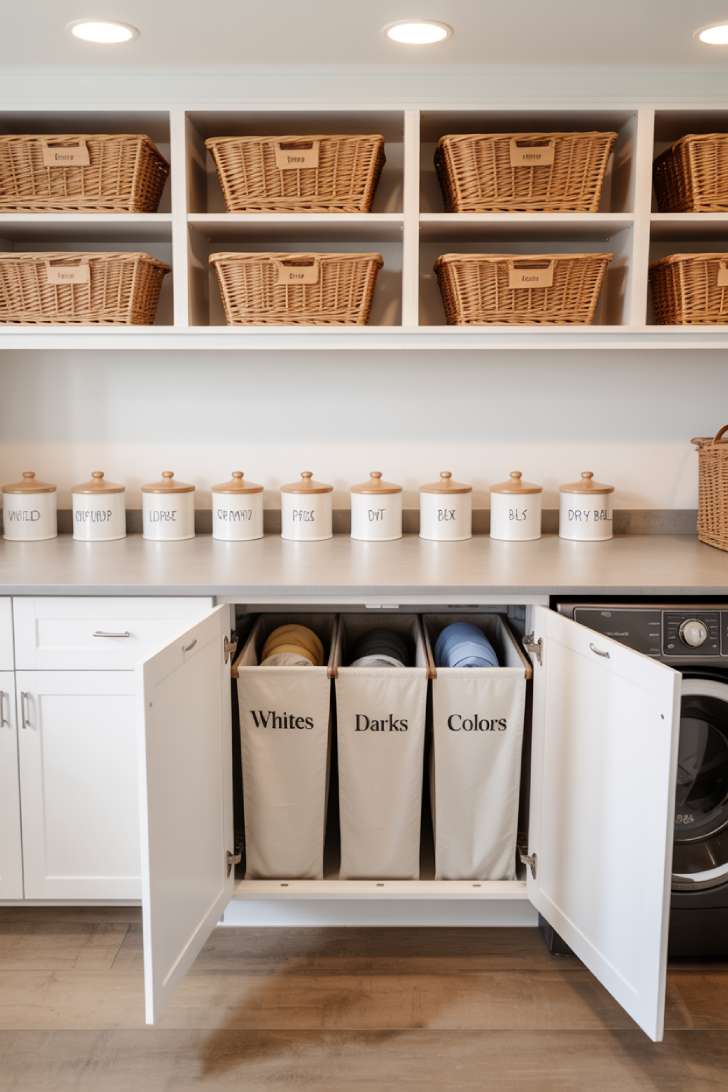
Organization in a laundry room isn’t just about tidiness.
It’s about time.
A well-organized laundry room means sorting takes thirty seconds, finding supplies takes five, and nothing gets lost behind the dryer.
The biggest upgrade you can make to your organization system is creating zones.
A washing zone: detergent, stain remover, and dryer sheets within arm’s reach of the machines.
A folding zone: a clear, dedicated surface with nothing else on it.
A storage zone: everything else, behind closed doors or in labeled baskets.
Tilt-out or pull-out hamper cabinets are one of the cleverest built-in solutions available.
Dirty laundry goes directly into sorted sections — whites, darks, colors — and disappears from view the moment the door closes.
Decanting detergent and supplies into matching containers is a small step that has a surprisingly large effect on how the room looks.
Mismatched bottles and cardboard boxes add visual noise. Uniform ceramic or glass containers bring calm.
Labels complete the system. Clear, consistent labeling means every family member knows exactly where things go — and where to find them.
Organization is as much about reducing visual noise as it is about function. A room full of mismatched products and random piles registers as stressful, even if everything is technically accessible. Containing and labeling items shifts the room from chaotic to controlled, and that shift affects how much you resist going in there.
Style Blueprint:
- Built-in pull-out or tilt-out hamper with multiple sorting sections
- Matching ceramic or glass canisters with printed or handwritten labels
- Uniform wicker or fabric baskets in upper open shelving
- Leather or linen label tags for baskets
- Recessed or flush-mount ceiling lighting for bright, even task illumination
Why Every Laundry Room Needs a Sink
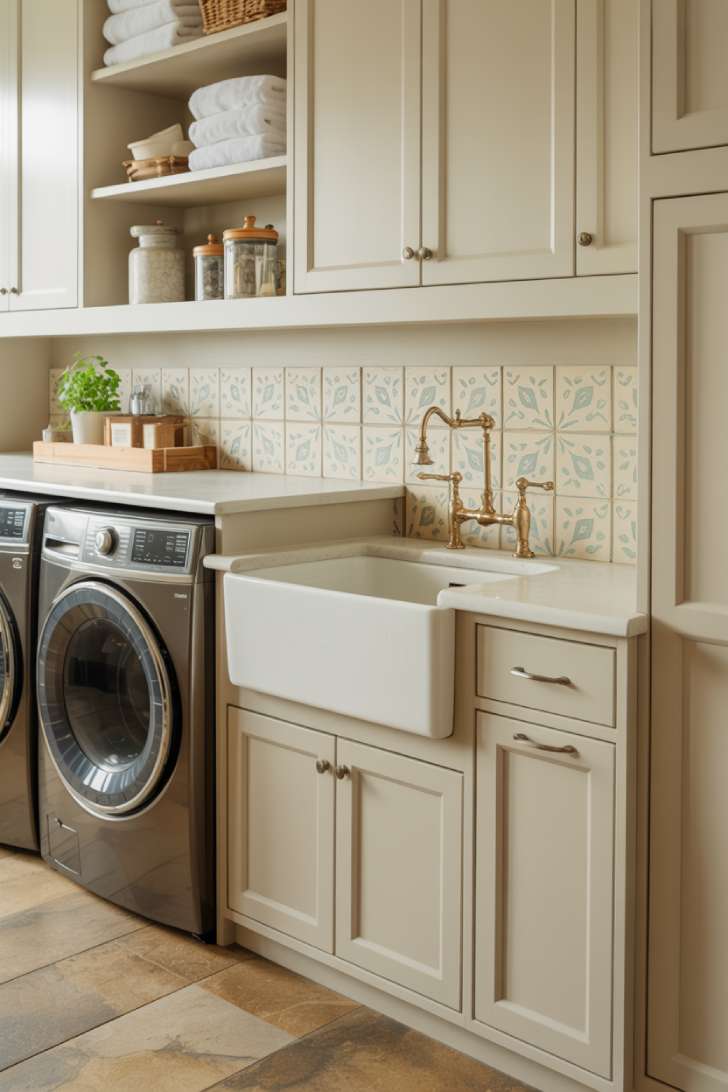
A utility sink in a laundry room is one of those upgrades that, once you have it, you can’t imagine living without.
Stain treatment, hand-washing delicates, rinsing muddy gear, filling a mop bucket — all of it becomes dramatically easier.
The farmhouse apron-front sink has become the default choice for laundry rooms, and the reasons are practical as well as aesthetic.
The deep basin handles bulky items — soaking sweaters, rinsing athletic gear — without splashing.
The apron front gives the sink a strong visual presence that anchors the room.
Paired with a bridge faucet or a wall-mounted pull-down, the sink becomes a genuine focal point.
The backsplash behind a laundry sink is the best place in the room to introduce a decorative tile.
Hand-painted tiles, patterned encaustic tiles, or even a simple penny tile mosaic transform what would otherwise be a purely functional wall section into the most beautiful spot in the room.
The sink changes the spatial logic of the room. Having a dedicated wash point creates a clear workflow — sort, pre-treat, wash, fold — and that workflow organization reduces the mental friction of doing laundry. A room that supports a clear process feels less like a burden.
Style Blueprint:
- Deep white farmhouse apron-front or drop-in utility sink
- Wall-mounted or deck-mount bridge faucet in brushed brass or matte black
- Decorative hand-painted or patterned tile backsplash behind the sink
- Base cabinet with shaker or flat-front doors beneath the sink
- Continuous quartz countertop connecting the sink to the adjacent appliance area
Design Pro-Tip: Install your laundry sink at a slightly higher-than-standard counter height — 36 to 38 inches instead of 34. It eliminates the back strain from bending over to hand-wash or soak items, and it costs nothing extra to specify during cabinet installation.
Lighting Is the Detail Most People Get Wrong
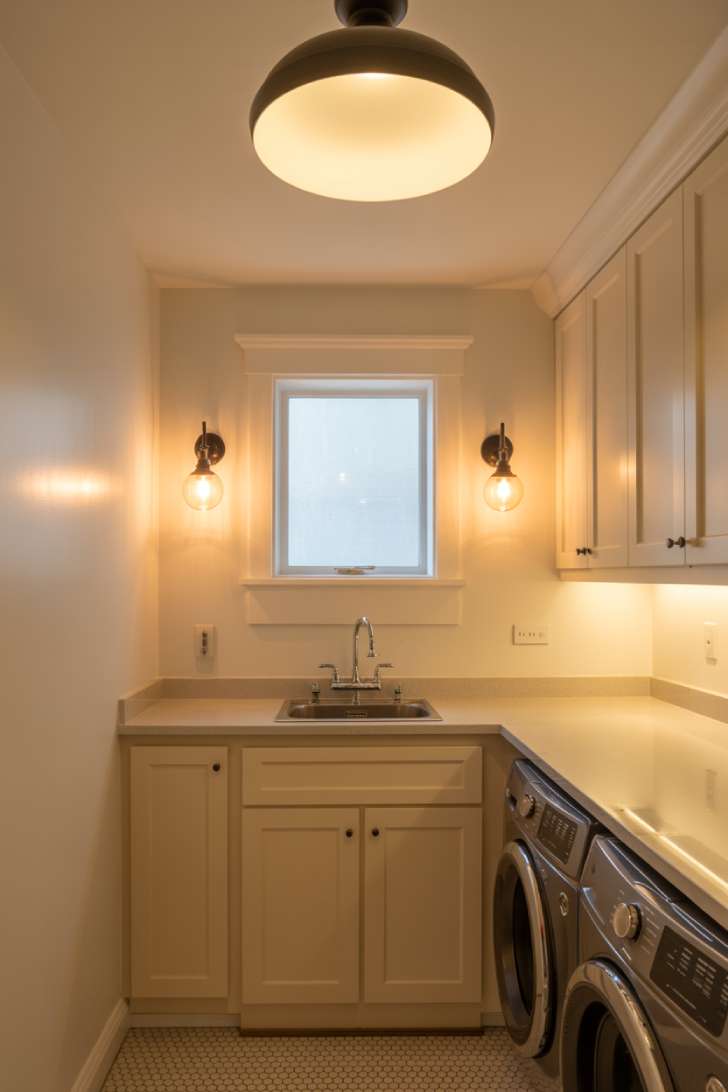
Lighting in a laundry room is almost always an afterthought.
One builder-grade fluorescent strip, usually positioned slightly wrong, casting a flat, unflattering light over everything.
Replacing it is one of the fastest and cheapest upgrades in a laundry room makeover.
A schoolhouse-style flush-mount fixture costs between $40 and $120 and installs in under an hour with no electrical experience.
It reads as designed rather than default — which is really all you need from a ceiling fixture.
But if the budget and the layout allow for more, layering the lighting is where things get genuinely good.
Sconces flanking a window or mirror add warmth and symmetry.
Under-cabinet LED strips improve task lighting dramatically — especially useful for reading detergent labels and checking clothes for stains.
The layered approach — overhead, task, and accent — transforms the room from a functional utility box into a space that actually has atmosphere.
Lighting changes how a room feels more than almost any other single element. A well-lit laundry room with layered sources reads as calm and considered. A single harsh overhead light makes even a beautifully designed room feel like a utility closet. The investment in a second or third light source is almost always worth it.
Style Blueprint:
- Schoolhouse or globe-style flush-mount ceiling fixture in matte black or brushed brass
- Two matching wall sconces flanking a window or sink
- Under-cabinet LED strip lights in warm white (2700K–3000K)
- Dimmer switch if the wiring allows for it
- Clear or frosted bulbs for a clean, residential look rather than commercial
The Backsplash: Small Area, Big Statement
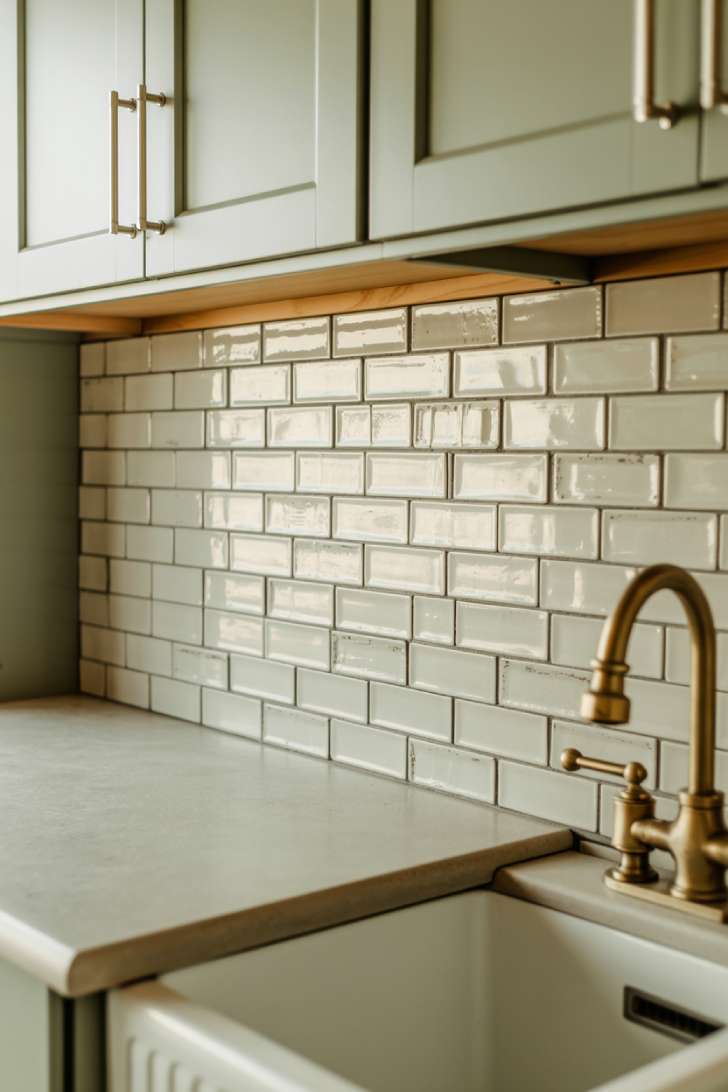
A backsplash is a small surface area that carries a disproportionate amount of visual weight.
It sits at eye level.
It’s the thing you look at while you’re sorting, pre-treating, and filling the machine.
Getting it right matters more than most people expect.
Classic white subway tile remains the most popular choice for laundry rooms, and it earned that position honestly.
It’s clean, it’s timeless, and it works with every color palette.
The current trend is moving toward vertical stacking rather than the traditional horizontal brick pattern.
Vertically stacked subway tile feels more modern and graphic while using the exact same material.
For something more decorative, hand-painted Talavera-style tiles, penny tile, or encaustic cement tile behind the sink area create a focal point that makes the whole room feel more considered.
Peel-and-stick backsplash panels — which have improved enormously in quality over the past few years — offer a genuinely viable budget option that can go up in an afternoon without any tile work.
Texture on a wall surface does something interesting to light. The slight variation in handmade tile surfaces catches and diffuses light in a way that perfectly flat painted walls don’t, creating a sense of depth and warmth. It’s a small detail that reads as quality without requiring an expensive material.
Style Blueprint:
- Vertical-stack subway tile or handmade-look ceramic tile in off-white or soft color
- Warm gray or white grout (avoid bright white grout, which shows dirt quickly)
- Tile extending from countertop to the bottom of upper cabinets
- Backsplash material that complements but doesn’t match the floor tile
- Peel-and-stick tile panels as a budget-friendly alternative
Design Pro-Tip: Keep your backsplash tile and floor tile in the same color family but different scales. A large-format floor tile with a small-format backsplash tile (or vice versa) creates visual interest without pattern clash — and it’s a trick professional designers use constantly in small spaces.
Drying Solutions That Don’t Eat Your Floor Space
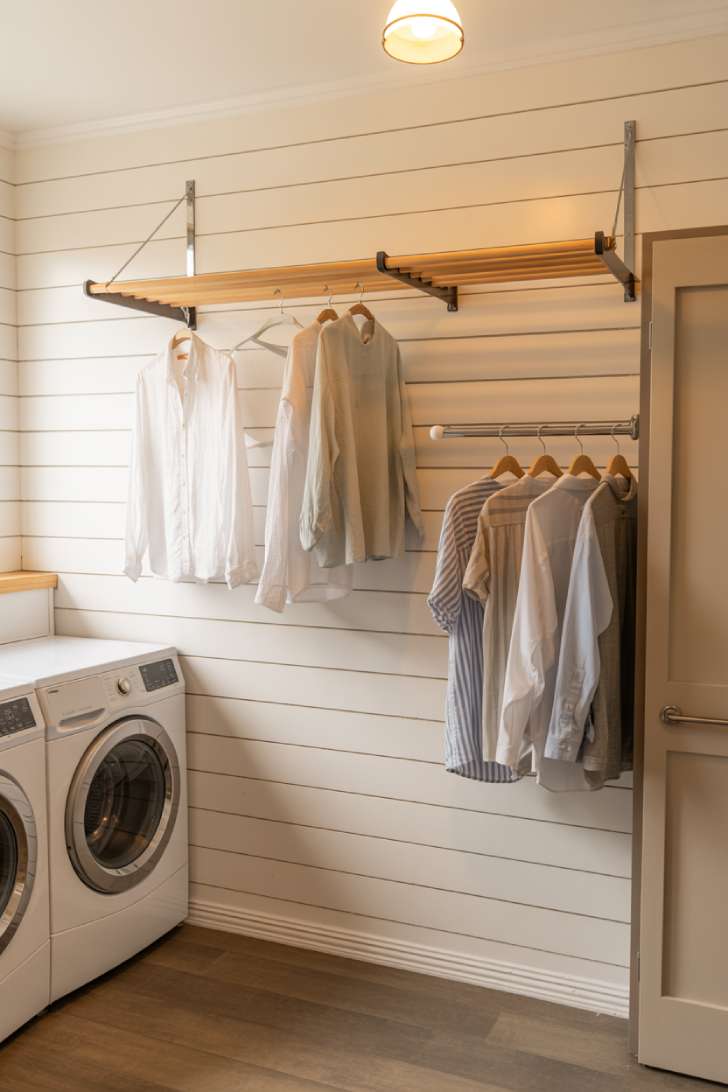
Air drying is non-negotiable for a lot of clothing.
Delicates, wool, structured pieces, anything prone to shrinking — the dryer is not an option.
Without a dedicated drying solution, these items end up draped over doorknobs, shower rods, and the backs of chairs all over the house.
A wall-mounted retractable drying rack solves this completely.
It extends when you need it — holding multiple garments across parallel dowels — and folds flat against the wall when you don’t.
It takes up zero floor space.
A ceiling-mounted pulley rack (similar to a traditional Victorian airer) works on the same principle and is particularly effective in rooms with higher ceilings.
For everyday pieces that need to hang fresh — shirts, blouses, work pants — a closet rod mounted between two cabinets or across the back wall is the simplest solution available.
It costs almost nothing, installs in twenty minutes, and immediately eliminates the pile that forms on top of the dryer.
Dedicated hanging space changes the behavior pattern in a laundry room. When there’s a clear, designated place for wet and fresh items, they actually end up there instead of migrating to the rest of the house. It’s less about aesthetics and more about removing the decision-making friction of “where does this go?”
Style Blueprint:
- Wall-mounted retractable wooden or stainless drying rack
- Closet rod mounted between cabinets or on brackets above the machines
- Wooden hangers in a consistent style and color for visual cohesion
- Shiplap or painted wood planks behind the hanging area for warmth
- Small S-hooks on a rod for hanging delicates individually
The Laundry-Mudroom Combo: Two Problems, One Room
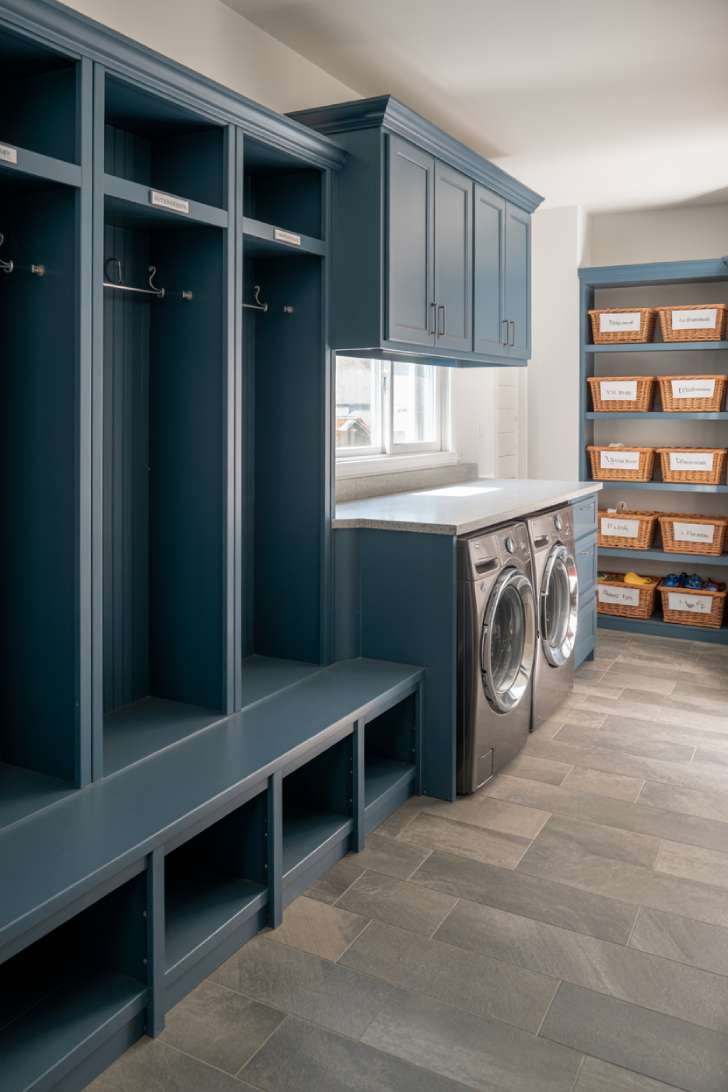
If your laundry room sits near a back door, side entry, or garage entrance, combining it with a mudroom is one of the smartest spatial decisions you can make.
The concept is simple: the entry zone catches dirt, coats, bags, and shoes before they reach the main living areas.
The laundry zone sits adjacent, creating a logical flow — dirty gear off, straight into the wash.
Built-in lockers or cubbies per family member are the centerpiece of the mudroom side.
Each person gets a hook for their coat, a cubby for their shoes, and a shelf for their bag.
When everyone knows exactly where their things go, the pile-at-the-door problem disappears.
A bench with storage underneath — either drawers or open cubbies for baskets — makes the space functional for sitting down to remove shoes while keeping the floor clear.
The laundry side needs the same elements as any laundry room makeover: cabinets, a countertop, good lighting, and a durable floor.
The flooring connecting both zones should be continuous — one material running throughout — for visual cohesion and easy cleaning.
Porcelain tile in a stone or concrete look handles both heavy foot traffic and the moisture of a laundry area without complaint.
In a combined space, the visual consistency of materials is what makes the difference between two rooms that happen to share a wall and one cohesive, well-designed zone. Carrying the same cabinet color, tile, and hardware finish across both functions makes the whole thing feel planned rather than patched together.
Style Blueprint:
- Built-in lockers or cubbies with individual hooks, shelves, and shoe storage per person
- Continuous bench with storage running the length of the mudroom wall
- Large-format porcelain tile in a stone or concrete look running throughout
- Matching cabinet color and hardware across both laundry and mudroom zones
- Utility sink in the laundry section for rinsing muddy gear or pet paws
The Finishing Touches That Tie It All Together
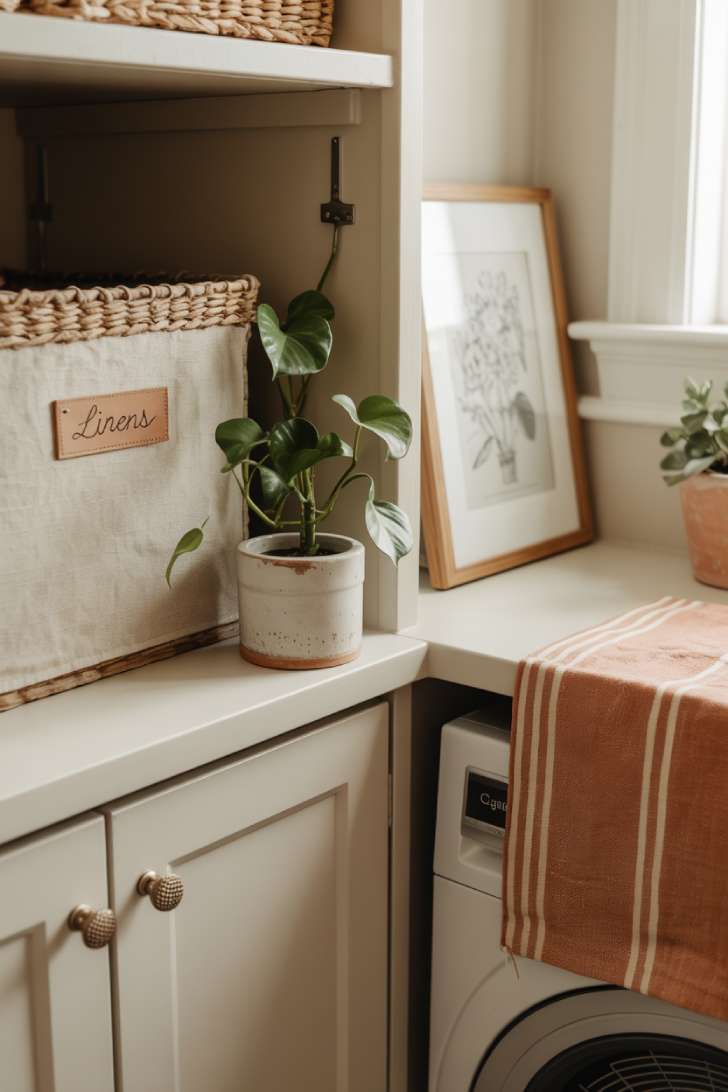
Here’s the truth about finishing touches: they’re what make a laundry room feel like it was designed rather than assembled.
Everything else — the cabinets, the countertop, the tile — provides the structure.
The details make it yours.
Hardware is the fastest finish upgrade available.
Swapping standard builder pulls for knurled brass, matte black, or unlacquered brass hardware takes less than an hour and costs between $30 and $80 for a full set.
The effect is immediate and significant.
A washable rug in front of the machines adds warmth, softens the hard surface underfoot, and introduces color or pattern at floor level.
Go for something machine-washable — practical in a room where spills happen regularly — and look for cotton flatweave or a low-pile option that won’t hold lint.
One piece of art — a single framed botanical print, a simple typographic sign, or even a vintage label — signals that the room was cared about.
It doesn’t need to be expensive.
A trailing plant on the shelf brings life into an otherwise utilitarian space.
Pothos, heartleaf philodendron, and ivy all thrive in low-to-medium light and handle the humidity of a laundry room without complaint.
And seasonally rotating a few small textile or decor accents — a different basket cover, a new hand towel, a small ceramic seasonal piece — keeps the space feeling fresh without any real effort or expense.
Small details work because of their cumulative effect. A single framed print doesn’t change a room. A plant doesn’t change a room. But a plant, a rug, consistent hardware, a piece of art, and a labeled basket together create a space that feels considered and personal. The brain reads the sum of those details as care — and that changes how a room feels to be in.
Style Blueprint:
- Knurled or architectural-style cabinet pulls in brushed brass or matte black
- Washable cotton flatweave rug in a stripe or natural tone
- One framed print or small piece of art at eye level
- A single trailing plant in a ceramic or terracotta pot
- Coordinated textile accents: matching laundry bags, a hand towel, a basket liner
Start Small, Build From There
A laundry room makeover doesn’t happen all at once — and it doesn’t need to.
The most successful ones start with a single, well-chosen change.
Maybe that’s a countertop over the machines.
Maybe it’s a bold coat of paint and new hardware.
Maybe it’s as simple as pulling everything out, decanting the supplies into matching containers, and adding a good light fixture.
Pick the change that solves your biggest daily frustration and start there.
Layer in the rest over time.
What you’ll find is that each improvement makes the next one feel more worthwhile — and the room that used to feel like a chore starts to feel like a small, functional, genuinely pleasant part of your home.
Save this post for when you’re ready to start planning, and pin the ideas that speak most to your space and style.