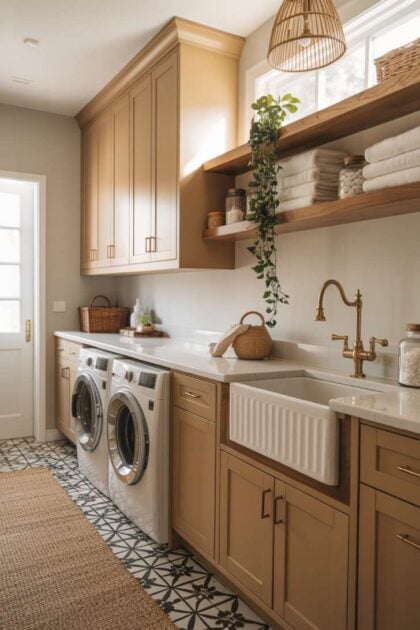
The laundry room deserves so much more than a coat of builder-grade paint and a bare bulb overhead.
It’s one of the most visited rooms in the home, yet it’s almost always the last to get any real attention.
The good news? You don’t need a full renovation to make it beautiful.
Whether you’re working with a tiny closet or a dedicated laundry room, these 13 laundry room decor ideas will give you all the inspiration you need to turn a forgettable space into one you’ll actually enjoy being in.
Pattern with Purpose: Make Your Walls the Star
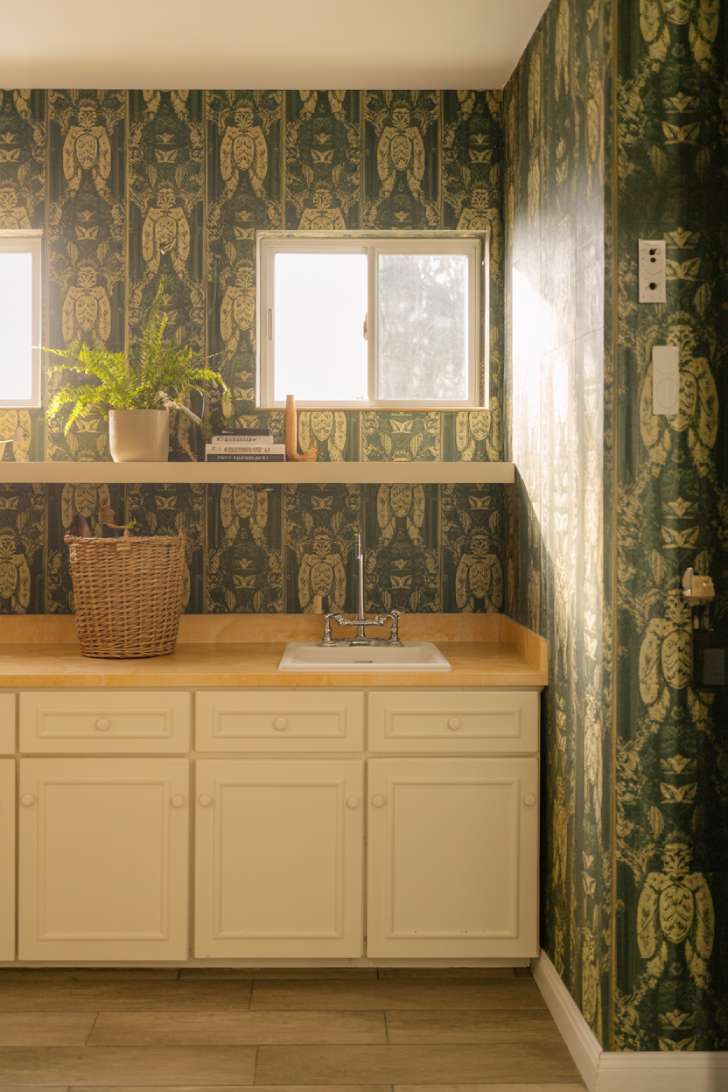
There’s a reason wallpaper has made such a strong comeback in laundry room design — it works.
Small rooms are actually the best places to go bold with pattern, and the laundry room is no exception.
Because the space is compact, even a single wallpapered wall can completely shift the energy of the room without feeling overwhelming.
Botanical prints, vintage florals, classic ticking stripes, and large-scale geometric patterns all perform beautifully here.
The trick is pairing the wallpaper with calm, solid-colored cabinetry and trim so the pattern gets to breathe.
A soft cream or warm white on the cabinets lets the wallpaper do the talking without creating visual chaos.
Pattern on the walls creates what designers call “perceived depth.”
Your brain reads the layering of image and color as a sign that a room has more going on than its square footage suggests, which makes even the smallest laundry room feel considered and curated rather than cramped.
Style Blueprint:
- Botanical or vintage-patterned wallpaper in a color that complements your cabinetry
- White or cream shaker-style lower cabinets
- Marble-look or warm quartz countertop
- Woven or rattan storage basket for the countertop
- One small live plant (fern, pothos, or trailing ivy)
Color Sets the Whole Tone
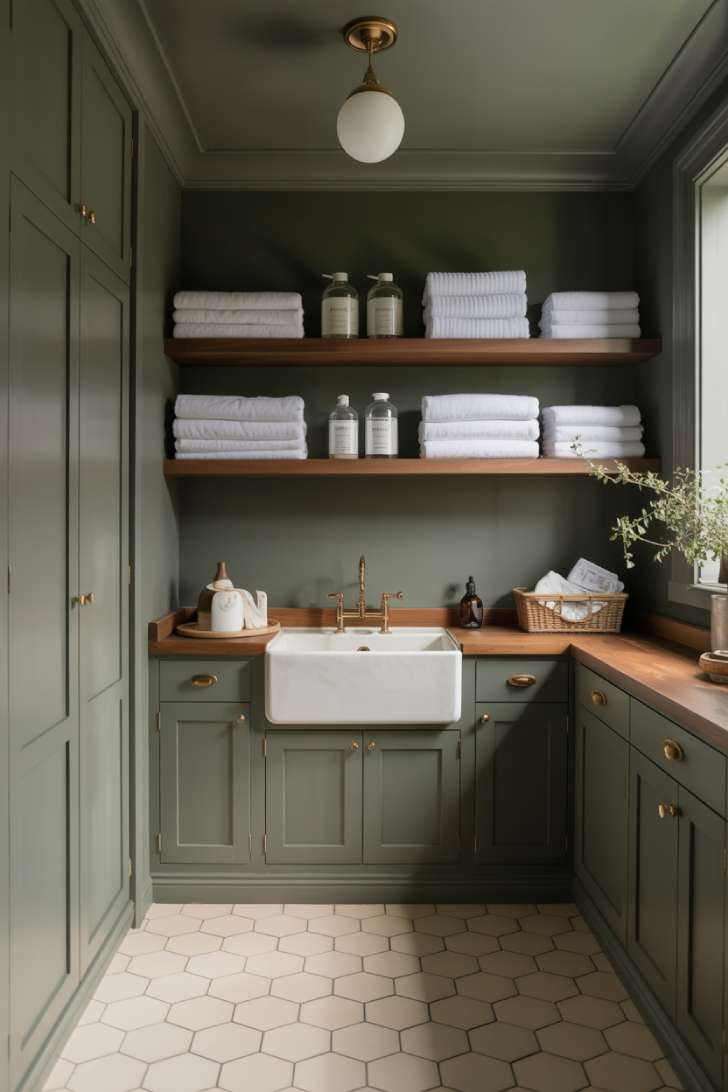
Nothing changes a room faster or more affordably than color.
And the laundry room is one of those rare spaces where you genuinely have permission to be adventurous.
The current shift in laundry room color ideas is moving away from stark, clinical whites toward warmer, earthier shades — think putty, mushroom, sage green, and warm flax.
These tones feel grounded and cozy rather than sterile.
If you’re drawn to something moodier, deep navy, forest green, and even charcoal can create a surprisingly beautiful laundry room — especially when layered with warm wood accents and brass hardware.
One of the most satisfying approaches right now is color drenching: painting the walls, trim, cabinets, and ceiling in the same shade for a rich, immersive effect that feels luxurious rather than flat.
Color drenching works so well in small rooms partly because it eliminates the visual interruption of color changes between surfaces.
The eye doesn’t know where to stop, so the room reads as larger and more intentional.
Warm-toned greens are also psychologically calming — they’re connected to nature, which makes a chore feel a little more like a ritual.
Style Blueprint:
- One bold paint color applied to walls, trim, and cabinets (color drenching)
- Warm brass or antique gold cabinet hardware
- White farmhouse or utility sink for contrast
- Glass or ceramic jars for detergent display
- Cream or warm neutral tile floor to balance the dark walls
Cabinetry That Works as Hard as It Looks
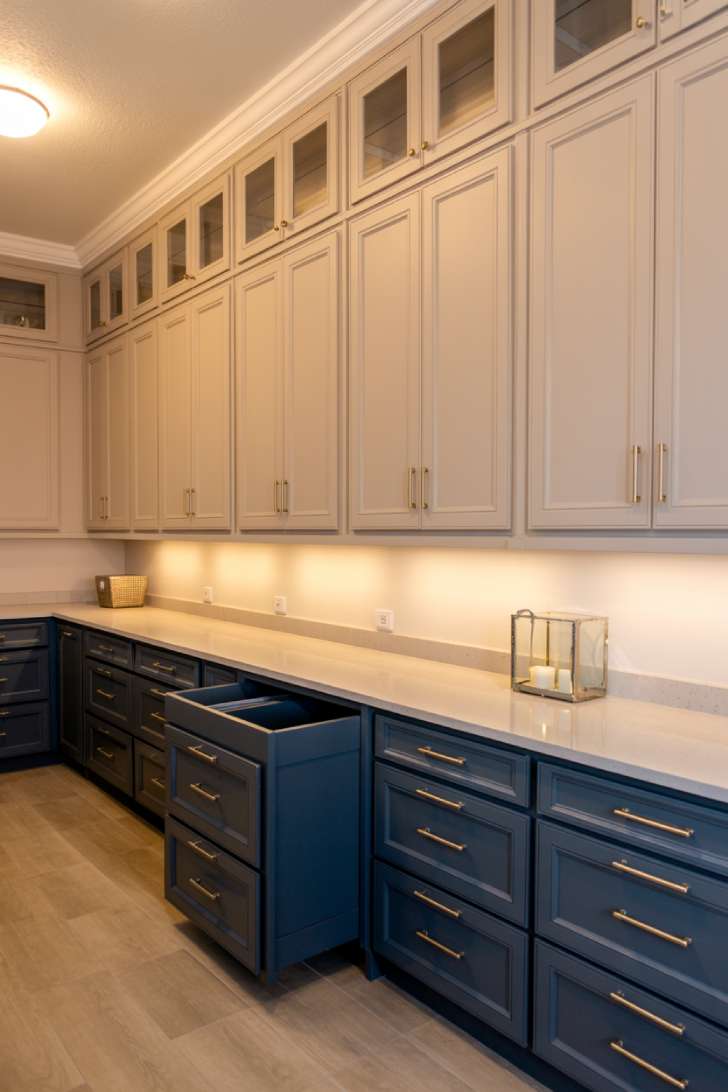
Good cabinetry is where laundry room design gets serious.
It’s the element that ties everything else together — storage, style, and structure all in one.
The most popular direction right now leans toward floor-to-ceiling cabinetry that maximizes every inch of vertical space.
Two-toned designs are particularly striking: white or cream uppers paired with a deeper shade below — navy, olive, charcoal — create depth and visual interest without the room feeling heavy.
Glass-front upper cabinets are a great addition if you want the room to feel more open, and they give you a chance to display neatly folded linens or matching storage containers in a way that’s genuinely decorative.
Flat-panel doors suit a more modern laundry room, while shaker-style doors are the go-to for transitional and farmhouse spaces.
Don’t overlook the hardware. Matte black, brushed brass, and unlacquered bronze are all having a real moment in laundry room cabinets right now.
The reason two-toned cabinetry feels so satisfying in laundry rooms is that it creates a visual anchor at the base of the room.
Darker lower cabinets ground the space while lighter uppers keep the ceiling feeling high and open.
It’s the same principle used in high-end kitchen design, and it translates beautifully here.
Style Blueprint:
- Floor-to-ceiling cabinetry in two contrasting tones (light uppers, dark lowers)
- Glass-front upper cabinet doors for display
- Brushed brass or matte black hardware
- Built-in hamper drawer for hidden laundry storage
- Wide quartz or stone-look countertop
A Tile Floor That Steals the Show
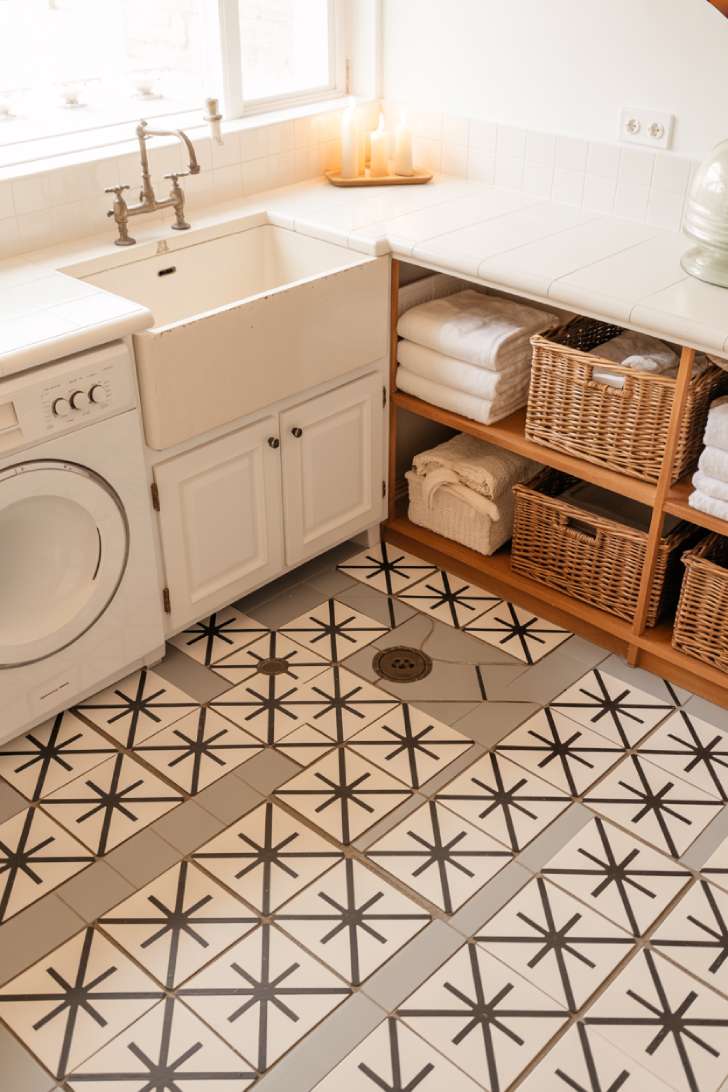
The floor is a design opportunity that’s far too often wasted in laundry rooms.
A beautiful tile floor can anchor the entire room’s aesthetic, and in a small space, it becomes an unexpected focal point that draws the eye downward in the best possible way.
Encaustic cement tiles with geometric patterns are among the most popular choices right now — and for good reason.
They’re durable, water-resistant, and come in an almost endless range of colors and motifs.
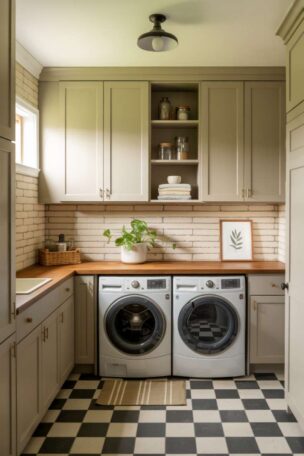
Checkerboard floors in classic black and white, unexpected color combos like sage and cream, or oxblood and warm beige are all having a strong moment in current laundry room flooring design.
Hexagon tiles, herringbone patterns, and penny rounds are also consistently popular because they add movement and texture underfoot without requiring elaborate installation.
One detail that’s often overlooked: grout color. A contrasting grout dramatically changes the personality of a tile — it defines each piece and adds graphic punch, while a matching grout creates a softer, more seamless effect.
Patterned floors create what’s sometimes called “grounding energy” in a space — your eye is drawn down and then naturally scans upward, which means a great floor actually makes the whole room feel more layered and complete.
In a small laundry room, a statement floor is often more impactful than statement walls, because it doesn’t compete with cabinetry or appliances.
Style Blueprint:
- Encaustic cement, porcelain, or ceramic tile in a geometric or checkered pattern
- Contrasting grout color to define the pattern
- White or neutral walls and cabinetry to let the floor shine
- Vintage-style or unlacquered brass faucet
- Open wooden shelving for texture contrast
Design Pro-Tip: In a small laundry room, resist the urge to use small mosaic tiles wall-to-wall — they can make the space feel busier than intended. Instead, use one large-scale pattern on the floor and keep walls and cabinets calm. Let one surface carry the drama.
A Backsplash That Earns Its Place
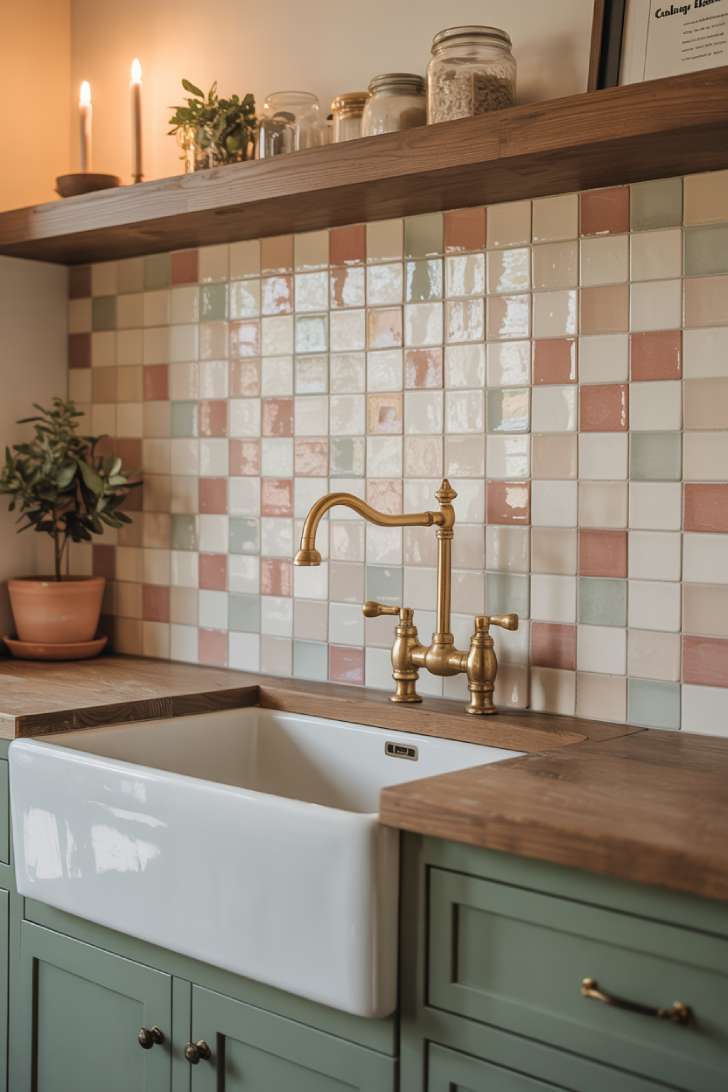
A backsplash in a laundry room isn’t just decorative — it’s doing real work.
It protects the wall behind the sink from splashes, detergent drips, and general moisture, which means it needs to be as practical as it is pretty.
Subway tile is still one of the most-used options, and it’s easy to see why: it’s clean, timeless, and incredibly versatile.
But the way subway tile is being installed has evolved.
Vertical stacking gives a classic material a fresh, contemporary feel that’s distinctly different from the old horizontal brick pattern.
For something with more personality, zellige tile — handmade Moroccan glazed terracotta — adds a beautiful organic texture and subtle color variation that no two tiles replicate exactly.
Mosaic tile insets, natural stone, and artisan ceramic are also worth considering if you want the backsplash to serve as a genuine design statement behind the sink.
Zellige and handmade tiles introduce what designers call “organized imperfection” — each tile is slightly different in color, glaze, and surface, and that variation catches light in a way that flat, uniform tiles simply can’t.
The result is a wall that looks alive and warm rather than flat and manufactured.
It’s particularly effective in laundry rooms, where the rest of the design is often intentionally simple.
Style Blueprint:
- Zellige, handmade ceramic, or vertically stacked subway tile for the backsplash
- Antique brass or unlacquered bronze faucet
- Deep apron-front or farmhouse sink
- Sage, navy, or warm neutral lower cabinetry
- One floating wooden shelf above the backsplash for display
Open Shelving Done Right
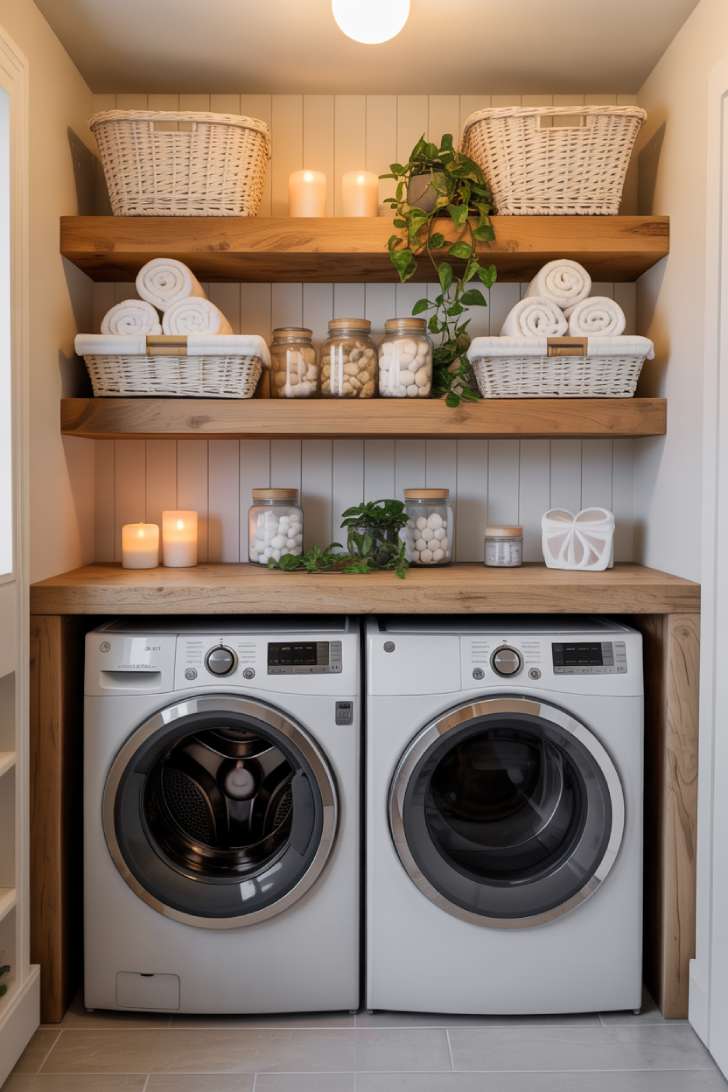
Open shelving in a laundry room is one of those ideas that looks effortless in photos and requires just a little intention to pull off in real life.
The key is editing. Not everything belongs on an open shelf.
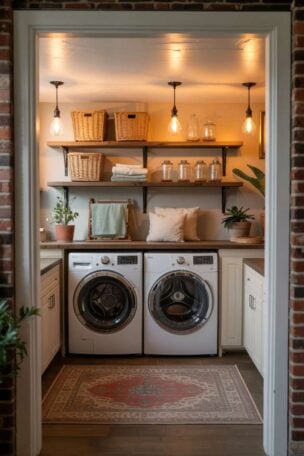
The most beautiful open shelving setups in laundry rooms use a mix of functional and decorative items: matching baskets or bins for laundry supplies, neatly folded white towels, a small plant, and a glass jar or two for things like dryer balls or clothespins.
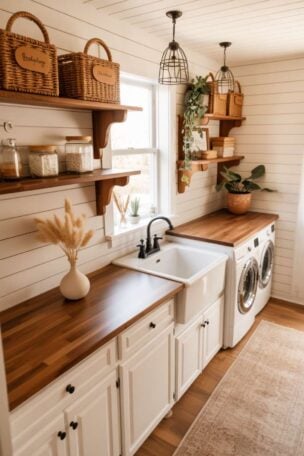
Warm-toned wooden shelves — oak, walnut, or even pine — contrast beautifully against white or colored walls, and add a natural texture that softens the harder surfaces of appliances and tile.
Placement matters too. Shelves above the washer and dryer are the most practical location, but shelves flanking a window or running along an entire wall can feel genuinely architectural.
Laundry room shelving doesn’t have to be purely utilitarian — it can be one of the most styled surfaces in the room.
Open shelves work psychologically because they make a room feel more personal and lived-in than a wall of closed cabinets.
When the items on the shelves are consistently styled — same tones, similar materials — the eye reads the display as intentional art rather than clutter.
The contrast between the organic warmth of wood and the harder surfaces of appliances also creates a softening effect that makes the room feel less industrial.
Style Blueprint:
- Warm-toned wooden floating shelves (oak, walnut, or pine)
- Matching baskets or bins in a neutral tone
- Glass jars for detergent, dryer balls, or clothespins
- Neatly folded white or linen-toned towels
- One trailing or compact live plant
The Countertop That Changes Everything
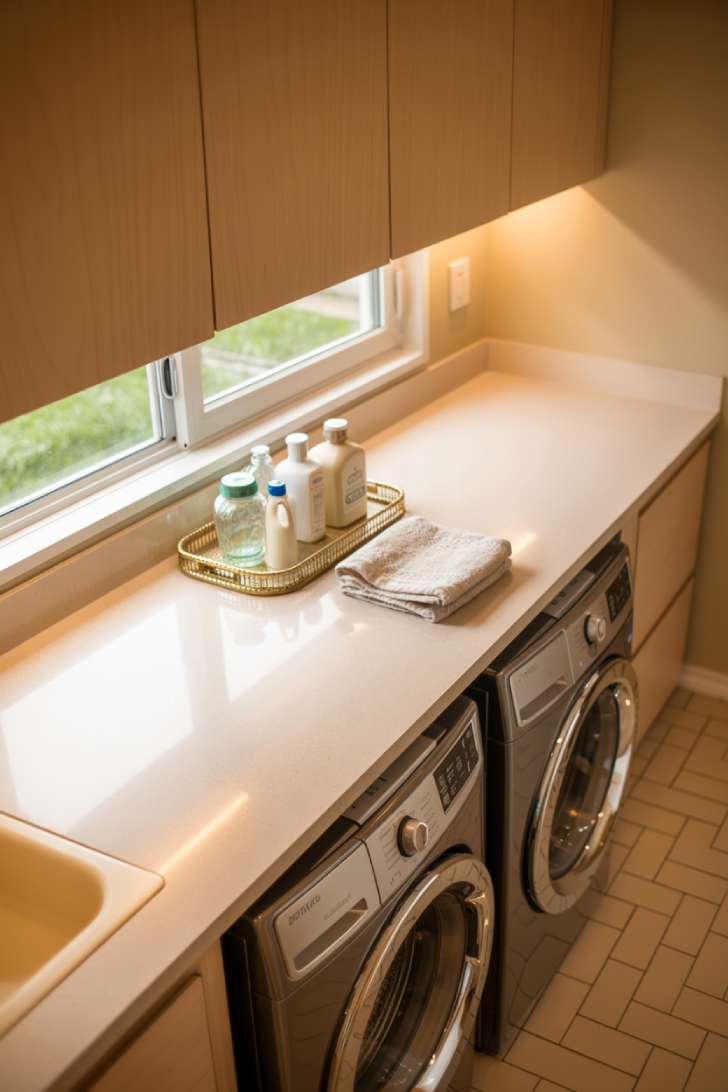
If there’s one upgrade that transforms the day-to-day experience of doing laundry, it’s a proper countertop.
Having a flat surface to fold clothes, treat stains, or sort items straight from the dryer makes the whole process feel less like a chore.
From a design standpoint, a countertop running above the washer and dryer creates a built-in, custom look that elevates the room’s entire aesthetic.
Quartz is the most popular material right now — it’s durable, moisture-resistant, and comes in everything from clean white to dramatic veined stone looks.
Butcher block adds warmth and an organic, kitchen-like quality that works especially well in farmhouse or transitional laundry rooms.
The countertop surface itself is also a natural spot for a small styled tray, a plant, or a ceramic dish — turning a functional surface into a visual moment.
A countertop unifies the appliances beneath it, making them look less like freestanding machines and more like an integrated part of the room.
The horizontal line it creates is also visually calming — it’s the same reason kitchen countertops feel so anchoring.
In a small laundry room, that clean horizontal line can make the whole space feel more organized even before a single item is put away.
Style Blueprint:
- Quartz or butcher block countertop spanning the full width of the appliances
- Small decorative tray for styling essentials
- Glass jars or ceramic containers for decanted laundry products
- Linen or cotton hand towel for a soft textural touch
- Window or pendant light above for natural or decorative light
Design Pro-Tip: When choosing a countertop material for a laundry room, treat it like a kitchen countertop — not a bathroom one. You want something that can handle moisture, weight, and regular use. Quartz beats marble every time for real-life laundry room conditions.
The Farmhouse Sink: A Hardworking Classic
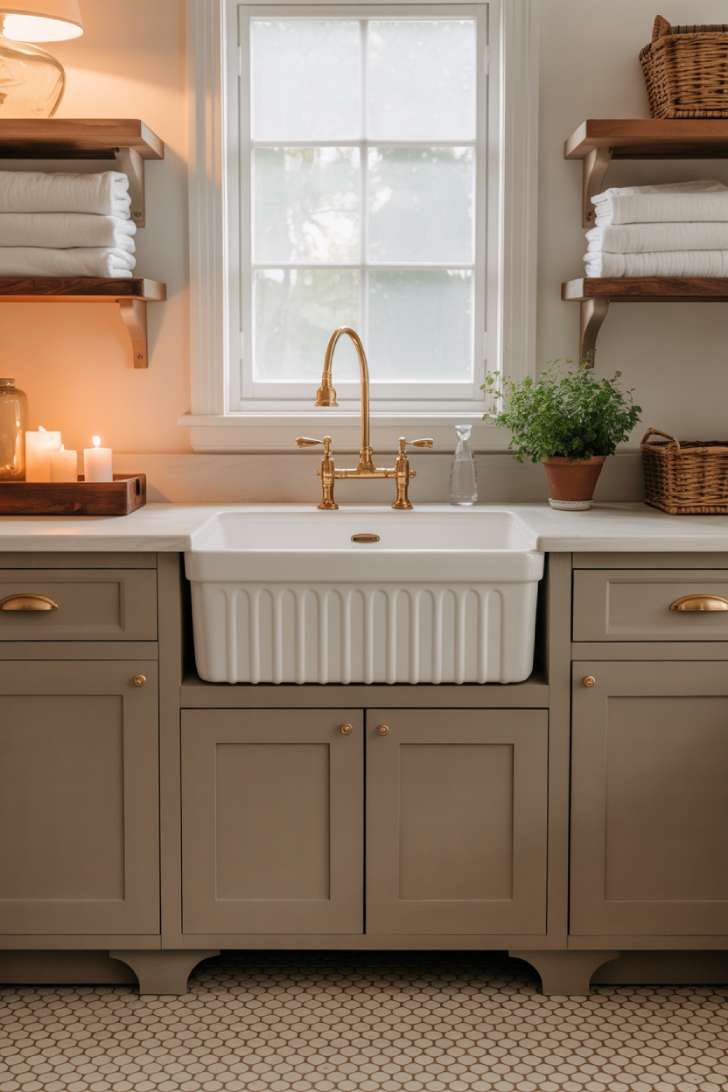
A farmhouse sink in the laundry room isn’t just a style statement — it’s genuinely one of the most useful things you can add to the space.
Deep enough to soak bulky items, wide enough to hand-wash delicates, and durable enough to handle everything from muddy sports gear to rinsing out mop heads, it earns its place every single day.
From a laundry room design standpoint, the apron-front sink also adds an architectural quality that pulls the whole room together.
White fireclay is the most classic choice — it has a matte, slightly textured surface that’s warm rather than clinical.
Stainless steel works beautifully in more industrial or modern laundry rooms, and cast iron in a deep color can feel almost furniture-like in a more traditional space.
Pair it with a vintage-style or unlacquered brass faucet and you have a combination that feels both timeless and current.
The farmhouse sink does something architecturally interesting in a laundry room: it acts as a visual anchor, the same way an island anchors a kitchen.
The eye is immediately drawn to it, which means it sets the tone for everything else in the room.
When it’s beautiful, the whole room reads as more considered and designed — even if everything else is relatively simple.
Style Blueprint:
- White fireclay or ceramic apron-front farmhouse sink
- Vintage-style or unlacquered brass gooseneck faucet
- Warm-toned cabinet base (gray, navy, sage, or warm white)
- Penny round, hex, or encaustic tile floor
- Open shelving directly above the sink for both function and display
Lighting That Makes You Want to Stay
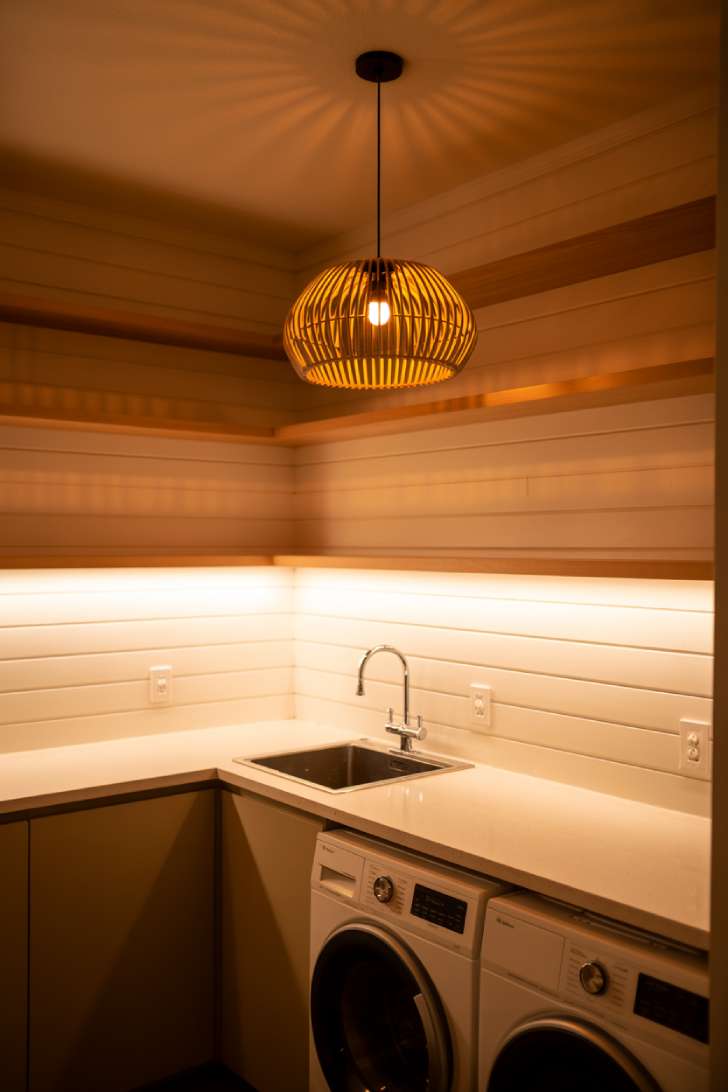
Most laundry rooms are terribly lit, and it affects the experience of being in them far more than people realize.
A single overhead fluorescent fixture does nobody any favors.
Layered lighting — the approach used in well-designed kitchens and bathrooms — changes the entire atmosphere of a laundry room.
Start with good ambient light: a warm-toned flush mount or semi-flush ceiling fixture that fills the room evenly.
Add under-cabinet LED strip lighting, which serves the very practical purpose of helping you spot stains on clothing and read product labels, but also creates a soft, warm glow along the countertop that feels genuinely luxurious.
If there’s a sink, a pair of wall sconces flanking it — or a pendant light above — adds both character and task lighting in the same moment.
Choosing a fixture that reflects the room’s overall style (a rattan pendant for a coastal or farmhouse feel, a sculptural brass flush mount for something more refined) is the difference between lighting that just works and lighting that contributes to the design.
Light temperature has a direct effect on how a room feels.
Warm white light (2700K–3000K) makes a room feel cozy and residential, while cool white or daylight bulbs (above 4000K) feel clinical and cold.
In a laundry room where you want to feel calm and comfortable, warm light is always the right answer.
It also makes white linens and light-colored surfaces look softer and more inviting.
Style Blueprint:
- Warm-toned flush mount or semi-flush ceiling fixture
- Under-cabinet LED strip lighting (warm white, 2700K–3000K)
- Pendant or sconce lighting above or beside the sink
- Fixture style that matches the room’s overall aesthetic (rattan, brass, ceramic, etc.)
- Warm white bulbs throughout for a cozy, residential feel
Small Details, Big Impact: The Power of Accessories
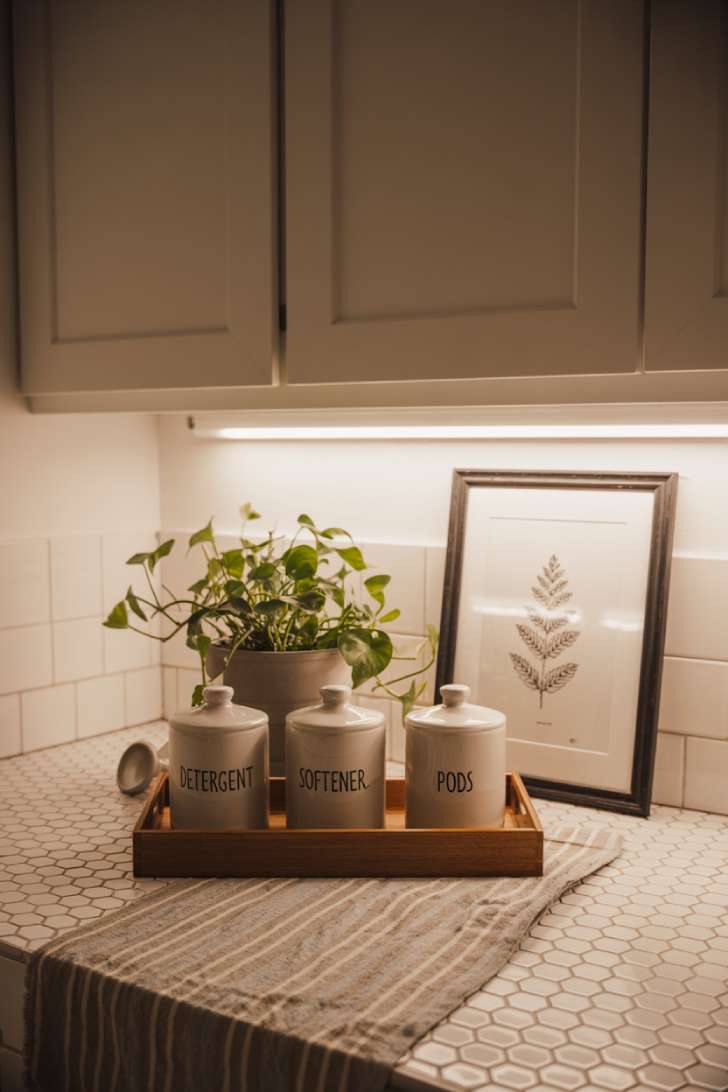
Accessories are what make a laundry room feel finished.
They’re the difference between a space that’s been decorated and one that’s just been organized.
And in a room where the main features are appliances, a few well-chosen decorative touches go a long way.
Decanting laundry products into glass or ceramic containers is one of the most popular styling moves right now — and it’s genuinely worth doing.
The visual calm of matching containers on a shelf or countertop is immediately noticeable, and it makes the products feel like part of the decor rather than something to hide.
A runner rug in a narrow laundry room adds warmth, softens the floor visually, and absorbs sound — all practical benefits that also happen to look great.
Wall art, even a single framed print, gives the room a “finished” quality that’s hard to achieve any other way.
Small live plants — a trailing pothos, a compact fern, or even a small herb pot on the windowsill — add life and color in a way that no accessory can replicate.
Accessories work because they signal intention.
When a room has been styled with care — even with small, inexpensive items — it communicates that the space is valued.
That psychological shift actually changes how you feel about spending time in it.
A laundry room with a beautiful rug and a plant on the shelf feels like a room in the home, not a utility closet that happens to be indoors.
Style Blueprint:
- Matching ceramic or glass jars for decanted laundry products
- Small tray to corral accessories on the countertop
- Woven cotton or jute runner rug
- One framed print or small piece of wall art
- A trailing or compact live plant
Design Pro-Tip: Keep your laundry room accessories to a “rule of three” on any given surface — one functional item, one natural element (plant or basket), and one purely decorative piece. More than three items on a small surface starts to read as clutter, not decor.
Small Space, Smart Design
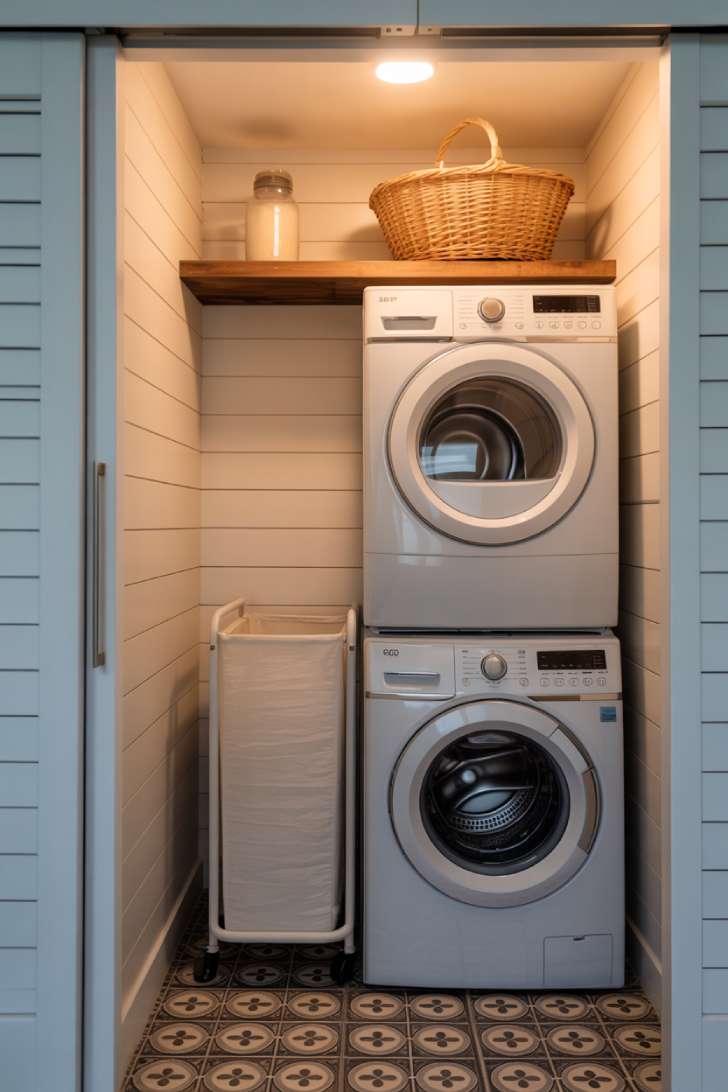
Not everyone has a dedicated laundry room, and that’s completely okay.
Some of the most beautifully designed laundry spaces are the smallest ones — because constraint forces creativity.
Stacking the washer and dryer is the most impactful single move in a small laundry room.
It frees up floor space that can then be used for a slim cabinet, open shelving, or even a small folding station.
Pocket doors or sliding barn doors replace swinging doors that eat into precious square footage.
Slim rolling carts — narrow enough to slide between the washer and dryer — are a surprisingly effective way to add storage in the few inches of dead space most people ignore.
Vertical space is everything in a small laundry room.
Tall, narrow shelving units that reach toward the ceiling, wall-mounted pegboards for hanging tools and bags, and hooks on the inside of cabinet doors all add storage without taking up any floor space.
Light colors, reflective surfaces, and good lighting all make a small laundry room feel larger than it actually is.
In small spaces, the vertical axis is the most underused design resource available.
Most people stop adding storage at eye level, leaving everything above it empty.
Tall storage draws the eye upward, which creates the perception of height — and height always makes a small room feel larger.
It’s the same reason ceiling-height bookshelves make a small living room feel grand.
Style Blueprint:
- Stacked washer and dryer to free up floor space
- Slim rolling cart for between-appliance storage
- Tall or ceiling-height shelving or cabinetry
- Sliding or pocket door to replace a swinging door
- Light paint colors and warm lighting to open up the space
The Laundry-Mudroom Combo: Two Rooms, One Beautiful Space
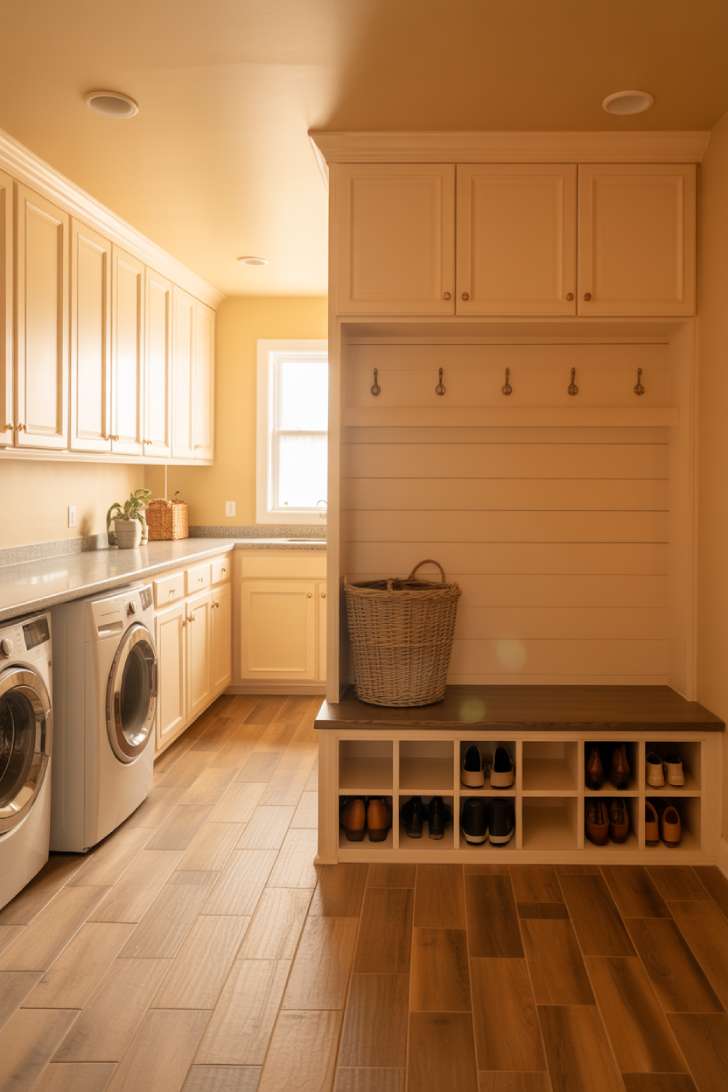
Combining the laundry room and mudroom is one of the smartest design decisions a homeowner can make.
These two rooms share a common purpose — managing the mess that comes in and out of a home — and they work better together than they do apart.
The most successful laundry-mudroom combos are designed around distinct zones within a single cohesive space.
The laundry zone anchors one side: washer, dryer, countertop, and storage.
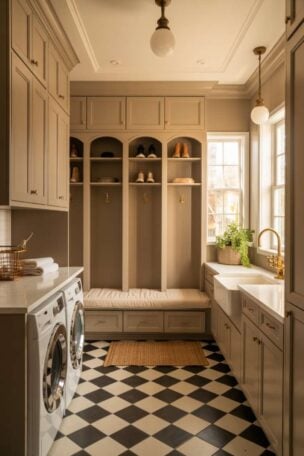
The mudroom zone anchors the other: a built-in bench with storage below, coat hooks or a row of pegs above, and cubbies for bags, shoes, and gear.
The flooring is particularly important in a combined space — it needs to handle heavy foot traffic, moisture, mud, and laundry day spills.
Large-format porcelain tile or patterned encaustic tile both perform well and look intentional in a dual-purpose room.
Keeping the cabinetry consistent across both zones — same color, same hardware, same door style — is what makes the combined room feel designed rather than improvised.
The laundry-mudroom combo works so well functionally because it creates a natural “processing zone” at the entry of the home — dirty clothes can go straight from the mudroom bench into the washer without traveling through the whole house.
From a design standpoint, the combination justifies a larger investment in the space’s finish quality, which is why these rooms often end up being some of the most beautifully executed in the home.
Style Blueprint:
- Consistent cabinetry color and hardware throughout both zones
- Built-in bench with shoe storage or cubbies below
- Row of coat hooks or a pegboard above the bench
- Large-format or patterned porcelain tile floor
- Quartz countertop spanning the laundry zone
Design Continuity: Let Your Laundry Room Belong to Your Home
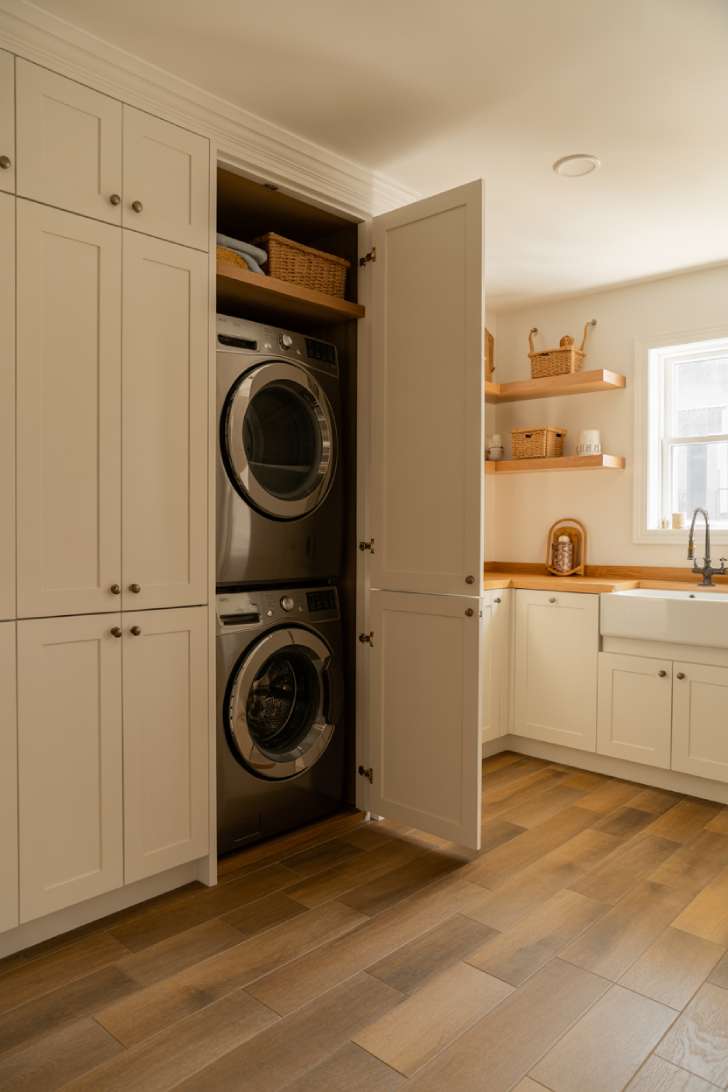
The most elegant laundry rooms don’t look like they were designed separately from the rest of the house.
They feel like a natural extension of the home’s overall aesthetic — connected to the kitchen, the hallway, or whatever space sits adjacent to them.
This doesn’t mean everything has to match exactly. It means there should be a visual conversation happening between rooms.
If the kitchen has warm white shaker cabinets and brushed brass hardware, carrying those same elements into the laundry room creates a cohesive thread that makes the whole home feel more considered.
Flooring continuity is one of the most powerful tools here.
Running the same tile or wood-look flooring from an adjacent kitchen or hallway into the laundry room makes the space feel larger and more integrated.
The “invisible laundry” concept — hiding appliances behind cabinetry doors that match the surrounding room — is a beautiful approach for laundry rooms that open directly onto a main living space or kitchen.
When the laundry room looks like it belongs, the whole home benefits.
Design continuity works on a deeply instinctive level.
When materials, colors, and finishes repeat across spaces, the home feels calmer and more harmonious — even if you can’t immediately identify why. It’s the absence of visual interruption that creates that feeling.
A laundry room that matches its surroundings doesn’t just look better; the whole home feels more put-together as a result.
Style Blueprint:
- Cabinetry color and style matched to the adjacent room
- Same hardware finish used throughout connected spaces
- Continuous flooring from the adjacent room into the laundry room
- Appliances concealed behind matching cabinet door panels
- Farmhouse sink and consistent fixture finishes to tie the spaces together
Design Pro-Tip: Before choosing your laundry room cabinet color, hold a paint chip against your kitchen cabinets in natural light. You don’t need to match exactly — but staying within the same undertone family (warm vs. cool) is what creates harmony between connected rooms.
Your Beautiful Laundry Room Is Closer Than You Think
Transforming a laundry room doesn’t require a massive budget or a full gut renovation.
Sometimes it’s a bold wallpaper choice, a new set of floating shelves, or simply decanting your detergent into matching glass jars.
Other times it’s a bigger commitment — new tile, custom cabinetry, or a farmhouse sink that changes the room entirely.
Either way, the ideas in this list are proof that the laundry room has as much design potential as any other space in your home.
Pick one idea that excites you most and start there.
Save it, plan it, and give this hardworking room the attention it’s always deserved.