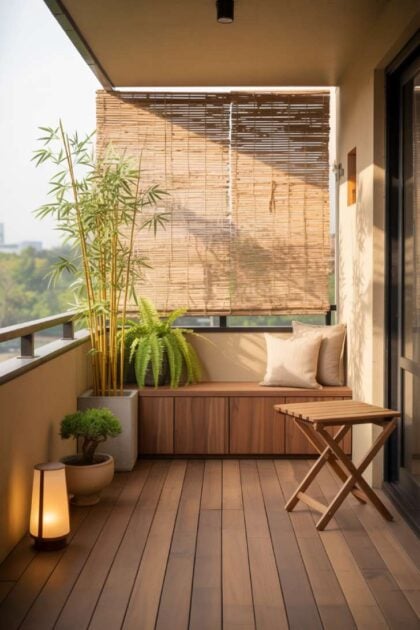
A balcony is rarely just a balcony. At its best, it’s the place where you exhale.
Where the morning coffee tastes better, where the evening light hits differently, and where the noise of the day finally starts to fade.
The problem is that most balconies never reach that potential.
They become storage areas, laundry spots, or just ignored square footage — a missed opportunity sitting right outside the door.
That’s where japandi balcony design changes everything.
Japandi is the meeting point of two design philosophies that were made for each other: Japan’s wabi-sabi, which finds beauty in imperfection, natural aging, and quiet simplicity, and Scandinavia’s hygge, which is about physical warmth, comfort, and the pleasure of a well-made space.
Together, they produce something that feels genuinely different from any other design style — minimal without being cold, warm without being cluttered, and always, always connected to nature.
A japandi outdoor space works so well on a balcony because the style is already built around the idea of mindful living and a close relationship with the natural world.
You don’t need a large space.
You don’t need a big budget.
You need intention — and these 11 ideas will show you exactly what that looks like.
What Makes a Balcony Truly Japandi?
Before getting into the ideas, it helps to have a clear picture of what separates a japandi balcony from a regular minimalist outdoor space.
It comes down to five things, and every great japandi design has all of them.
- Natural materials — wood, bamboo, stone, rattan, terracotta. If it didn’t come from the earth, think carefully before including it.
- A muted, earthy neutral color palette — warm whites, sandy beiges, soft taupes, greiges, charcoal, and muted sage green. Nothing bright, nothing synthetic-looking.
- Low-profile, functional furniture — pieces that sit close to the ground, serve a clear purpose, and don’t compete for attention.
- Deliberate greenery — not a collection of random plants, but a carefully chosen group that adds texture, life, and a sense of calm.
- Breathing space — empty space is not wasted space. In japanese scandinavian decor, negative space is a design decision, not an oversight.
Keep these five principles in mind as you work through the ideas below, and the whole thing starts to feel less like decorating and more like editing.
Lay the Foundation with Natural Wood Decking
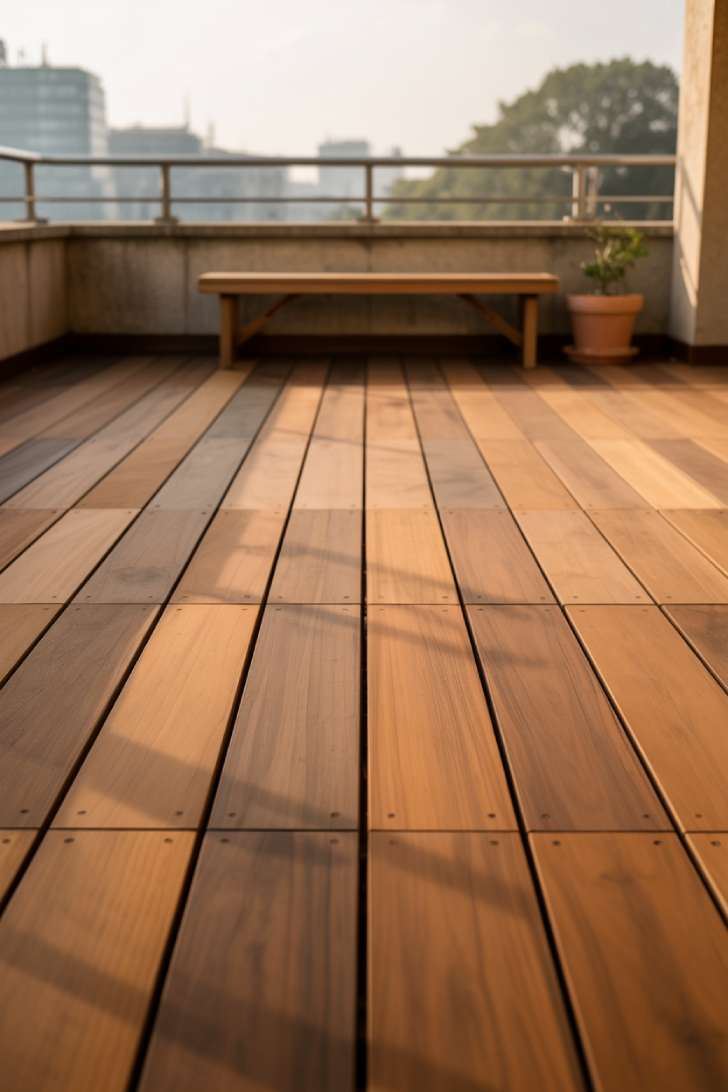
The floor is the first decision — and the most important one.
Everything else on a japandi balcony sits on top of it, both literally and visually.
Get the floor right, and the whole space clicks into place.
Get it wrong, and no amount of beautiful furniture or careful plant arrangement will save it.
Warm wood underfoot does something specific to how a space feels.
It signals comfort before you’ve even sat down.
The brain reads natural wood grain as safe, organic, and familiar — which is exactly the mood a japandi outdoor space is designed to create.
Teak is the top choice here.
It’s dense, naturally water-resistant, and develops a beautiful silver-gray patina as it weathers — which, in wabi-sabi terms, means it gets more beautiful with age, not less.
Cedar and ipe are strong alternatives that behave similarly.
One underrated trick is to match the balcony decking material as closely as possible to the interior flooring.
When the floor flows from inside to outside without a visual break, the balcony stops feeling like a separate utility area and starts feeling like a genuine extension of the home.
Make sure drainage slopes are correct before installation, and apply a quality oil treatment once a year to keep the wood healthy.
Style Blueprint:
- Wide-plank teak, cedar, or ipe decking boards
- Natural oil finish (not varnish — it cracks outdoors)
- Consistent board direction running toward the view
- Minimal visible fixings for a clean surface
- Matching or complementary interior flooring tone
Set the Tone with the Right Color Palette
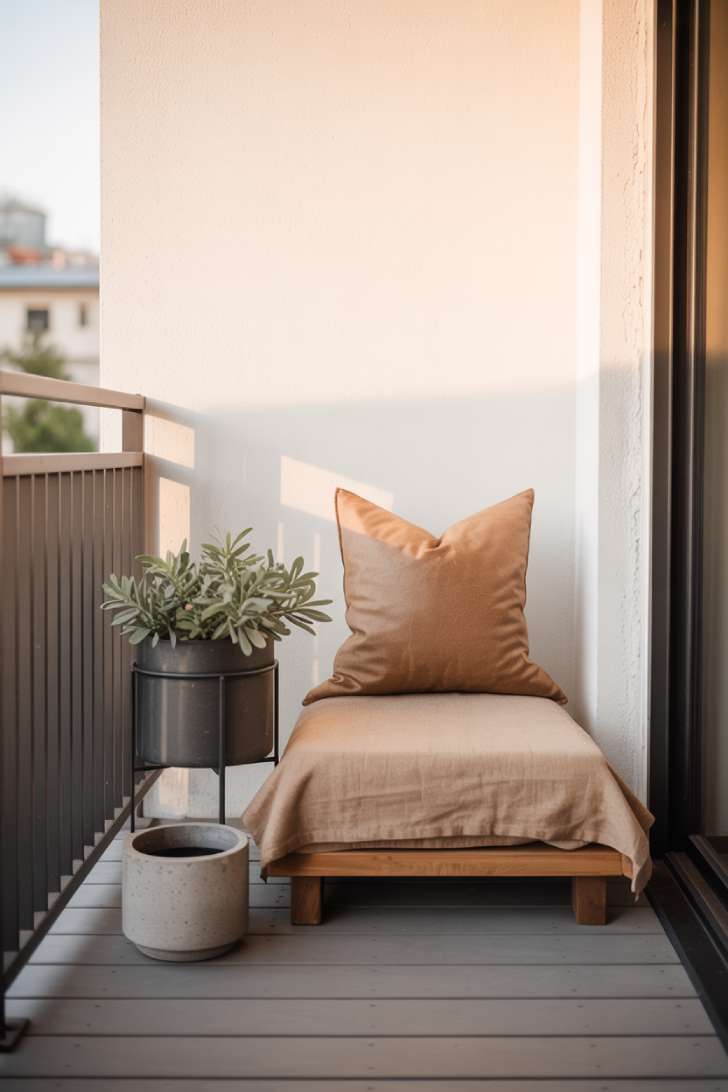
Color on a balcony behaves differently than it does indoors.
Outdoor light is stronger, more variable, and far less forgiving of colors that are slightly off.
This is one of the reasons the neutral outdoor color palette at the heart of japandi design works so well outside — muted tones don’t fight the light.
The base palette here is warm whites, sandy beiges, greiges, and soft taupes.
These are the colors of natural linen, unfinished stone, dry sand, and weathered wood — all materials that belong outdoors already.
Charcoal and matte black play an important supporting role.
A slim black railing, a dark-toned planter, or a matte black wall-mounted light fixture grounds the lighter tones and stops the palette from feeling washed out.
The rule of thumb is to keep dark accents to around 10–15% of the visible surfaces.
Any more and the space starts feeling heavy.
Sage green arrives almost automatically through plants — but it can also appear in a single cushion or a ceramic pot glaze.
Avoid terracotta as a primary tone outdoors; it reads as too warm in strong sun.
Use it sparingly as an accent in a single planter.
Style Blueprint:
- Warm white or soft greige for walls and large surfaces
- Sand or taupe linen cushions as the primary textile
- Matte black or charcoal for railings, fixtures, and one planter
- Sage green introduced through living plants
- Concrete or unglazed ceramic for secondary pot choices
Design Pro-Tip: When styling a japandi balcony, choose your railing finish before anything else. A matte black railing sets a sophisticated, grounding tone that makes every neutral tone around it feel richer. A silver or chrome railing does the opposite — it competes and cheapens. If you can’t replace the railing, paint it.
Keep Seating Low and Intentional
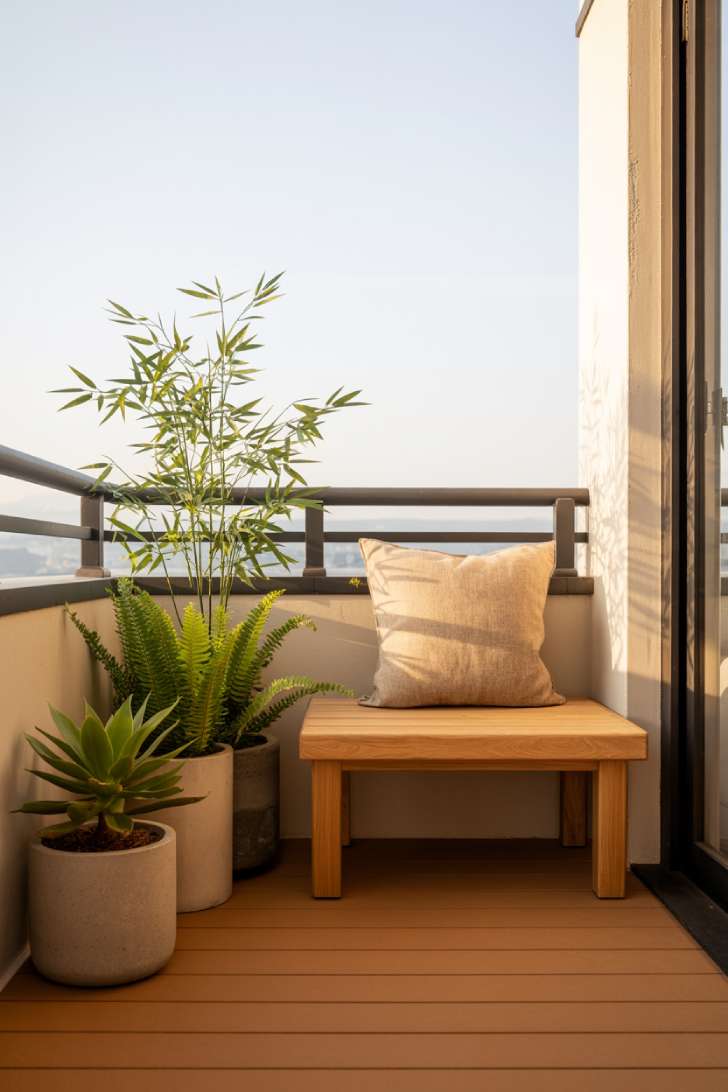
Furniture placement on a japandi balcony is never about filling the space.
It’s about placing one strong piece in exactly the right spot — and then stopping.
Low-profile seating is a signature of japandi design, and it works for a reason that goes beyond aesthetics.
Seating that sits close to the floor pulls attention downward — toward the decking, the plants, the detail at ground level.
It creates a sense of groundedness that higher chairs simply don’t produce.
There’s a reason Japanese design has always favored floor-level living: it changes your relationship with the space you’re in.
You slow down.
You notice more.
The best material choices for japandi outdoor seating are solid teak, oak, or ash for wooden benches, and rattan or woven seating for chairs.
Rattan adds an organic texture that works perfectly against the clean lines of a wood floor and a smooth wall.
One strong seat, one small surface for a cup or a plant, and nothing else.
That’s the formula.
Resist the urge to add a second chair “just in case.”
If the space needs more seating occasionally, folding options stored flat against the wall are the japandi furniture outdoor answer.
Style Blueprint:
- Single low bench or two low chairs in teak, oak, or rattan
- Seat height no more than 40–42 cm from the floor
- One neutral linen or cotton cushion per seat, no pattern
- One small side surface (tray, low stool, or folding table)
- Clear floor space of at least 60 cm in front of seating
Build in Storage to Eliminate Visual Noise
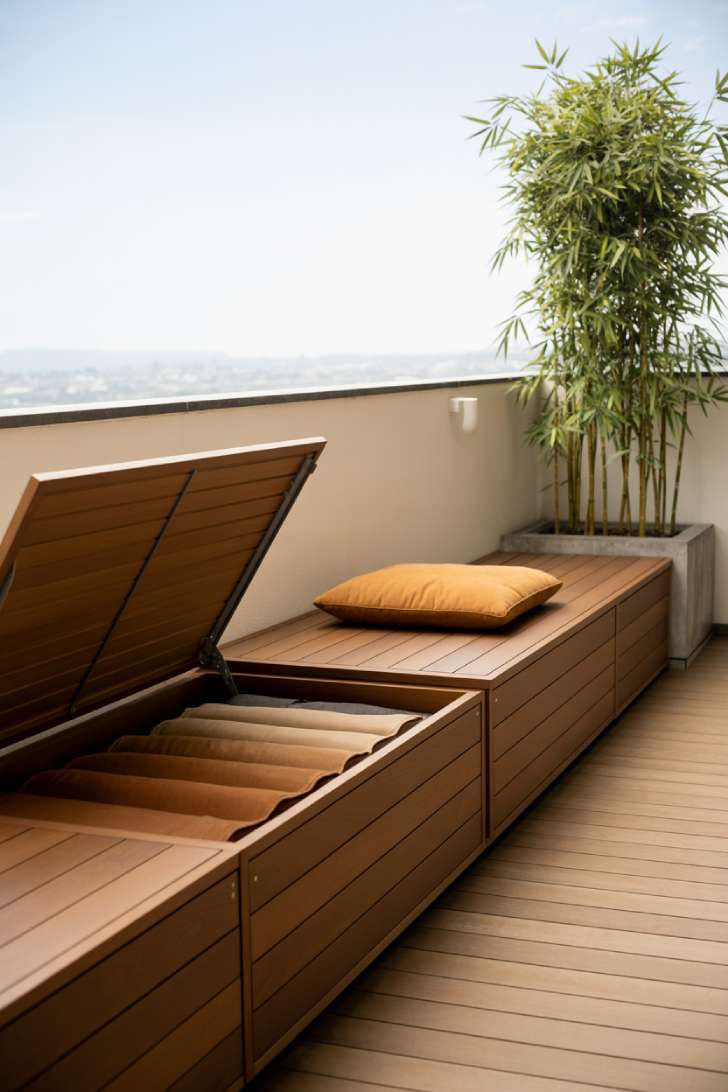
Clutter is the enemy of calm.
And on a balcony — where cushions, gardening tools, throws, and plant care supplies tend to accumulate — the fight against clutter is ongoing.
The best japandi solution is to make storage invisible.
A built-in storage bench along one wall serves three purposes at once.
It provides seating.
It hides everything that would otherwise live on the floor.
And it gives the balcony a custom, considered quality that no off-the-shelf furniture can replicate.
Solid oak or ash works well for the exterior — both weather well with proper treatment and have the warm, honest grain quality that japandi material philosophy calls for.
Marine-grade plywood inside keeps the structure light without compromising the storage capacity.
Stainless steel hardware throughout is non-negotiable outdoors — it’s the only metal that won’t leave rust marks on the wood over time.
For a balcony between 2–6 square meters, a bench depth of around 40–45 cm gives comfortable seating while keeping the footprint tight.
A well-oiled ash lid develops a beautiful patina over the years — which is, of course, exactly the point.
Style Blueprint:
- Solid oak or ash exterior with marine-grade plywood interior
- Stainless steel hinges and fittings throughout
- Bench depth 40–45 cm, seat height 42–45 cm
- Smooth flat lid (no ornamentation) with oil or outdoor wax finish
- One centered cushion in a neutral linen or cotton fabric
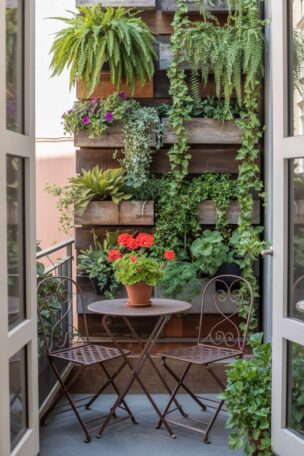
Add a Folding Table for Flexible, Purposeful Living
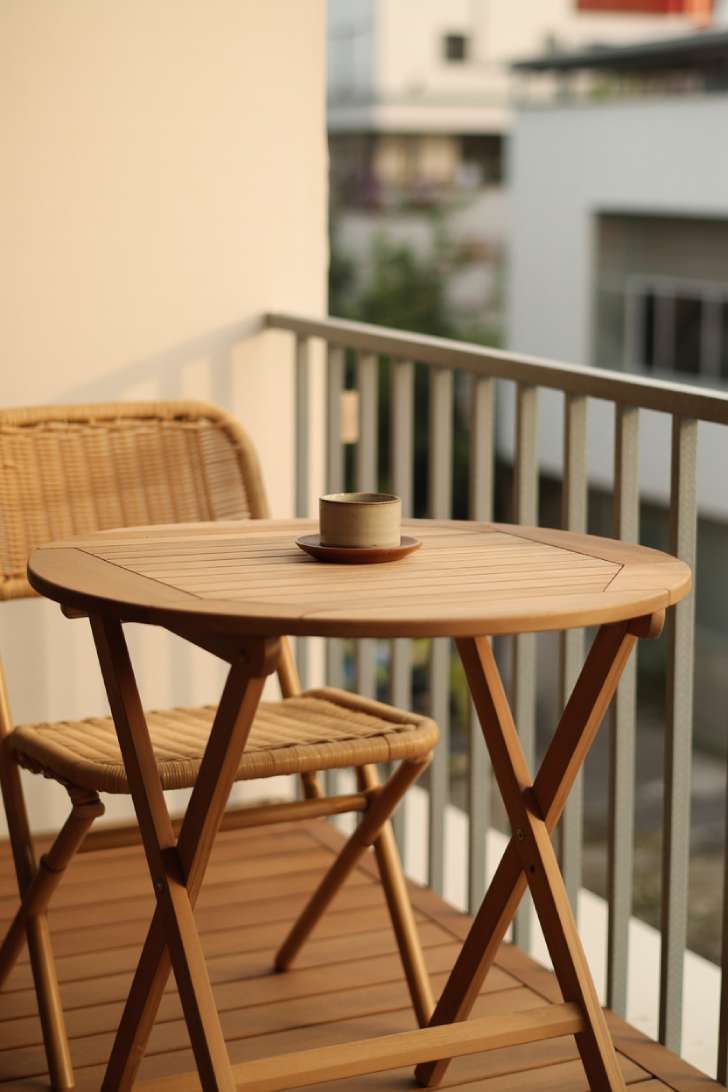
A japandi balcony should be able to shift between uses without feeling busy or over-furnished.
A folding bistro table makes that possible.
A round table, 60–70 cm in diameter, is the right scale for a japandi balcony.
Small enough to feel unobtrusive.
Large enough for two cups, a book, and a small plant tray.
Teak or oak veneer paired with a lightweight aluminum frame is the most practical combination — it looks natural and warm while being genuinely light enough to fold and store flat against the wall in seconds.
That ability to disappear is the whole point.
When the table is put away, the balcony becomes a contemplative sitting space.
When it’s set up, it becomes a morning dining spot or a working corner.
One space, multiple purposes, zero extra furniture.
If space allows for a wall-mounted bracket, a fold-flat wall-hung table takes this even further — the table drops down when needed and returns flush to the wall when not.
Style Blueprint:
- Round teak or oak-veneer table, 60–70 cm diameter
- Lightweight aluminum frame for easy folding
- Two stackable or folding chairs in matching or complementary material
- Wall-bracket mounting option for very small balconies
- Store completely flat against the wall when not in use
Design Pro-Tip: On a small japandi balcony, treat the wall as usable square footage. A wall-mounted fold-flat table, a single floating shelf, or a pair of wall brackets for a bike or broom keeps the floor completely clear — and a clear floor always reads as a larger, calmer space.
Curate Greenery Like a Living Composition
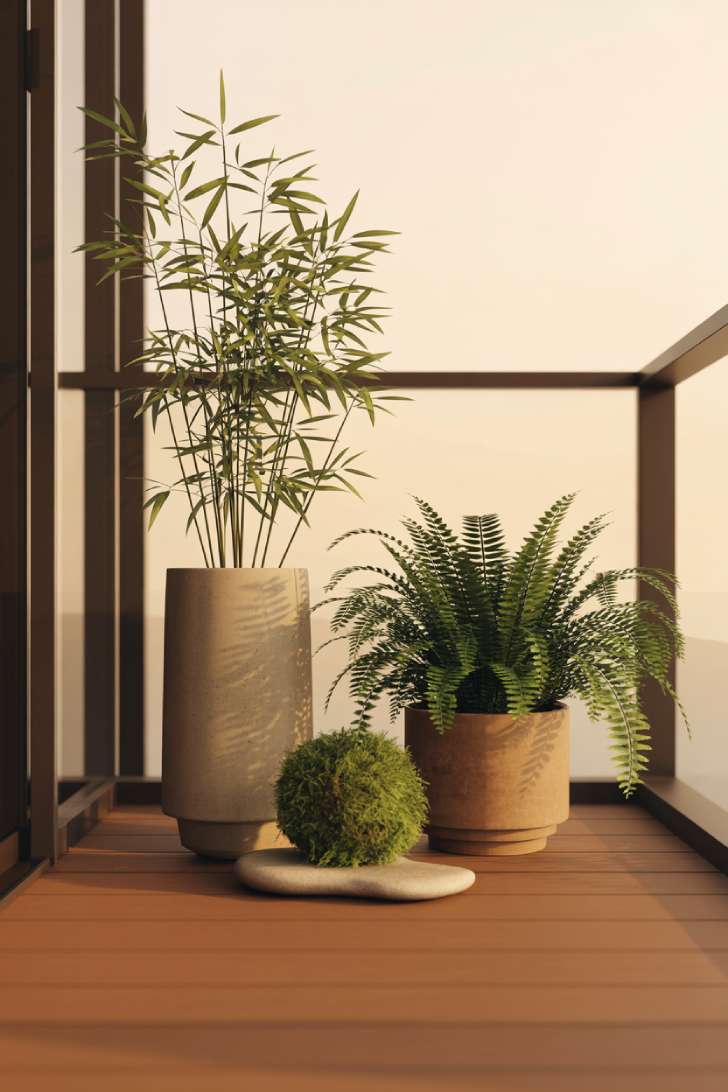
Plants on a japandi balcony are not decoration.
They are design.
The difference is in how they’re chosen, placed, and maintained.
A random collection of whatever was on sale at the garden center is decoration.
A carefully selected group of plants with complementary textures, heights, and tones — arranged with the same attention you’d give to furniture — is japandi outdoor design.
Grouping plants creates something that individual pots placed around a space never achieve — a sense of a small, living ecosystem.
The eye reads a group as a single composed element, which keeps the space feeling ordered rather than busy.
For height variation, combine a tall structural plant (bamboo, Japanese maple, or a slim ornamental grass) with a mid-height leafy plant (fern, peace lily, or fatsia) and a low ground-level element (moss, succulent, or a kokedama).
The kokedama — a Japanese art form where a plant’s roots are wrapped in moss and shaped into a ball — is one of the most quietly beautiful things you can add to a japandi outdoor space.
For planters, concrete and unglazed terracotta are the best choices.
Both age beautifully outdoors.
Both have the honest, organic quality that wabi-sabi outdoor living requires.
Match sun exposure and wind levels to plant choice — beautiful plants that are struggling don’t serve the calm the design is aiming for.
Style Blueprint:
- Minimum three plants grouped together in one corner
- Height variation: tall, mid, and low-level plants in the grouping
- Planter materials: matte concrete, unglazed terracotta, or unfinished wood
- Species to consider: bamboo, Japanese maple, fern, moss, bonsai, or succulents
- No brightly colored or heavily glazed pots
Soften the Space with Natural Textiles
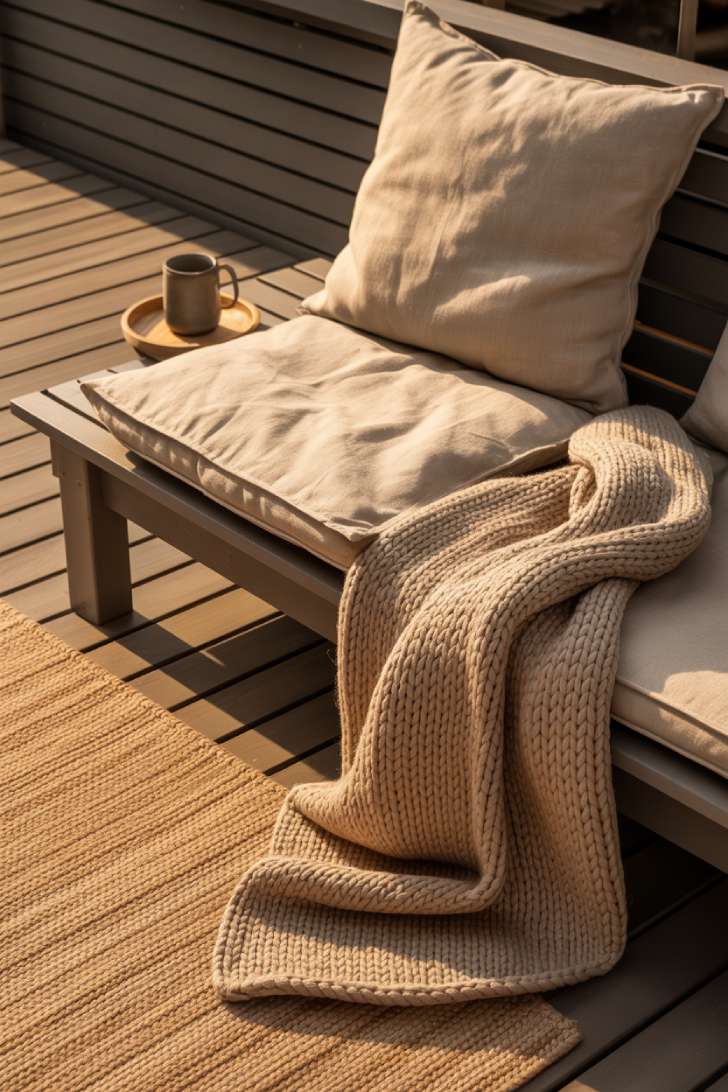
A balcony with only hard surfaces — wood, concrete, metal — will always feel slightly austere.
Textiles are what close the gap between a japandi balcony that looks good in photographs and one that actually feels good to sit in.
The combination of a linen cushion, a wool throw, and a jute or sisal rug works because each material adds a different textural note.
Linen is flat, cool, and slightly crisp.
Wool is warm, soft, and visually substantial.
Jute is rough, earthy, and grounding.
Together, they create a layered sensory richness that a neutral palette can sustain without becoming boring.
The rug does something important beyond texture — it defines the seating area as a destination.
A rug signals: this is where you sit.
It creates a room-within-a-room effect that makes even a tiny balcony feel like it has a considered layout.
Color guidance here is simple: undyed natural tones, oat, warm cream, and soft grey.
No patterns, or the most subtle geometric weave at most.
For outdoor use, store cushions inside during rain, or choose an outdoor-rated linen-look performance fabric that mimics the natural aesthetic while handling weather.
Style Blueprint:
- Undyed or warm-toned linen cushion covers (one per seat)
- Chunky-knit or woven wool throw in oat, cream, or soft grey
- Jute, sisal, or natural-fiber outdoor rug to define seating zone
- No synthetic-looking fabrics, no bold patterns
- Rotate to heavier wool textiles in cooler months
Create Privacy with Bamboo Screens
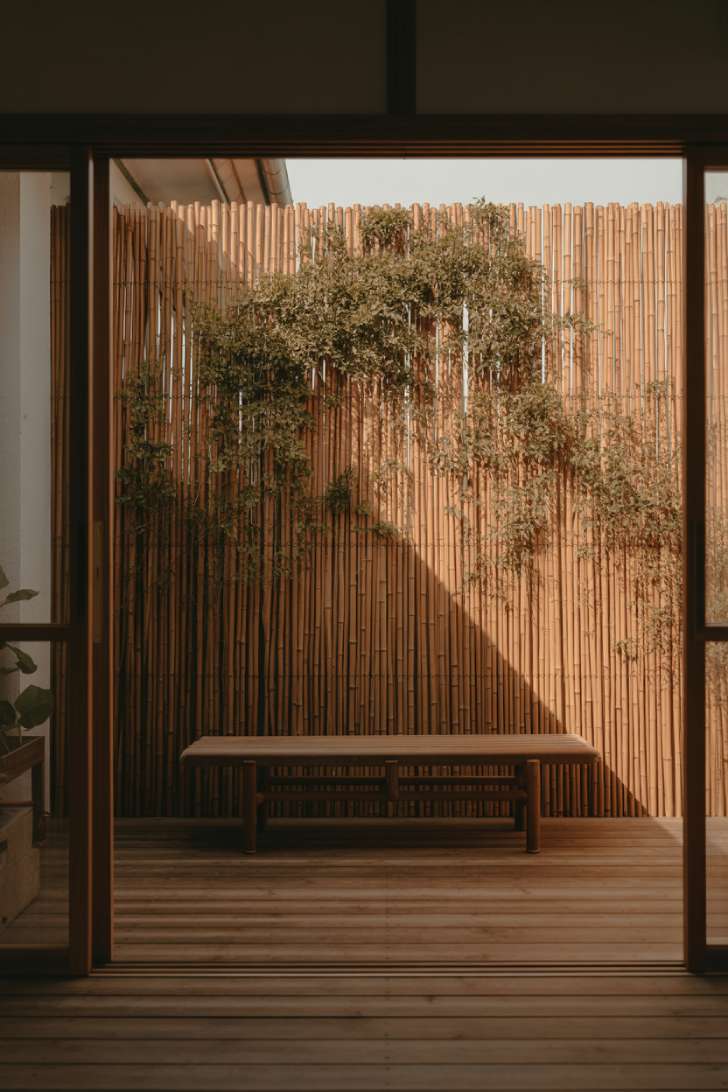
No amount of beautiful furniture and careful planting will make a balcony feel like a sanctuary if it’s completely exposed.
Privacy is not a luxury in japandi balcony design — it’s a structural requirement.
The good news is that the most effective privacy solutions are also among the most beautiful.
A bamboo screen does more than block sightlines.
The filtered light it creates — thin parallel lines of sun moving slowly across the decking through the day — is one of the most specifically Japanese visual experiences you can introduce to a small balcony space.
It is, in the truest sense, wabi-sabi outdoor living: beautiful, transient, and shaped by natural forces.
Bamboo screens are the most authentic choice, but woven rattan panels are more durable in wet climates and age in a similar way.
For a living alternative, a simple timber trellis panel with climbing jasmine, ivy, or climbing hydrangea creates a screen that changes with the seasons — fragrant in spring, lush in summer, and spare in winter.
Each season looks completely different, and each is beautiful in its own way.
Secure all panels with strong brackets rated for wind load — a privacy screen that shifts or rattles in the wind defeats the purpose entirely.
Style Blueprint:
- Natural bamboo or woven rattan privacy panels, full-height
- Secure wall or railing mounting with wind-rated brackets
- Optional: timber trellis with climbing jasmine or ivy as a living alternative
- Allow plants to soften the upper edges of any solid screen
- Avoid plastic privacy screens — they undermine the entire material palette
Design Pro-Tip: Bamboo screens work best when they’re one tone warmer than the wall behind them. If the wall is cool white, choose honey-toned bamboo. If the wall is warm greige, go for a slightly darker, more aged bamboo or woven rattan. The slight warmth difference creates depth without contrast.
Light the Evening with Warm, Low-Level Glow
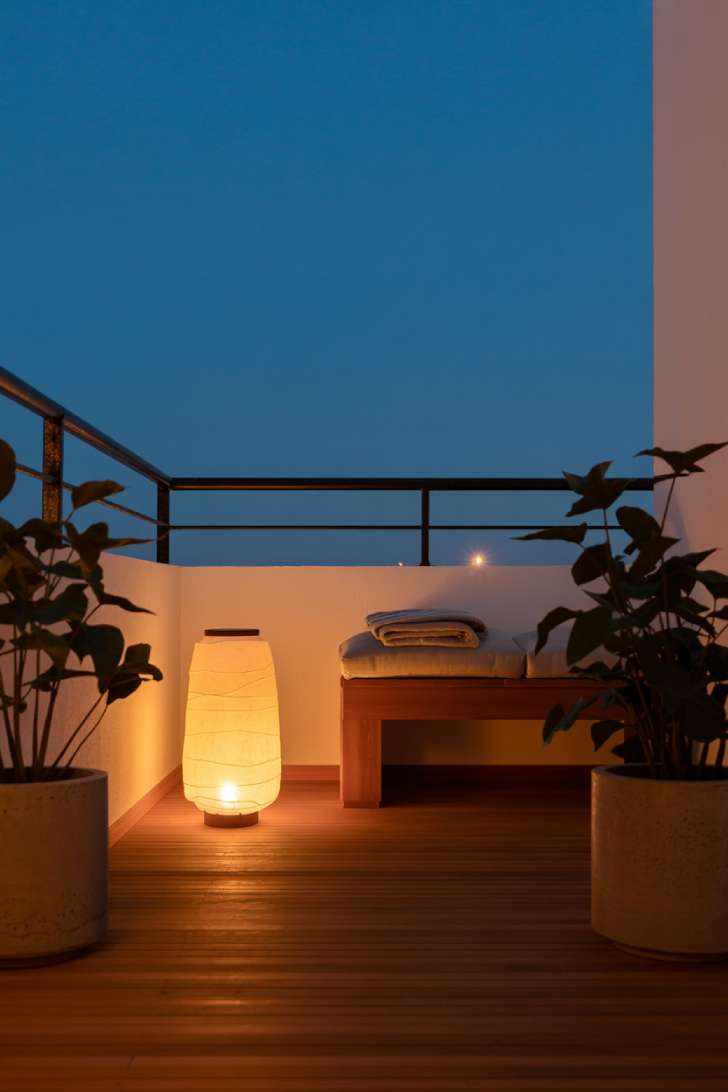
Daytime is only half the life of a japandi balcony.
The evening version of the space — lit well — can be even more compelling than the daytime one.
The key word is warm.
And the second key word is low.
Ground-level lighting changes the entire character of a space.
When light comes from below — from a lantern sitting on the decking — it creates pools of warmth that feel intimate and sheltering.
Overhead lighting does the opposite: it flattens the space, removes shadow, and strips out the atmospheric depth that makes an evening balcony feel special.
The tōrō — the traditional Japanese stone or ceramic garden lantern — is the most authentic lighting choice for a japandi outdoor space.
Modern concrete and ceramic versions are widely available and weather beautifully.
A single large lantern in a corner, positioned near a plant grouping, creates a focal point that anchors the whole evening arrangement.
For fixture materials, brass, matte black, rattan, and ceramic are the natural choices — each ages well and fits the material language of japandi design.
Avoid anything with a chrome or silver finish.
Style Blueprint:
- One large ceramic or concrete floor lantern as the primary light source
- Warm amber bulb tone (2200–2700K) for all exterior fixtures
- Matte black, brass, rattan, or ceramic for all fixture materials
- Position lanterns at ground level or maximum 80 cm height
- No cool-white or bright white bulbs outdoors in this style
Let Shou Sugi Ban and Handmade Objects Tell the Story
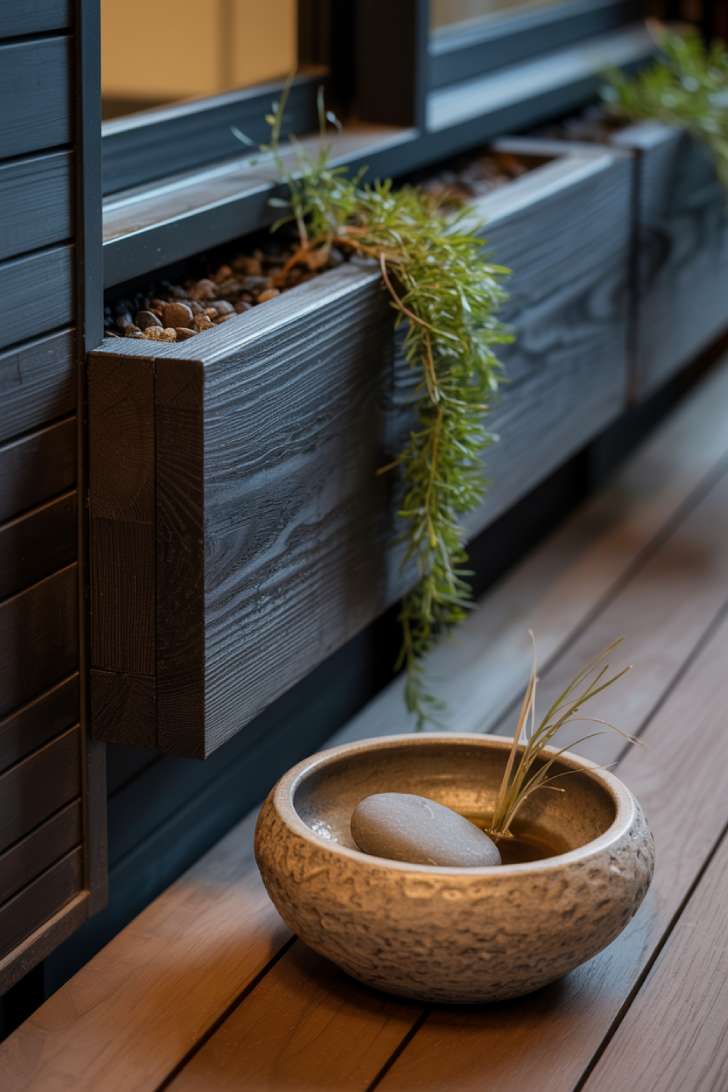
The details matter more in japandi design than in almost any other style.
Precisely because the space is stripped back, every object that remains carries more visual weight.
Choose those objects carefully, and the balcony tells a story.
Shou Sugi Ban — the Japanese technique of charring wood to preserve and beautify it — produces a surface that is simultaneously ancient and completely modern.
The charred finish repels water, resists rot and insects, and requires almost no maintenance beyond an occasional light oiling.
On a japandi balcony, it works beautifully as a planter box, a narrow wall panel, or an accent strip of decking.
The contrast of the deep charcoal black against warm teak and soft white walls is striking without being loud.
Beside the Shou Sugi Ban, bring in one handmade object.
A single rough-thrown ceramic bowl.
A carved wooden tray.
A woven basket holding a spare throw.
The handmade quality — the slight irregularity, the visible human effort — is precisely what wabi-sabi celebrates.
One imperfect, beautifully made object does more for the spirit of a japandi outdoor space than any number of identical, machine-made accessories.
Style Blueprint:
- One Shou Sugi Ban charred wood element (planter, panel, or accent strip)
- One handmade ceramic or stone object as a focal accent
- Finish all wood elements with outdoor-grade natural oil, not varnish
- Limit decorative objects to an absolute maximum of three per balcony
- Choose objects with visible grain, texture, or handcraft marks
Design a Stillness Corner for Mindful Living
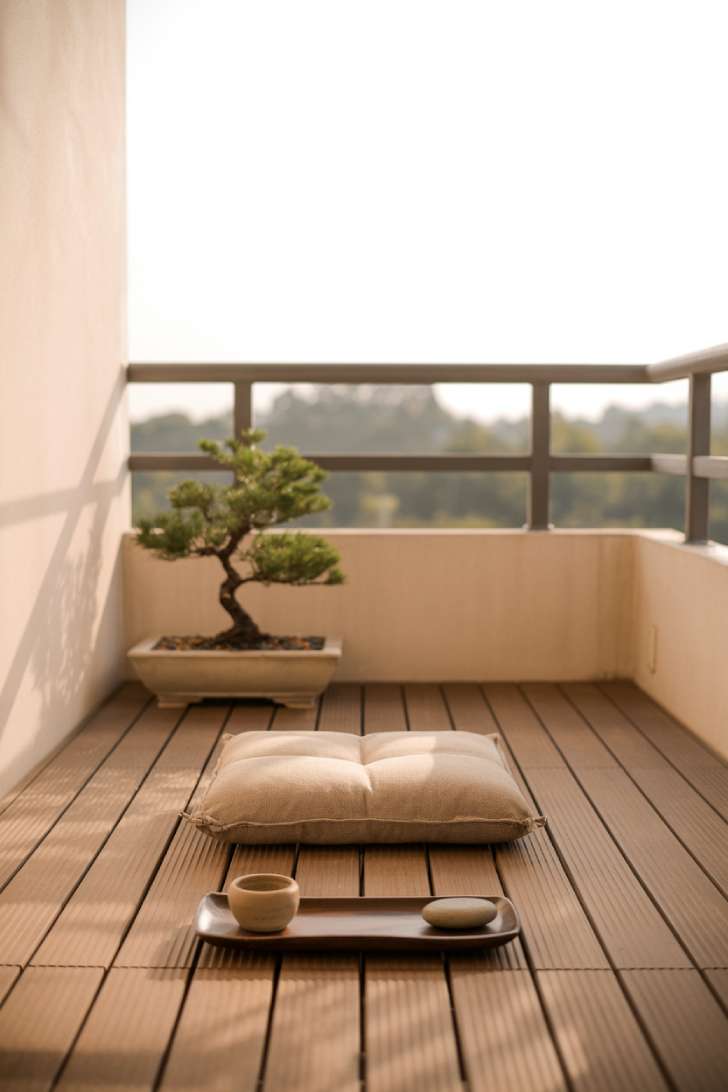
The most powerful thing a japandi balcony can offer is not a beautiful view or a perfect palette.
It’s a reason to stop.
To sit, to breathe, and to be present.
That’s what a dedicated stillness corner creates — and it’s the idea that pulls every other element of japandi design together into its true purpose.
A zabuton — a flat Japanese floor cushion — is the only seat this corner needs.
It sits directly on the decking, low and close to the ground, creating the same earthward pull that defines japandi seating throughout.
A very low tray in front of it, just large enough for a single cup, is the only surface.
One small bonsai beside it — tended slowly, patiently, over years — is the only decoration.
The empty space around these three things is not a design failure.
It is the design.
The brain processes negative space as permission to rest.
When the eye has nowhere pressing to go, the mind follows.
That’s the direct psychological impact of a space built around deliberate emptiness — it creates the conditions for stillness without asking for it.
Orient the corner toward the best available view, and away from any street noise where possible.
Sit there every morning for five minutes.
The balcony will earn that investment back a hundred times over.
Style Blueprint:
- Single flat zabuton floor cushion in undyed natural linen or cotton
- Very low flat wooden or lacquered tray (maximum 8 cm height)
- One bonsai or small architectural plant in a shallow unglazed ceramic pot
- Absolutely no other objects in this specific corner
- Orient toward the view; leave a clear sightline to the horizon or sky
Bringing It All Together
A japandi balcony doesn’t happen all at once.
The best ones are built slowly, one good decision at a time.
Start with the floor if you can — the decking sets every tone that follows.
Then choose one seating piece.
Then one plant grouping.
Then the lighting.
Then, one day, you realize the space is done — not because it’s full, but because nothing is missing.
That’s the mark of a genuinely japandi outdoor space: a quiet completeness that doesn’t call attention to itself.
It just makes you want to sit down, slow down, and stay a while.
Save the ideas that spoke to you.
Come back to them as the space takes shape.
The goal was never a perfect balcony.
It was a balcony that feels like yours.