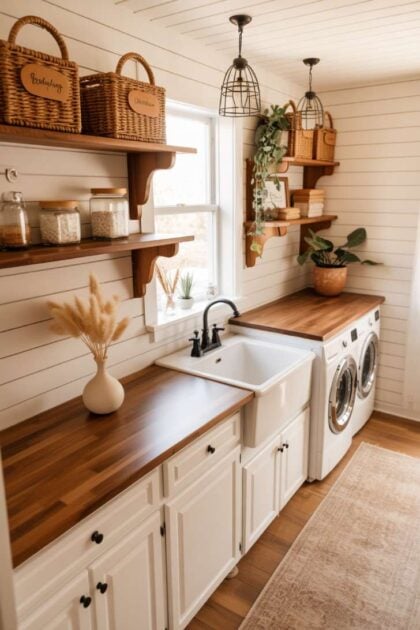
The laundry room is probably the last space you think about when planning a home refresh.
And yet, it’s one of the rooms you visit every single day.
A farmhouse laundry room changes that relationship completely.
It takes a purely functional space and wraps it in warmth — shiplap walls, worn wood textures, deep apron sinks, and the kind of storage that actually looks good sitting out in the open.
The farmhouse aesthetic is rooted in one simple idea: every room in your home deserves to feel intentional and welcoming, even the ones no one else sees.
This list pulls together 13 rustic laundry room decor ideas that range from full renovations to simple weekend upgrades, covering laundry room storage ideas, flooring, lighting, sinks, and everything in between.
Whether you’re starting from scratch or just want to breathe new life into a tired space, there’s something here for every budget and every room size.
What Makes a Farmhouse Laundry Room?
At its heart, farmhouse style is the marriage of beauty and utility.
Nothing is purely decorative, and nothing is purely functional — everything pulls double duty.
The visual language is built on a handful of recurring elements that, when layered together, create that instantly recognizable cozy, country-inspired feel.
Here’s what defines the look:
- A neutral or nature-inspired color palette — whites, creams, soft greens, warm beiges
- Natural materials like wood, stone, aged metal, and woven fibers
- Vintage or antique-inspired accessories that tell a story
- Storage that’s organized enough to leave fully visible
- Handcrafted or hand-finished details that feel personal, not mass-produced
With those principles in mind, let’s get into the ideas.
Texture First, Everything Else Second
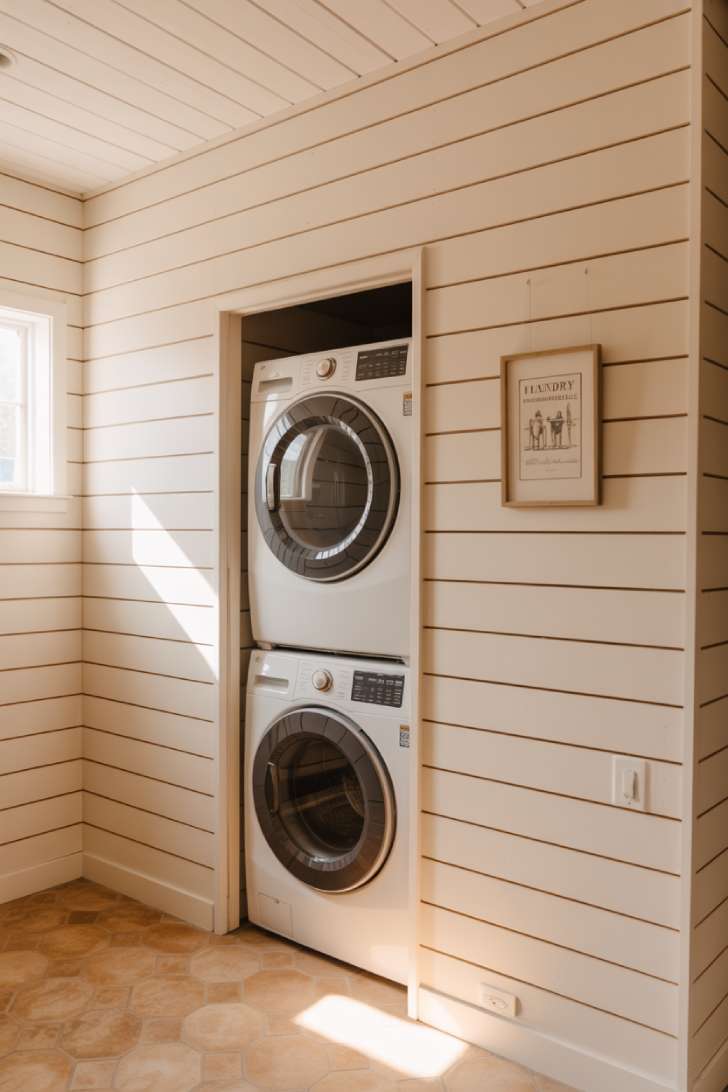
There’s a reason shiplap walls appear in nearly every farmhouse laundry room you’ve ever admired.
The horizontal lines create a rhythm that makes the eye travel across the room rather than stopping at any one spot.
That movement makes even the smallest laundry closet feel larger and more considered.
White shiplap, in particular, bounces light around in a way that painted drywall simply can’t match — the slight shadow that falls between each plank adds depth without making the space feel heavy or closed in.
It’s one of those details that reads as “expensive renovation” but is actually one of the more budget-friendly DIY projects you can take on.
Sheets of plywood cut into six-inch slats, nailed horizontally to the wall, then painted white — that’s genuinely all it takes.
For renters, paintable peel-and-stick shiplap wallpaper exists and performs surprisingly well in low-moisture spaces.
Pair the wall with a vintage-style framed print or a simple peg rail, and you’ve set the entire tone of the room with a single design move.
Style Blueprint:
- White or natural-wood shiplap panels (DIY plywood or peel-and-stick for renters)
- Matte white paint in a durable, washable finish
- Simple peg rail or wooden shelf mounted at eye level
- Vintage-style framed laundry print or sign
- Warm-toned floor tile or wood-look vinyl to contrast the white walls
The Sink That Does Everything
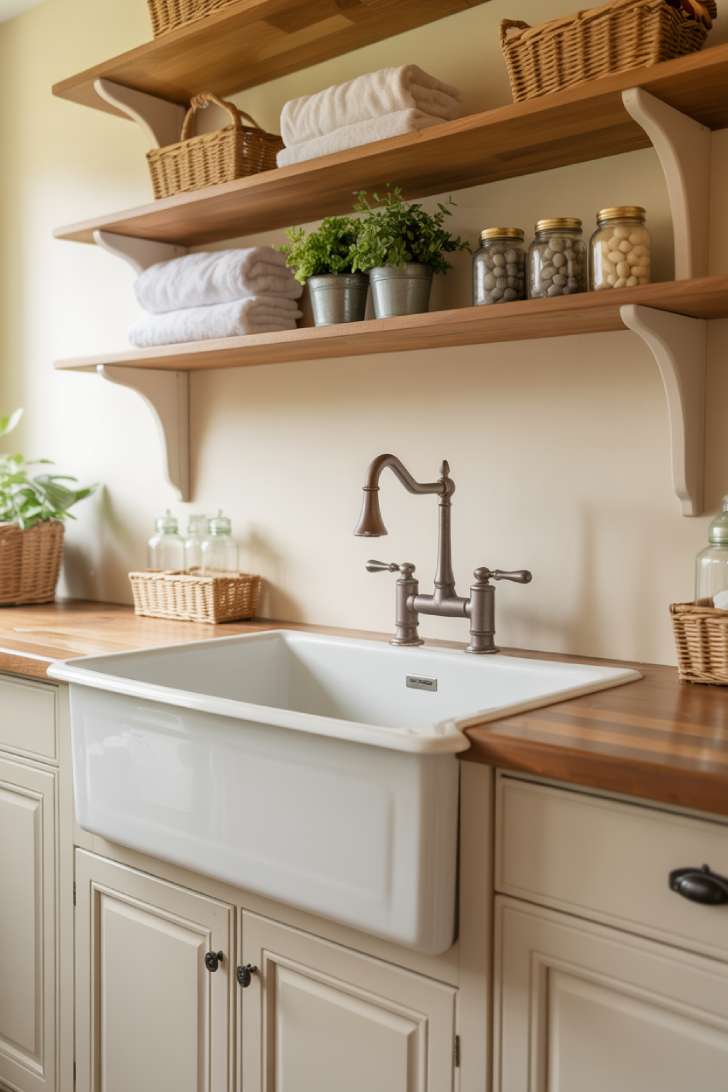
If shiplap sets the tone of a farmhouse laundry room, the sink is what makes it feel truly special.
An apron-front sink — deep, wide, and built to work hard — is the kind of fixture that stops people in their tracks.
It’s not just beautiful.
It actually changes how you use the space.
Hand-washing delicates, soaking muddy sports gear, rinsing out a mop bucket — all of those tasks become genuinely easier with a deep farmhouse basin instead of a shallow utility bowl.
The visual weight of an apron-front sink anchors the room in a way that lighter fixtures can’t.
It draws the eye immediately and signals that this space was thoughtfully designed, not just thrown together.
Pair it with a matte black or antique bronze gooseneck faucet and you’ve got a combination that photographs beautifully and holds up to decades of daily use.
One practical note: apron sinks are heavy, and the cabinetry beneath them needs to be solid enough to handle the load.
If a full apron sink isn’t in the budget, a deep single-bowl utility sink dressed up with a wooden shelf above and a vintage-style faucet gets you surprisingly close to the same look.
Style Blueprint:
- Deep apron-front porcelain or fireclay sink
- Matte black or antique bronze gooseneck or bridge faucet
- Solid shaker-style base cabinet with enough structural support for the sink’s weight
- Butcher block or sealed wood countertop running alongside the sink
- Small potted herb or trailing plant near the window for a lived-in touch
Storage That Looks Good Enough to Leave Out
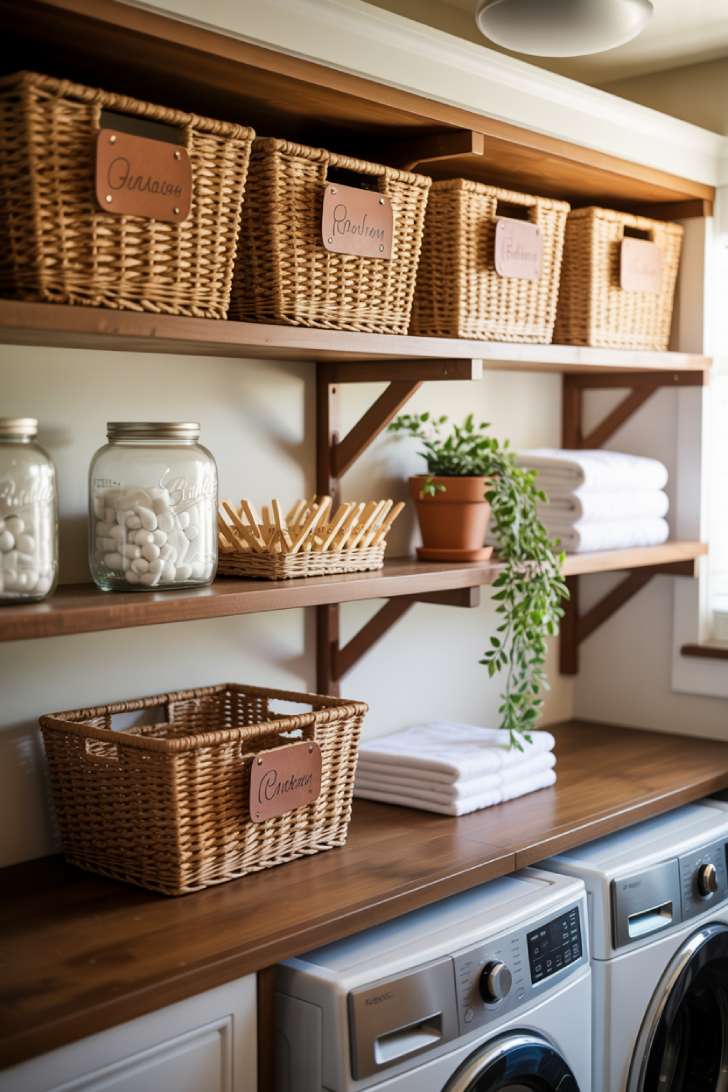
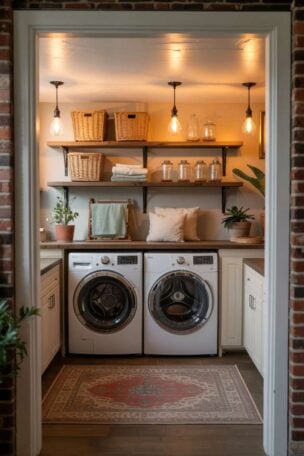
Open shelving is the farmhouse laundry room’s answer to cabinet doors.
And honestly? It’s the smarter choice.
When your storage is visible, you’re forced to keep it organized — and when it’s organized, it becomes part of the room’s decor rather than something to hide.
The key is choosing containers that are as attractive as they are functional.
Woven seagrass baskets with leather labels, clear glass mason jars, small terracotta pots — these are laundry room storage ideas that double as styling moments.
From a purely practical standpoint, open shelving is also faster to use.
You can see exactly where everything is at a glance, which matters when you’re moving quickly between loads.
The wood tone of your shelves does a lot of heavy lifting here.
A warm walnut or honey oak stain brings richness to a mostly white room without making it feel dark.
If you’re working with a small laundry room, try mixing open upper shelves with closed lower cabinets — the open shelves keep the space feeling airy while the lower cabinets give you somewhere to tuck away the things that don’t need to be on display.
Style Blueprint:
- Solid wood open shelves with a warm walnut or oak stain
- Woven seagrass or rattan baskets with leather or linen labels
- Clear glass mason jars for pods, clothespins, and dryer sheets
- At least one small live or faux trailing plant
- Black iron shelf brackets for a farmhouse-industrial contrast
Design Pro-Tip: Mount your open shelves at least 18 inches above the top of your washer and dryer. Any lower, and you’ll constantly be reaching around them when loading laundry. Any higher, and the items on the shelves become hard to grab quickly. That 18-inch clearance is the sweet spot between style and daily usability.
Warm Up the Whole Room With Wood
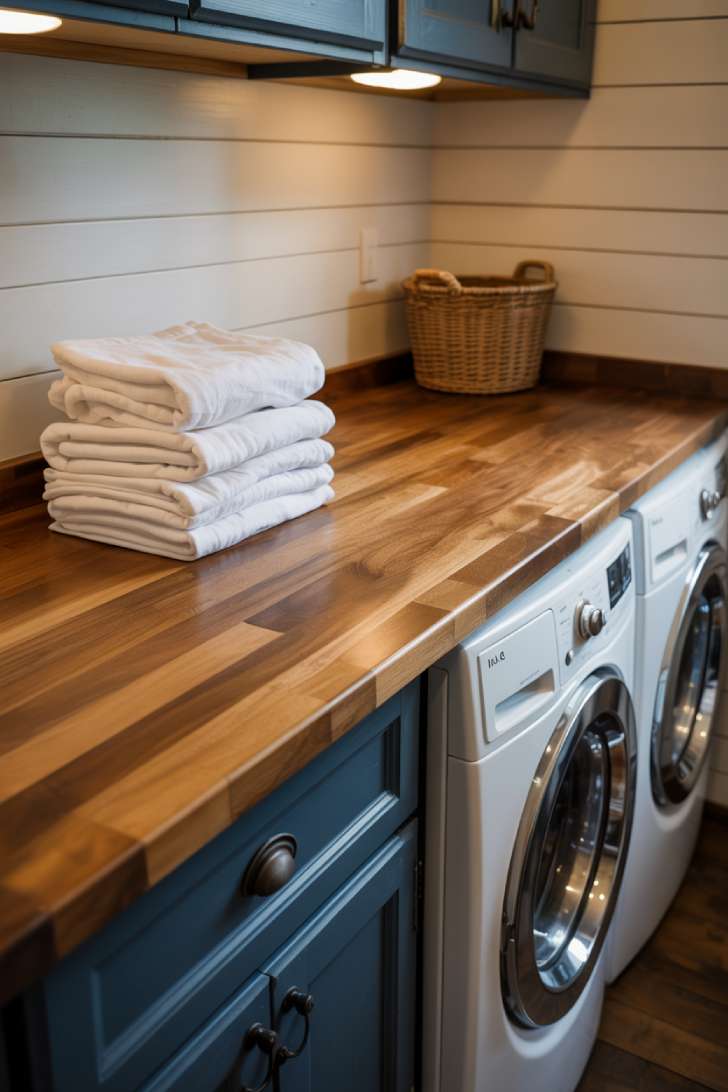
A wood countertop over the washer and dryer is one of the simplest, most affordable upgrades you can make to a farmhouse laundry room — and it makes an enormous difference.
It adds warmth the moment you walk in.
Wood is tactile in a way that laminate and quartz aren’t.
The grain, the variation, the slight imperfections — those are the qualities that make a space feel real and lived-in rather than showroom-perfect.
Butcher block is the most popular choice, and for good reason.
It’s widely available, easy to cut to size, and it looks genuinely beautiful paired with both light and dark cabinetry.
Reclaimed wood is another option if you want something with even more character — old barn wood repurposed as a folding counter has a kind of authenticity that’s hard to replicate with new materials.
The one thing you cannot skip is proper sealing.
Laundry rooms are humid environments, and unsealed wood will warp, crack, and discolor faster than you’d expect.
A marine-grade sealer or a food-safe oil finish applied every year or two is all it takes to keep the surface looking beautiful for decades.
Style Blueprint:
- Butcher block or reclaimed wood countertop, cut to the width of the washer and dryer
- Marine-grade sealer or food-safe oil finish (reapply annually)
- Dark-painted cabinetry below — navy, forest green, or charcoal work particularly well
- Black iron or aged brass cup-pull hardware
- A small basket or tray on top for frequently used items
The Door That Changes Everything
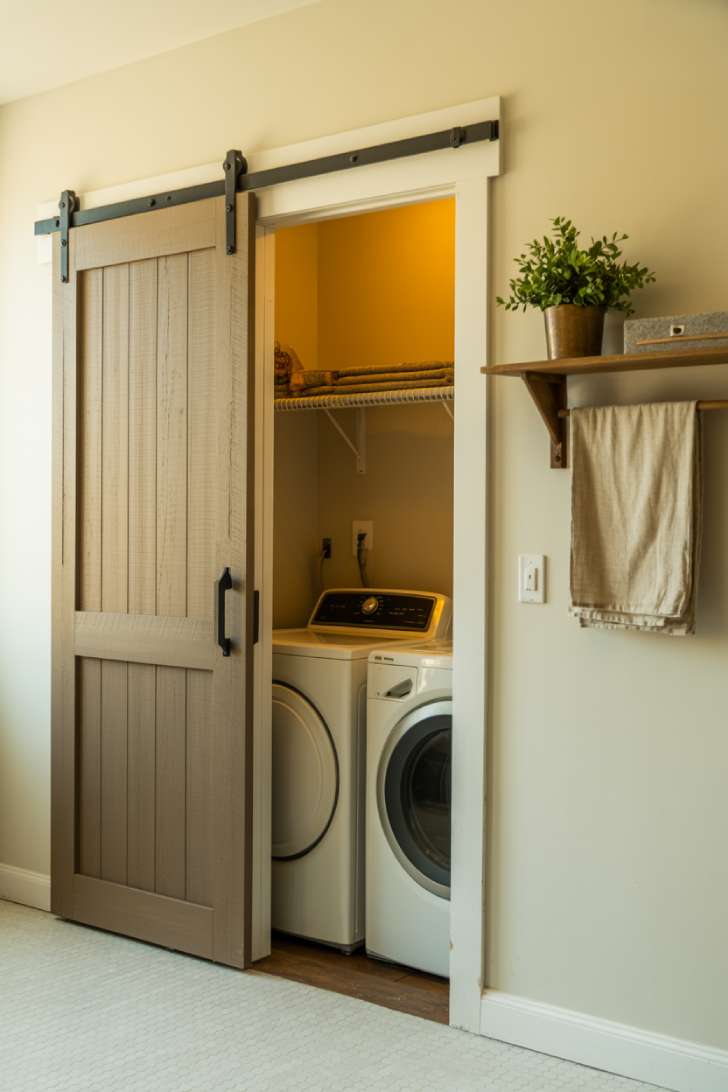
A sliding barn door is one of those additions that immediately signals “farmhouse” without needing any other explanation.
It’s also one of the most practical upgrades for a small laundry room or laundry closet.
Unlike a traditional swing door, a barn door doesn’t require clearance space to open — it simply slides along the wall.
That alone can reclaim a meaningful amount of usable floor space in a tight room.
The style options are wider than most people realize.
Weathered natural wood brings the most rustic energy.
A painted version — white, black, or a muted sage — leans more toward the modern farmhouse side of the spectrum.
The hardware matters just as much as the door itself.
Black iron rails and handles are the classic choice, creating a contrast that works whether the door is light or dark.
What makes a barn door feel particularly right in a laundry room is the way it changes the psychological relationship with the space.
When the door slides shut, the laundry room disappears.
The house feels tidier, the hallway feels cleaner, and there’s a genuine sense of separation between chore time and everything else.
Style Blueprint:
- Solid wood sliding barn door (weathered, painted, or stained)
- Black iron sliding barn door hardware kit with wall-mounted rail
- Door stop to prevent the door from sliding too far and hitting the wall
- Small wooden shelf or hook mounted nearby for functional styling
- White hexagon or subway floor tile to contrast the rustic door
Color Is the Mood-Setter
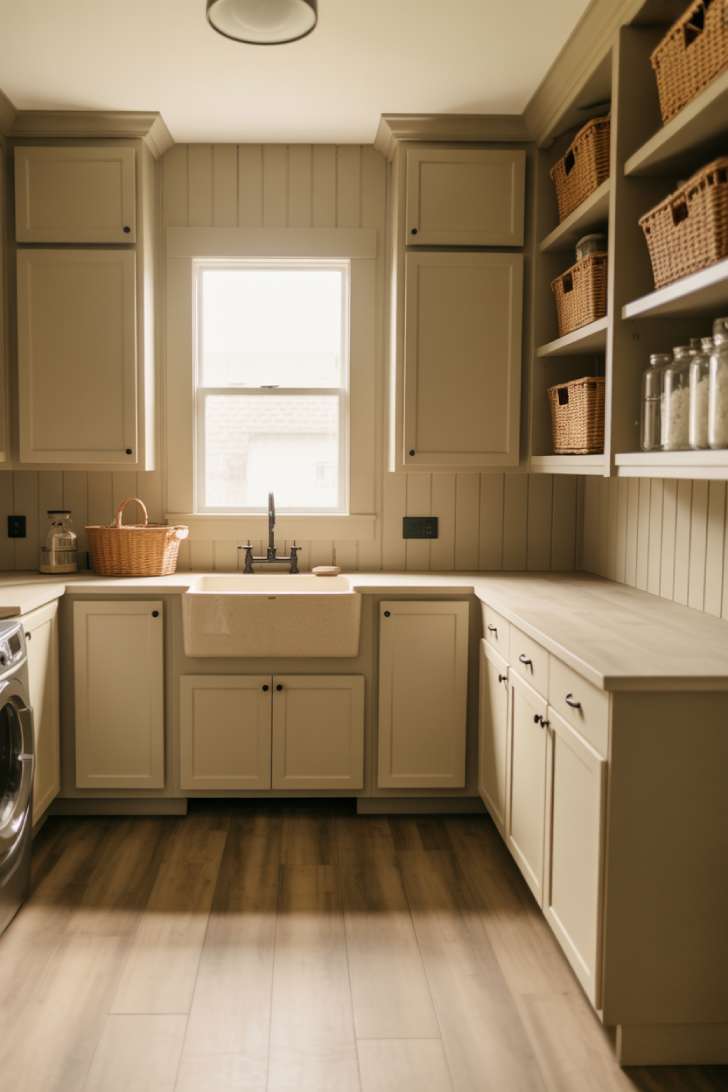
Color does more work in a laundry room than most people give it credit for.
The right shade can make a windowless space feel airy, a cramped corner feel calm, and a purely functional room feel like somewhere you actually want to spend a few minutes.
White and cream are the classics for a reason.
They reflect light, they pair with everything, and they create that clean, bright feeling that farmhouse style is known for.
But in 2025, the more interesting choices are in the green family.
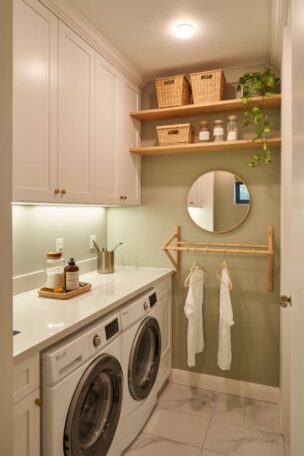
Sage, eucalyptus, and olive are all having a significant moment — and they work particularly well in laundry rooms.
These tones have a grounding, calming quality that makes the repetitive work of sorting and folding feel less tedious.
They’re also more forgiving of the subtle humidity and daily wear that laundry spaces accumulate over time.
One underrated move: paint the upper cabinets in a soft color and keep the lower cabinets white.
The contrast gives the room a layered, custom-built feel without requiring a full renovation.
Finish with matte black hardware throughout and you’ve got a color story that’s cohesive, current, and completely timeless.
Style Blueprint:
- Sage, eucalyptus, or soft cream paint in a durable eggshell or satin finish
- Two-tone cabinet treatment — colored uppers, white lowers
- White quartz or white shaker-style details to keep the palette balanced
- Matte black faucet, hardware, and light fixtures for contrast
- Wood-look LVP flooring in a warm blonde or honey tone
Design Pro-Tip: If your laundry room has no natural light, go at least two shades lighter on your paint color than you think you need. Paint chips always look darker on a full wall under artificial light. Test your chosen color on a large piece of foam board and move it around the room at different times of day before committing.
Vintage Details That Give the Room Its Soul
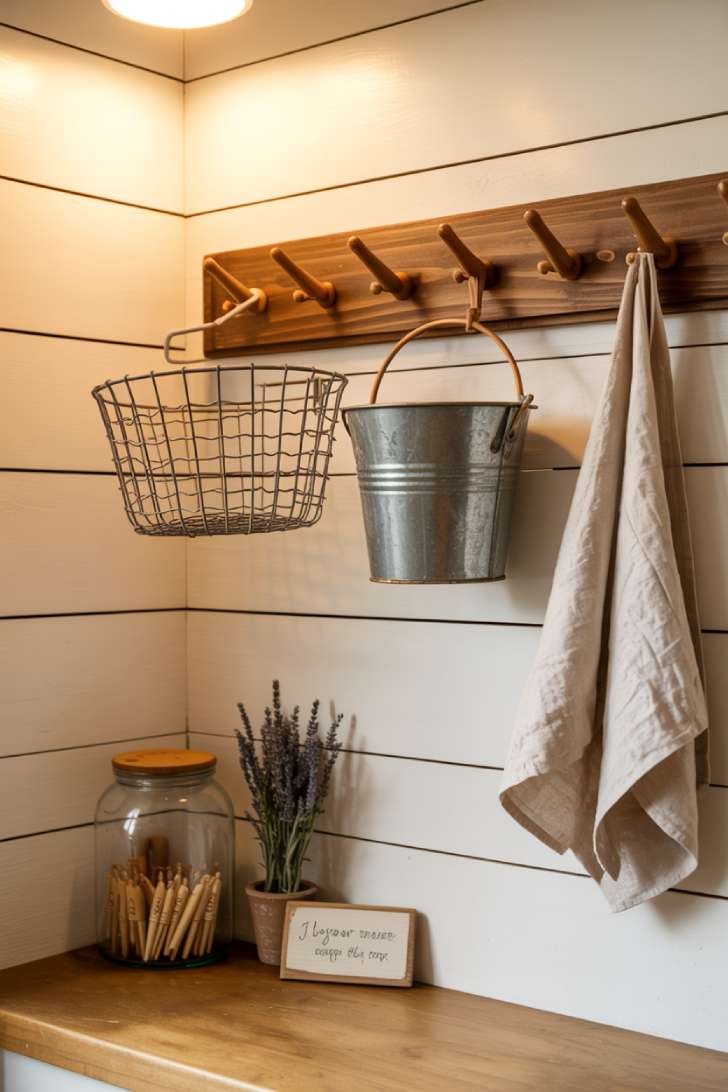
This is where the farmhouse laundry room stops being a styled space and starts feeling like a home.
Vintage accents — the kind of objects your grandmother actually used — bring a warmth and authenticity that no amount of new cabinetry can manufacture.
And the good news is that they’re almost always free or close to it.
Thrift stores, estate sales, and antique fairs are exactly where these pieces live.
A peg rail is one of the most effective vintage laundry room design moves you can make.
Mounted at shoulder height on a shiplap wall, it becomes a place to hang linen towels, a wire basket, a galvanized bucket — anything that’s both useful and worth looking at.
Glass jars filled with wooden clothespins, small bundles of dried lavender, old-fashioned laundry signs with hand-lettered text — these are the details that make a room feel like it has history.
The psychology behind these elements is worth thinking about.
Objects with visible age and patina communicate permanence.
They say that this room has been loved and used for a long time, even if it was just renovated last year.
That feeling of permanence is genuinely calming in a space associated with repetitive chore work.
Style Blueprint:
- Wooden peg rail mounted at shoulder height
- Glass jars for clothespins, dryer sheets, or small accessories
- Galvanized metal bucket or wire basket for rustic laundry room decor
- Dried lavender, wheat, or eucalyptus for natural fragrance and texture
- Handwritten or hand-lettered wooden sign with a laundry-related message
The Backsplash That Does the Heavy Lifting
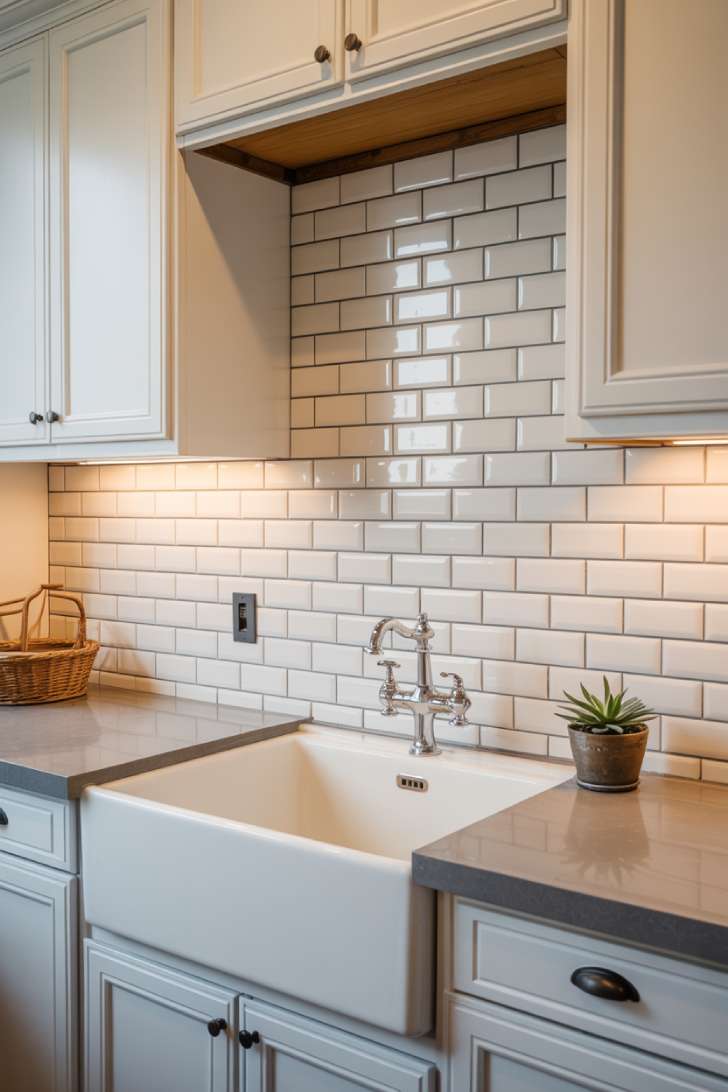
Subway tile has been a staple of farmhouse kitchens for decades, and it transfers to the laundry room just as naturally.
There’s something deeply satisfying about the simplicity of a white subway tile backsplash.
It’s clean, it’s bright, and it photographs beautifully in every lighting condition.
It also happens to be one of the most durable and hygienic surface options available for a space that deals with detergent splashes, water drips, and the general mess of laundry day.
Grout color is where most people make their first significant decision.
White grout makes the tiles read as one unified surface, which visually expands a small room.
Dark grey or charcoal grout makes each tile pop individually, adding visual texture — and it’s considerably more forgiving when it comes to keeping it clean over time.
The installation pattern opens up another level of customization.
A classic horizontal brick pattern is timeless and works in any style.
A herringbone layout adds movement and a slightly more decorative quality.
Stacked subway tile — where all the seams line up vertically — reads as more modern and works particularly well in a contemporary farmhouse space.
For a more committed approach, consider extending the tile beyond just the backsplash and running it up the full height of the wall.
It creates a cohesive, almost spa-like quality that makes the room feel far more intentional.
Style Blueprint:
- Classic white 3×6-inch subway tiles
- Grey or charcoal grout for durability and visual interest
- Brick pattern, herringbone, or stacked layout depending on the room’s style
- Tile sealer applied at installation and refreshed every 2-3 years
- Extend tile to full wall height for a more polished, finished look
Light That Actually Flatters the Space
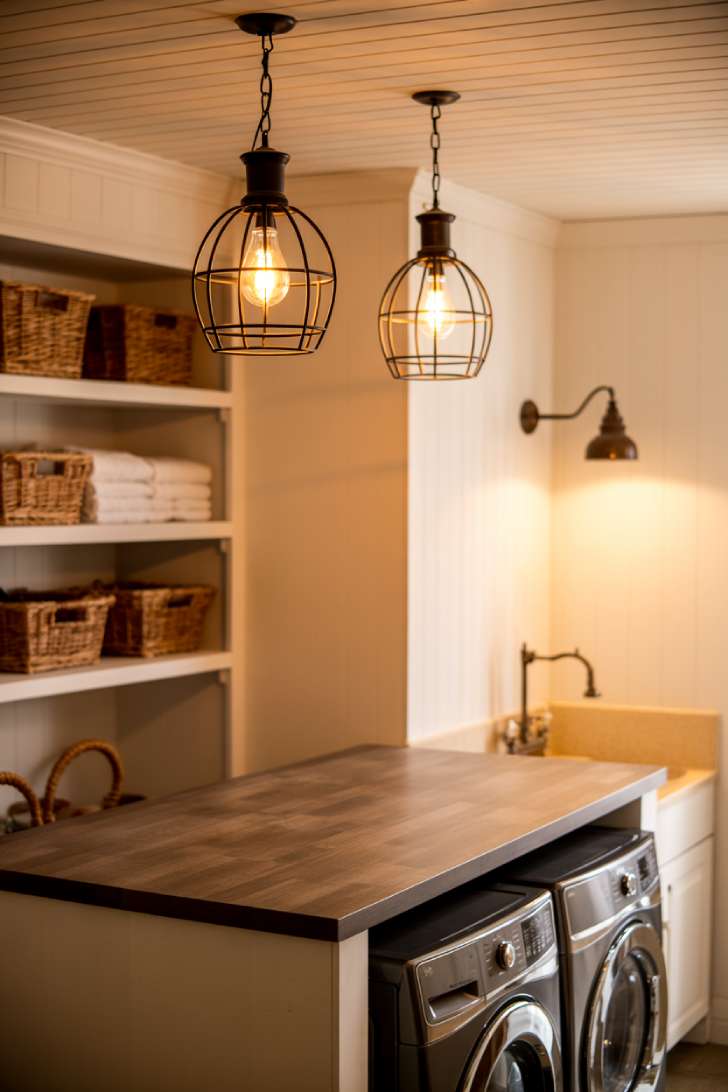
Lighting is where most laundry rooms fall completely flat.
A single flush-mount ceiling fixture with a cool-toned bulb makes even the most beautifully styled space feel harsh and utilitarian.
Farmhouse lighting takes a completely different approach.
Warm bulbs — 2700K to 3000K — are non-negotiable.
They turn the room’s neutral tones amber and golden rather than blue and sterile.
The fixture itself becomes part of the room’s character.
Black metal cage-style pendant lights, barn sconces, and vintage-inspired flush mounts with dark metal detailing all work beautifully in a farmhouse laundry room.
Pendant lights hung above a folding counter serve a dual purpose: they provide direct task lighting right where you need it most, and they visually anchor the work surface, making it feel like a dedicated, intentional space.
A sconce or two mounted above the sink adds a layer of warm, localized light that makes the sink area feel more refined.
For smaller laundry rooms without great ventilation, a ceiling fan with wood-toned blades and farmhouse-style detailing is a particularly smart solution — it handles air circulation while contributing to the room’s overall aesthetic.
Just make sure the blade tips sit at least 18 inches from any walls or cabinets.
Style Blueprint:
- Black metal cage-style pendant lights or barn sconces
- Warm-toned LED bulbs (2700K-3000K) throughout
- Task lighting positioned directly over the folding counter and sink area
- Dimmer switch for adjustable ambiance
- Ceiling fan with wood-toned blades for smaller, less-ventilated rooms
Design Pro-Tip: Never rely on a single ceiling fixture to light a laundry room. Layer at least two light sources — one overhead for general brightness, one task-focused over your work surface. That layering is what separates a room that “looks good in photos” from one that’s genuinely pleasant to work in every day.
Organization That Looks as Good as It Works
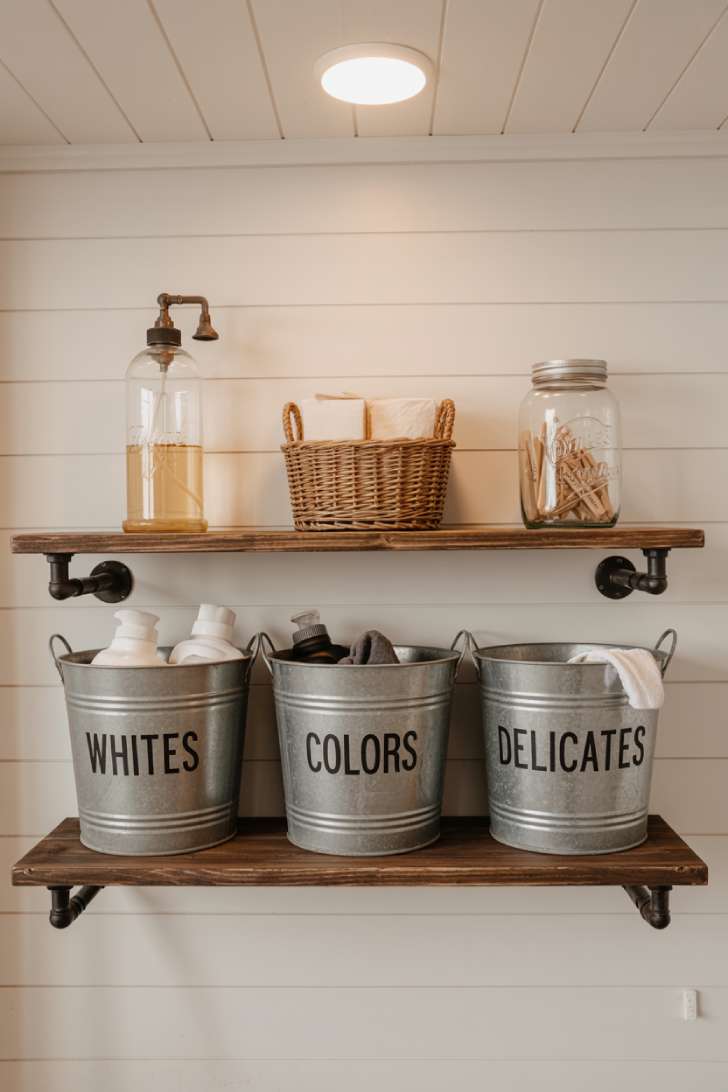
The farmhouse approach to laundry room organization is built on one guiding principle: if it’s going to sit out in the open, it needs to look like it belongs there.
That means swapping plastic detergent bottles and cardboard dryer sheet boxes for containers that earn their place on the shelf.
Mason jars are the obvious starting point.
They’re inexpensive, widely available, and they work for storing everything from laundry pods to clothespins to small stain-remover sticks.
Galvanized metal buckets or bins carry a wonderfully authentic vintage quality.
Labeling them by laundry category — whites, colors, delicates — turns a basic sorting system into a display piece that guests will actually comment on.
A glass dispenser for liquid detergent is another simple swap that has a surprisingly large visual impact.
It takes something that was previously an eyesore sitting on top of the machine and turns it into a polished, purposeful detail.
The laundry room storage ideas in this space are all about choosing materials that belong to the same visual family — glass, galvanized metal, woven fibers, dark-stained wood — and letting the consistency of those materials do the styling work for you.
Style Blueprint:
- Galvanized metal buckets or bins for sorting and storage
- Clear glass mason jars for pods, clothespins, and accessories
- Glass dispenser for liquid detergent or fabric softener
- Dark-stained wood shelf with black iron pipe brackets
- Woven basket or small bin for dryer sheets and lint rollers
The Floor That Ties It All Together
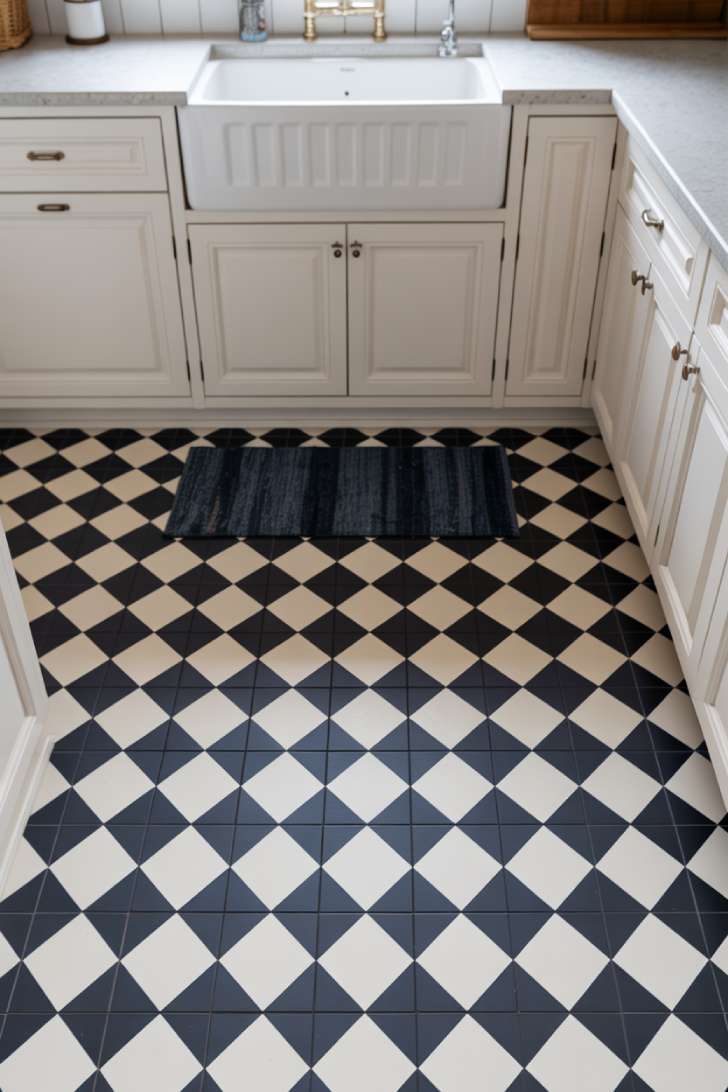
Flooring might be the most underestimated decision in a farmhouse laundry room renovation.
It’s the surface that unifies every other element — walls, cabinetry, countertops — and it’s what you’re standing on for every single load of laundry you do.
Getting it right matters both visually and physically.
For a purely farmhouse-traditional look, terracotta tile and wide-plank hardwood are the most authentic choices.
Terracotta brings immediate warmth and a handmade quality that reads beautifully against white walls.
Wide-plank hardwood — or a wood-look luxury vinyl plank that mimics it — grounds the room in natural material without the moisture-vulnerability of real wood.
For something with more visual punch, patterned cement tile is genuinely spectacular.
A classic black and white geometric pattern adds a graphic, design-forward quality that feels confident without being trendy.
It’s the kind of floor that looks like it was pulled from a 19th-century French farmhouse, and it pairs with almost any upper treatment you can imagine.
Practically speaking, luxury vinyl plank (LVP) is the most forgiving choice for a space that regularly deals with water, humidity, and the occasional detergent spill.
It’s waterproof, softer underfoot than tile, and available in wood-look finishes that are genuinely difficult to distinguish from real hardwood at a glance.
Whatever you choose, make sure the finish is slip-resistant — especially near the sink.
Style Blueprint:
- Patterned cement or encaustic-look porcelain tile for a statement floor
- OR warm-toned LVP in a wood-look finish for a practical, budget-friendly alternative
- Slip-resistant finish, particularly in the area around the sink
- Dark navy or natural jute runner rug in front of the sink for comfort and warmth
- Large-format tiles (12×24 or bigger) for a more open, less busy look in small rooms
Two Rooms in One
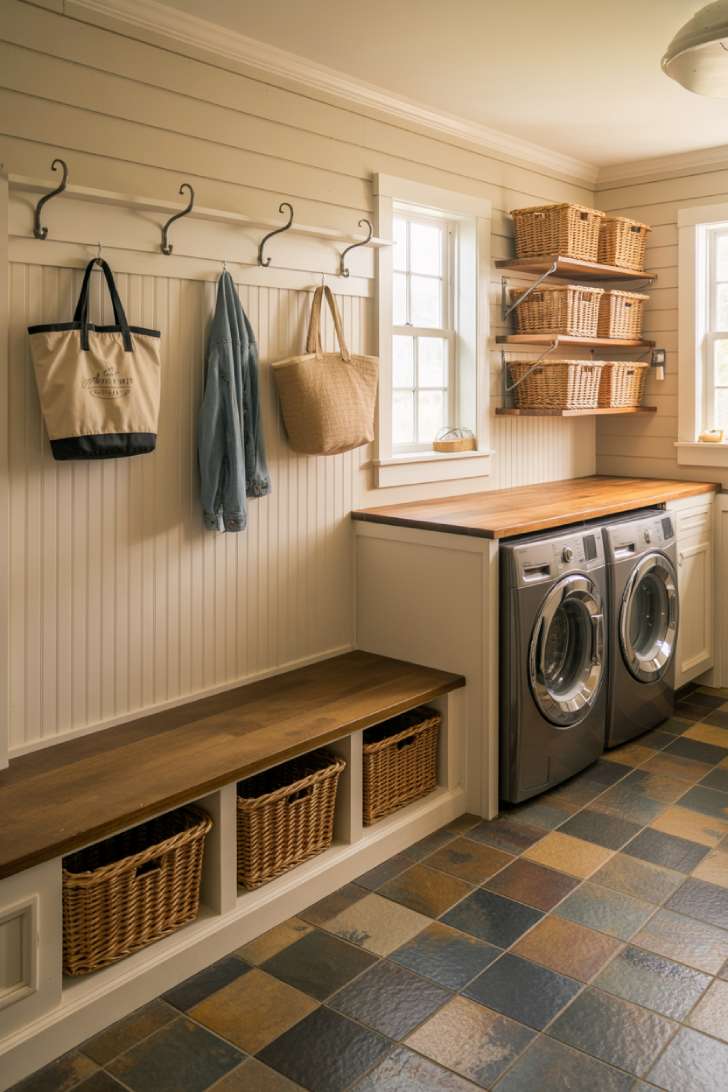
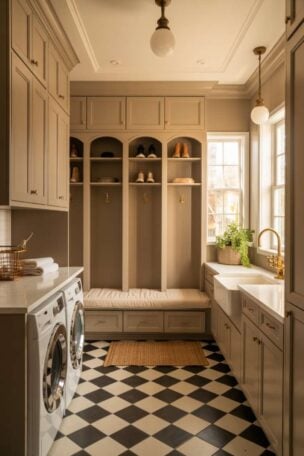
Combining the mudroom and laundry room is one of the most practical decisions a homeowner can make — and in farmhouse design, it’s also one of the most aesthetically natural.
The two spaces share the same DNA.
Both are utility-first rooms that deal with dirt, moisture, outdoor gear, and the daily chaos of a family in motion.
Bringing them together under one roof creates a hardworking hub that handles the messiest part of household life in a single, beautifully organized space.
The key to making a mudroom laundry room combo feel cohesive rather than chaotic is continuity.
Use the same cabinet finish, the same floor tile, and the same hardware throughout both zones.
Let the shiplap or beadboard run from one side of the room to the other without interruption.
On the mudroom side: a built-in bench with storage cubbies or baskets underneath, black iron coat hooks at two heights (adult and kid), and labeled storage for each family member.
On the laundry side: the washer, dryer, farmhouse sink, and open shelving.
A deep farmhouse sink placed at the intersection of both zones does double duty — laundry pre-soaking on one side, muddy boot rinsing on the other.
This is laundry room organization at its most honest: systems built around how a real family actually moves through a day.
Style Blueprint:
- Continuous flooring and wall treatment across both mudroom and laundry zones
- Built-in bench with under-seat storage cubbies or woven baskets
- Black iron coat hooks at two heights for adults and children
- Farmhouse sink positioned at the intersection of both functional zones
- Labeled storage (baskets, bins, or cubbies) for each family member
Design Pro-Tip: In a mudroom-laundry combo, position the dirtiest functions closest to the exterior door. That means boot storage, coat hooks, and a utility sink right at the entry point. The washer and dryer should be further into the space, so outdoor mess doesn’t travel past the laundry zone before it’s dealt with.
Make It Feel Like Yours
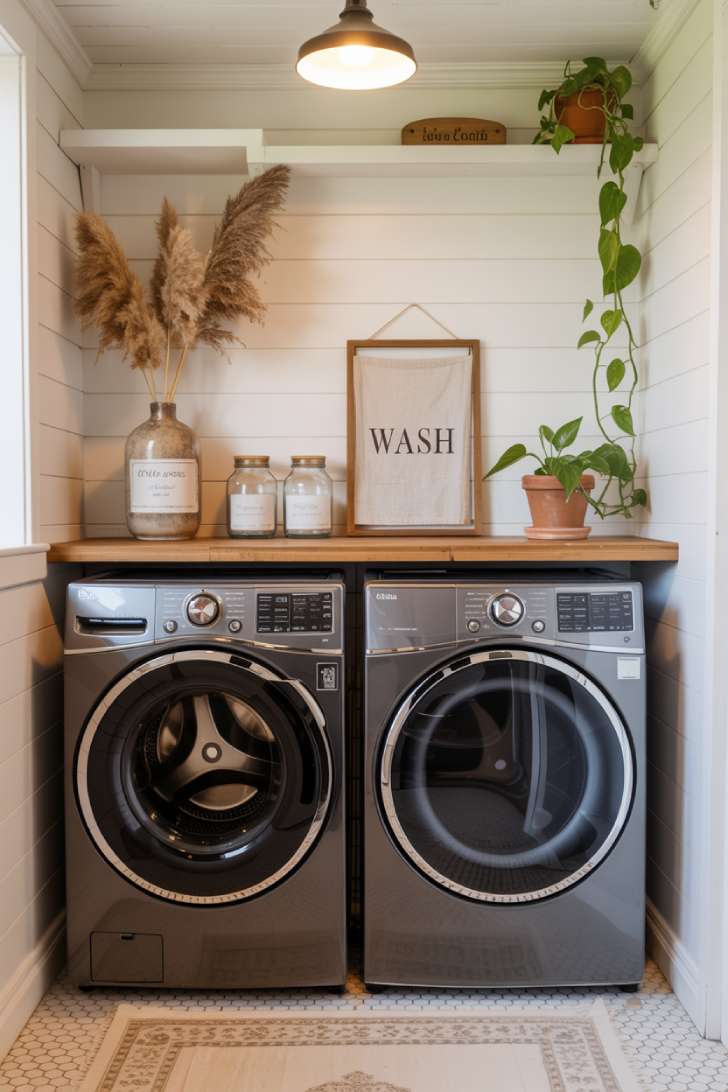
This last idea isn’t really about a specific product or material.
It’s about a decision.
The decision to treat your laundry room like it deserves to feel good.
A soft vintage runner rug underfoot changes the physical experience of standing through a full folding session.
A trailing pothos on the shelf, a ceramic vase of dried pampas grass, a small framed linen print — these are the touches that make a room feel inhabited by an actual person with actual taste.
The psychological effect of a personalized space on a repetitive task is real.
When the room around you is calm and beautiful, the work of doing laundry feels measurably less draining.
The visual weight of natural elements — a plant, dried flowers, a woven textile — introduces organic irregularity into a space that’s otherwise full of right angles and flat surfaces.
That contrast is what creates the “cozy” quality that farmhouse design is so consistently associated with.
Seasonal rotation works beautifully here too.
Dried lavender in summer, wheat stalks in fall, eucalyptus in winter — small swaps that keep the space feeling fresh without requiring any real renovation.
Start with one or two of these personal touches and build from there.
The goal isn’t perfection.
It’s a room that makes you feel something good every time you walk into it.
Style Blueprint:
- Soft vintage-style runner rug in front of the washer and dryer
- One or two live trailing plants (pothos, ivy) or high-quality faux alternatives
- Ceramic vase with dried pampas grass, lavender, or eucalyptus
- Small framed linen or wooden laundry-themed print
- Seasonal decor rotation to keep the space feeling current year-round
A Few Final Thoughts
A farmhouse laundry room isn’t a style reserved for people with large budgets or large spaces.
It’s a design approach built around the idea that the rooms you use most deserve the most care.
Shiplap costs less than wallpaper.
Open shelves cost less than built-in cabinetry.
Mason jars cost almost nothing.
Start with one idea from this list — just one — and let it pull the rest of the room forward.
A new coat of sage paint.
A set of labeled woven baskets.
A barn door that finally makes the hallway feel finished.
The best farmhouse laundry rooms don’t happen all at once.
They grow, layer by layer, into spaces that feel genuinely personal, genuinely functional, and genuinely worth walking into.
Save this post the next time laundry day rolls around — because you’ll want to come back to it.