The laundry room is having a serious moment in home design.
What was once a forgotten corner of the house — hidden in a basement or crammed into a closet — has become one of the most talked-about spaces in modern homes.
And honestly? It makes complete sense.
You spend more time in your laundry room than you probably realize. Getting the design right means every single load of laundry feels less like a chore and more like a routine you can actually enjoy.
These 11 dream laundry room ideas cover every style, every budget, and every square footage — from spacious, magazine-worthy spaces to tiny closets that punch way above their weight.
Let’s get into it.
When Storage Goes All the Way Up
There’s something almost instantly calming about a laundry room where everything has a place and nothing is visible that shouldn’t be.
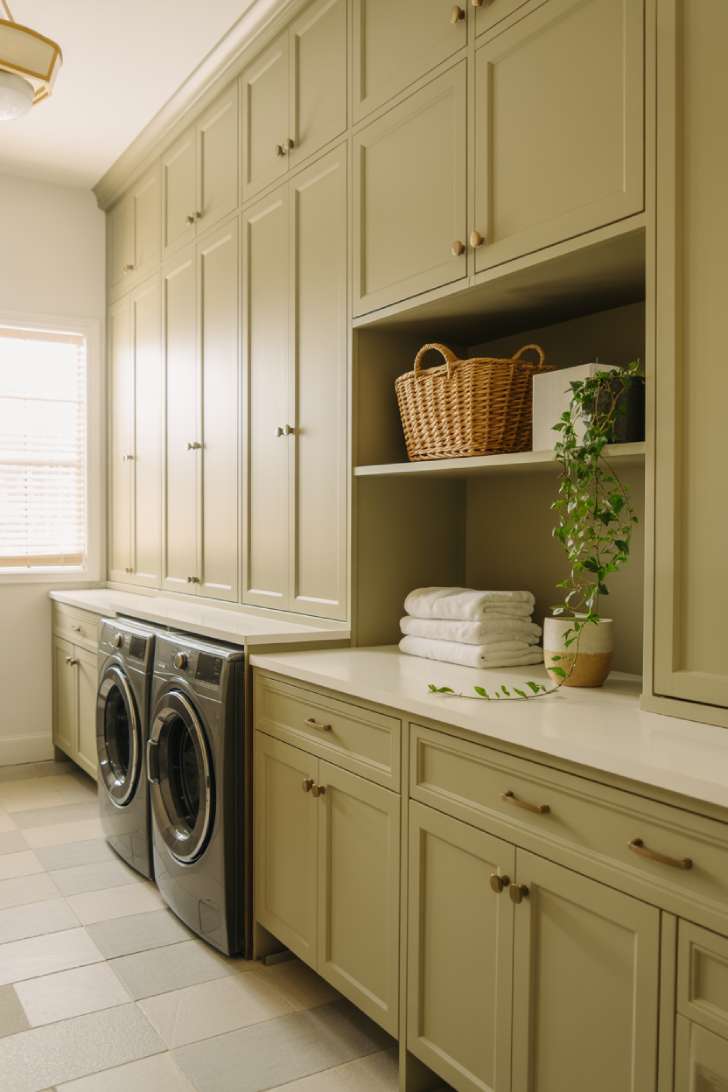
Floor-to-ceiling cabinetry does exactly that.
The vertical lines created by tall cabinets draw the eye upward, making even a modestly sized room feel significantly taller and more considered.
When the cabinetry runs uninterrupted from floor to ceiling, the room reads as one cohesive unit rather than a collection of mismatched pieces — and that visual order has a measurable effect on how relaxed you feel in the space.
Sage green as a cabinet color is a particularly smart choice here.
It’s warm without being loud, and it pairs naturally with brass hardware in a way that feels current but not trend-dependent.
The mix of open and closed sections is the real workhorse of this layout — closed doors keep the visual clutter of everyday laundry supplies hidden, while open shelves offer breathing room and a spot for a plant or two.
This idea works just as well in a compact laundry room as it does in a large one. In tighter spaces, opt for slim upper cabinets with recessed pulls to avoid anything protruding into the walkway.
Style Blueprint:
- Floor-to-ceiling shaker-style cabinetry in a warm, muted tone
- Brushed brass or matte black hardware throughout
- Quartz countertop in white or soft cream
- One section of open shelving for breathing room and styling
- Large-format matte porcelain tile flooring
The Folding Station That Changes Everything
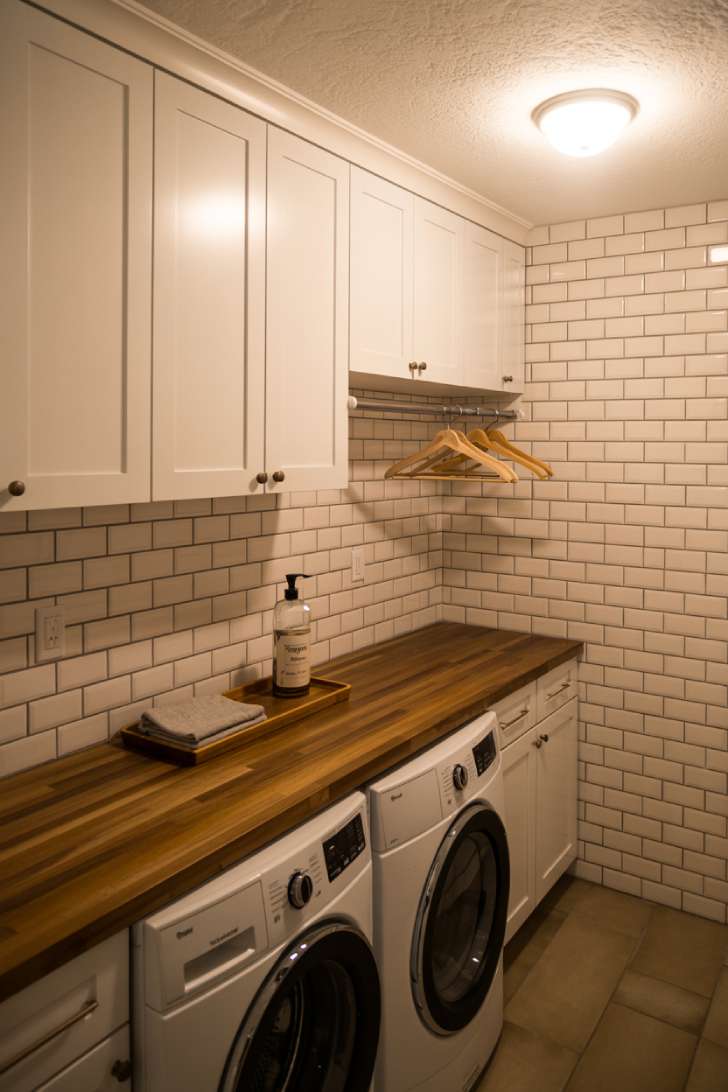
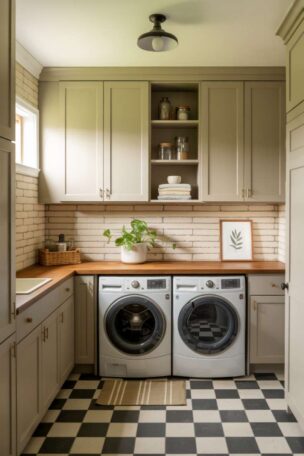
Installing a countertop directly above your front-loading washer and dryer is one of the highest-return moves you can make in a laundry room.
It costs relatively little compared to a full renovation, yet it completely changes how the space functions.
Suddenly, you have a dedicated spot to fold warm clothes straight from the dryer, pre-treat stains without balancing things on top of the machine, and sort a full load before it goes in.
Butcher block works beautifully here for a few reasons.
The warmth of the wood softens what can otherwise be a very hard, utilitarian space. It adds texture at eye level — right where you’re spending most of your time when you’re folding — and that texture registers psychologically as comfort and warmth.
The vertically stacked subway tile backsplash is doing more than you’d think.
Vertical lines lengthen the wall visually, making the ceiling feel higher. It’s a small shift from the traditional horizontal stack, but the difference in a room’s perceived height is real.
Don’t overlook the hanging rod mounted beneath the upper cabinets, either. It’s one of the most practical additions you can make, keeping freshly dried items wrinkle-free without requiring a separate drying area.
Style Blueprint:
- Butcher block or quartz countertop spanning the full width of both machines
- Vertically stacked subway tile backsplash
- Wall-mounted shaker cabinets above with matte black hardware
- Under-cabinet hanging rod for air-drying
- A simple wooden tray to corral detergent and supplies on the countertop
Farmhouse Charm That Actually Works Hard
The farmhouse laundry room is a perennial favorite — and it earns that status by being one of the rare design styles that looks beautiful and functions brilliantly at the same time.
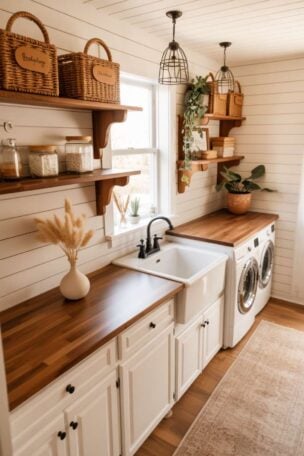
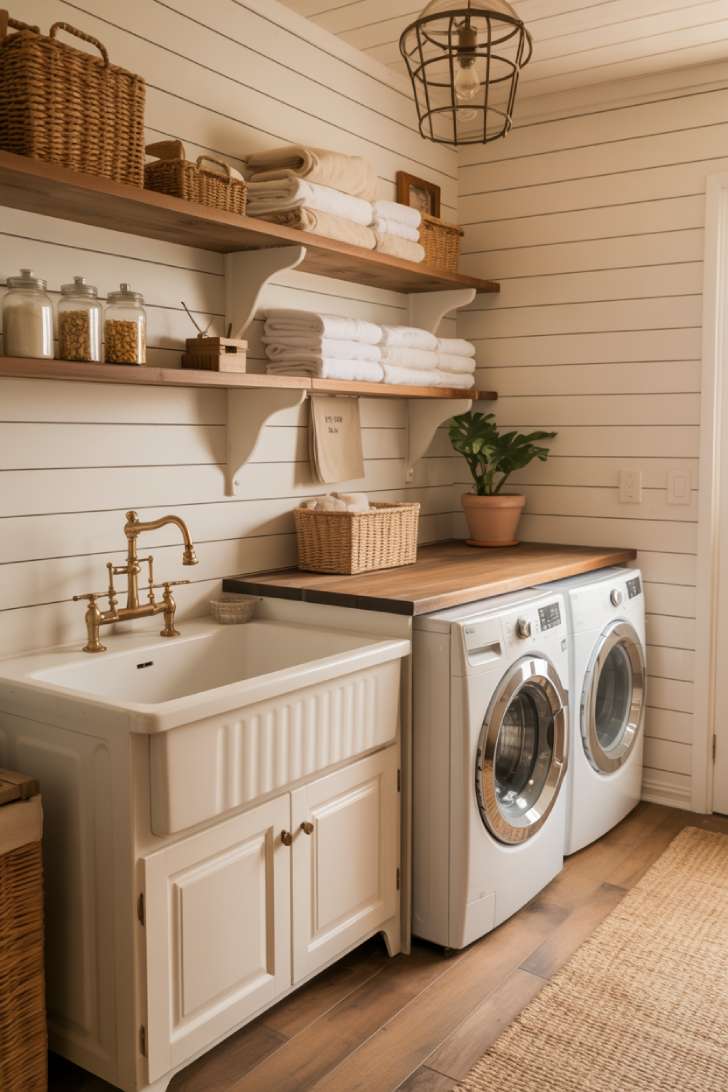
The apron-front sink is the anchor of this entire look.
Its deep basin is genuinely useful — ideal for soaking heavily stained garments, hand-washing delicates, or rinsing out mops — and its visual weight grounds the room in a way a standard undermount sink simply can’t.
Shiplap on the walls adds horizontal lines that make a narrow laundry room feel wider.
It’s tactile, too. Running your hand along a shiplap wall triggers a subconscious sense of craftsmanship and care — and that affects how you perceive the room’s quality overall.
Open wooden shelving here isn’t just aesthetic.
It keeps everything visible and accessible, which genuinely speeds up your laundry routine. No rummaging through closed cabinets for the stain remover.
The jute rug softens the hard floor underfoot and adds a layer of warmth that tile alone can’t provide. Choose a washable version — laundry rooms and spills go hand-in-hand.
Style Blueprint:
- Deep apron-front farmhouse sink with a bridge faucet in aged brass or matte black
- White shiplap or beadboard walls
- Open reclaimed wood shelving above the washer/dryer and sink
- Wide-plank wood-look porcelain tile flooring
- Woven jute or cotton washable runner rug
Design Pro-Tip: Before choosing your cabinet or wall color, tape large paint swatches on the wall and observe them at different times of day — especially under your artificial lighting at night. Laundry rooms often lack natural light, and a color that looks soft and warm in a showroom can appear flat or cold under overhead fluorescent light.
Going Bold With Color (And Not Looking Back)
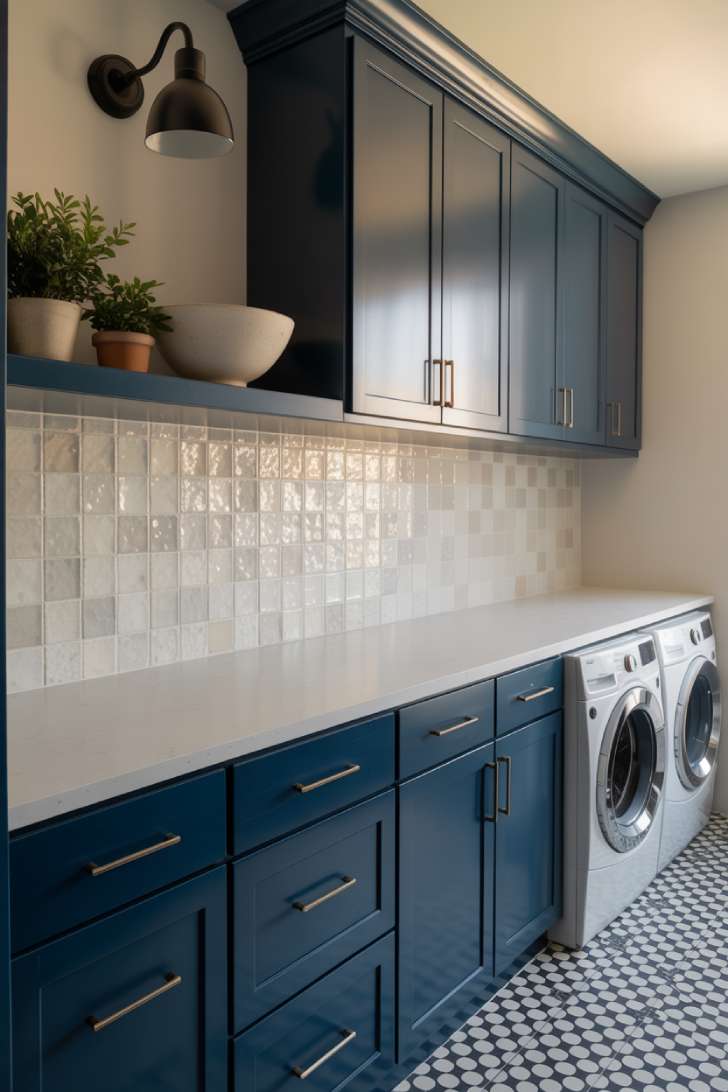
If there’s one laundry room design lesson worth absorbing, it’s this: color is not risky — blandness is.
A two-tone cabinet approach — deep navy below, crisp white above — is one of the most satisfying combinations in laundry room design right now.
The darker lower cabinets visually anchor the room and make the space feel intentional and grounded. The white uppers prevent the room from feeling heavy, keeping the upper half of the room light and open.
The zellige tile backsplash is the detail that takes this from “nice” to memorable.
Because each hand-glazed tile has a slightly uneven surface, light plays across the backsplash differently throughout the day. Morning light creates soft, scattered reflections. Evening light deepens the texture. The wall becomes genuinely interesting to look at — which matters when you’re standing in front of it folding laundry for the fifth time this week.
The geometric floor tile adds a third layer of pattern without competing with the backsplash, largely because the scale is different. Pairing a small, intricate floor pattern with a larger, more organic wall tile keeps the room feeling dynamic rather than chaotic.
Matte black hardware ties every element together with quiet authority.
Style Blueprint:
- Two-tone flat-panel cabinetry: deep navy or forest green lower cabinets, white uppers
- Matte black bar pulls or cup handles throughout
- Hand-glazed zellige or ceramic tile backsplash
- Bold geometric or encaustic-pattern floor tile
- White quartz countertop to balance the color weight
The Laundry Room That Runs Itself
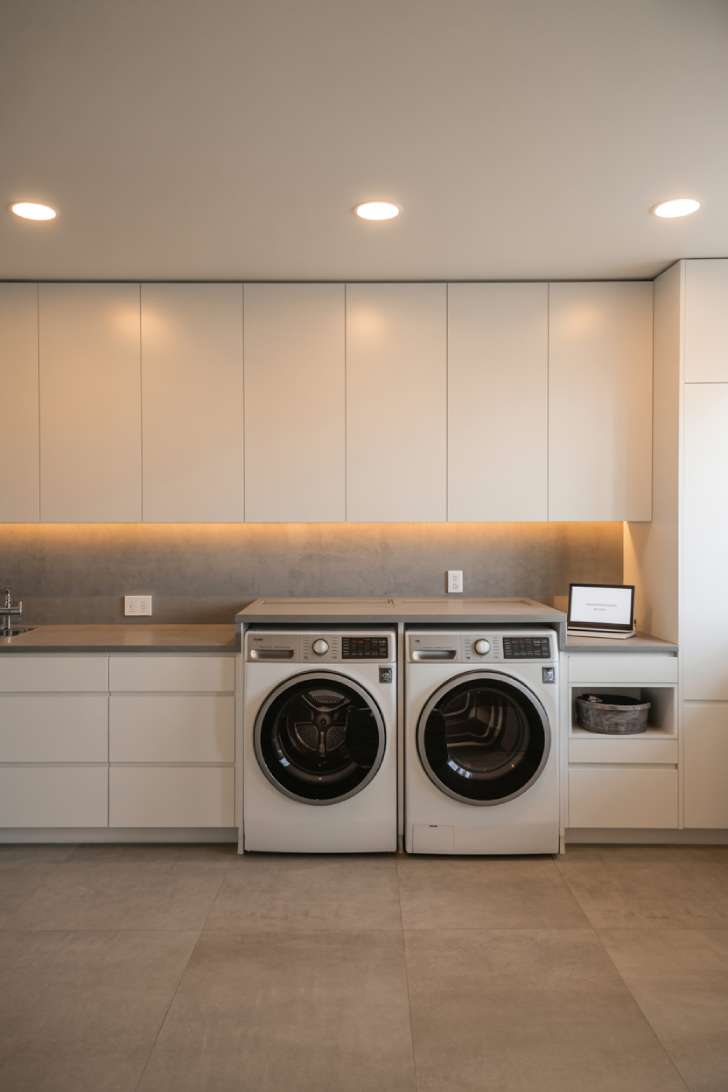
The tech-forward laundry room isn’t a luxury reserved for the very wealthy anymore.
High-efficiency smart washers and dryers — the kind that notify you when a cycle finishes, auto-dose detergent based on load weight, and can be started remotely from your phone — are now widely available at a range of price points.
What makes this laundry room design idea so compelling isn’t just the technology. It’s the restraint of the design surrounding it.
Handleless flat-panel cabinetry in a continuous white run lets the appliances become the visual feature without competition. Nothing distracts. Nothing clutters.
The LED strip lighting beneath the upper cabinets is doing double duty here.
Functionally, it illuminates the countertop work surface without shadows. Psychologically, it creates a warm horizontal band of light at mid-wall level — which makes the room feel both larger and more inviting than a single overhead light source ever could.
The concrete-look porcelain floor in warm grey is intentional, too. It reinforces the modern, clean character of the space without feeling cold.
If you’re planning this setup, include a dedicated charging shelf or tablet mount. Being able to monitor cycles, play music, or follow a folding tutorial without propping a phone against the detergent bottle is a small quality-of-life upgrade with a surprisingly big daily impact.
Style Blueprint:
- Smart washer and dryer with digital touchscreen and app connectivity
- Handleless flat-panel cabinetry in a continuous run to the ceiling
- Warm LED strip lighting beneath upper cabinets
- Concrete-look or warm grey large-format porcelain tile floor
- Built-in tablet holder or small charging shelf for smart device access
Design Pro-Tip: In laundry rooms with no natural light, layer your lighting in at least two ways — overhead for general visibility and under-cabinet for task lighting. A single overhead fixture creates harsh shadows exactly where you need to see most clearly: the countertop and inside the machines.
The Hardest-Working Room in the House
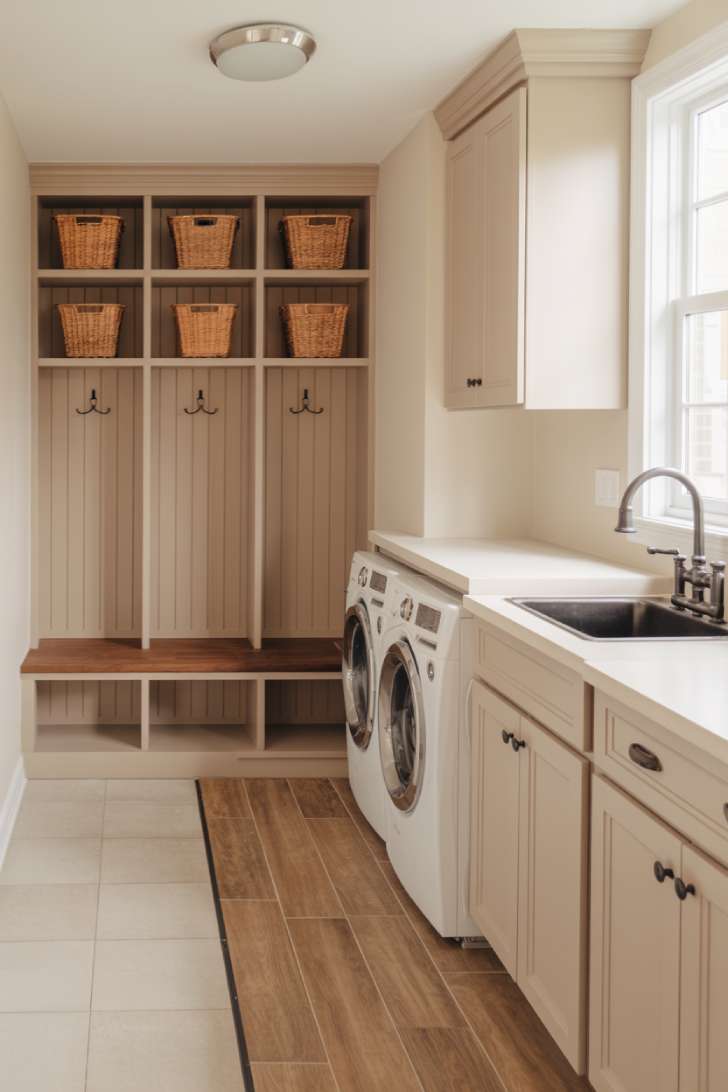
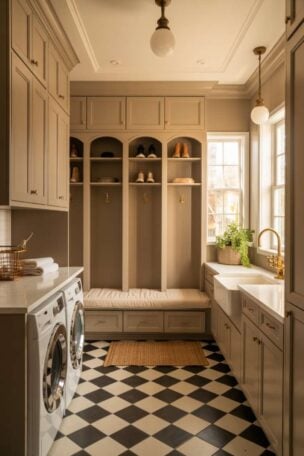
The mudroom laundry room combo is one of the smartest layout decisions a homeowner can make — particularly for busy families.
By combining both functions in one space, you create a room that handles the full lifecycle of dirty clothes: from the moment they come through the door to the moment they’re clean, folded, and ready to be put away.
The transition between the two zones deserves careful thought.
Here, the flooring change — from white tile in the mudroom entry area to wood-look plank in the laundry zone — is doing something clever. It signals a shift in purpose without requiring a wall or divider. The eye reads two distinct zones, even though the room is open.
The built-in bench with cubbies is more than just storage.
Sitting down to take off muddy boots near the door means dirt doesn’t travel further into the house. It’s a behavioral design choice that keeps the rest of your home cleaner, almost automatically.
Coat hooks positioned at varying heights accommodate everyone in the household — adults, kids, and the inevitable oversized backpack.
The utility sink anchors the laundry side and completes the workflow loop, allowing heavily soiled items to be rinsed before going into the wash.
Style Blueprint:
- Built-in mudroom bench with open cubbies and woven storage baskets
- Coat hooks at varying heights above the cubbies
- Two distinct flooring materials to define each zone visually
- Integrated utility sink with a durable matte black or brushed nickel faucet
- Tall flanking cabinets on either side of the washer and dryer
Small Space, Big Personality
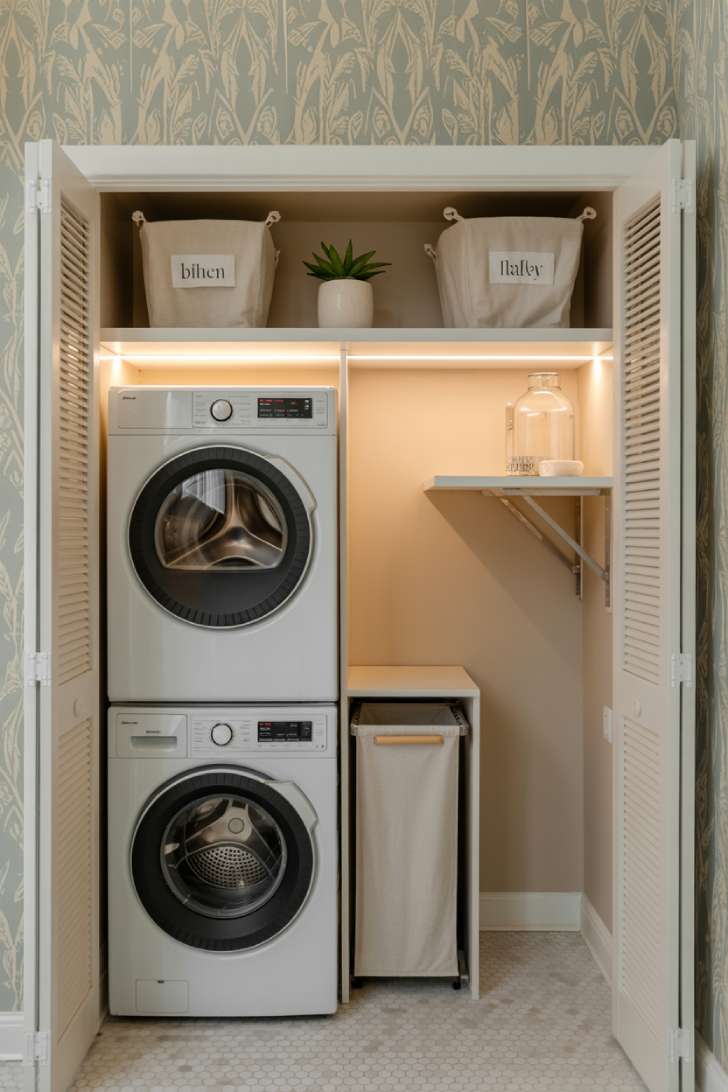
A small laundry room isn’t a limitation. It’s a design challenge — and the best ones prove that constraint breeds creativity.
Stacking the washer and dryer is the first and most impactful decision in a small space.
It immediately frees up the floor area to the side for a slim pull-out hamper, a fold-down shelf, or even a short run of base cabinets. That reclaimed floor space changes everything.
The botanical wallpaper on the back wall is deliberate and effective.
In a small, enclosed space, a bold pattern on the back wall creates the optical illusion of depth. Your eye is drawn into the pattern rather than stopping at the flat surface, and the room reads as slightly larger as a result.
It also transforms the space emotionally.
Walking up to a laundry closet with a plain white back wall feels clinical. Walking up to one with a considered, beautiful wallpaper feels like a space someone actually cared about — and that shifts your experience of doing laundry in a way that’s hard to quantify but very easy to feel.
The fold-down shelf is a non-negotiable in a space this size. Mounted on a hinge, it provides a full folding surface when you need it and disappears completely when you don’t.
Style Blueprint:
- Stacked front-load washer and dryer to maximize floor space
- Bold or botanical patterned wallpaper on the back wall
- Hinged fold-down folding shelf mounted to the side wall
- Slim built-in pull-out hamper beside the stacked unit
- LED strip lighting on the underside of upper shelves for machine visibility
Design Pro-Tip: In a laundry closet, bi-fold doors are almost always the better choice over standard swing doors. They require zero clearance when open, which means you can stand directly in front of the machines without a door swinging into your space.
When the Tile Steals the Show
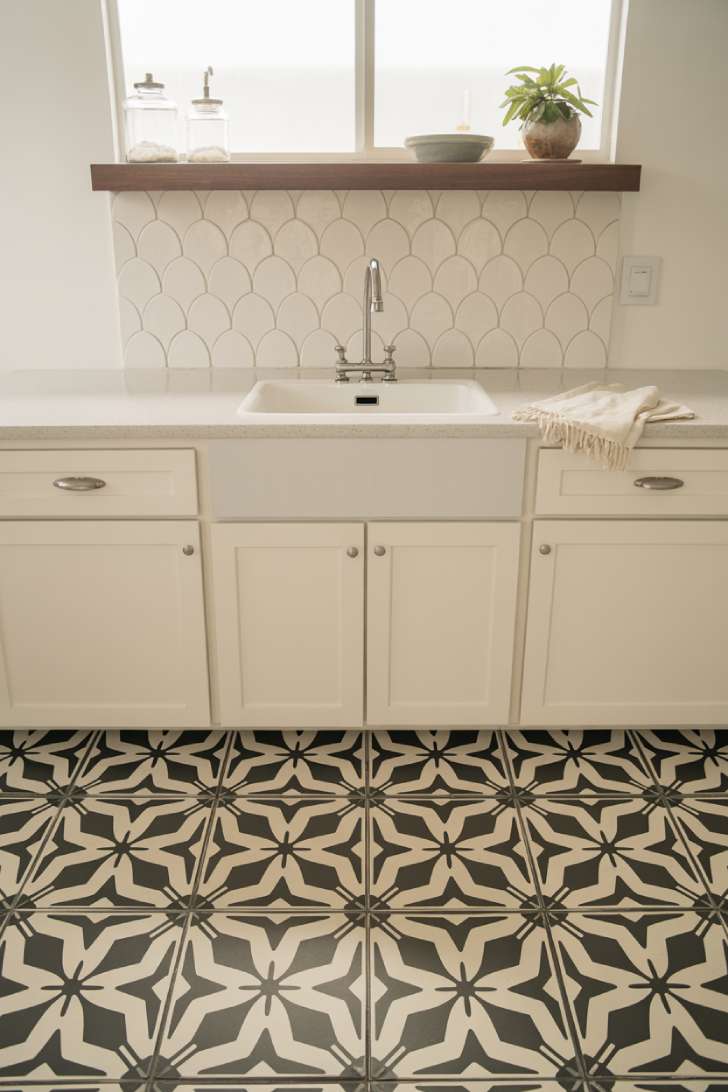
If you’ve ever walked into a room and immediately looked down at the floor, you understand the power of a statement tile.
In a laundry room, where the walls and cabinets are often largely obscured by appliances and storage, the floor is one of the most visible surfaces in the entire space.
A bold encaustic-style geometric floor tile with a Moroccan-inspired pattern does something remarkable to a laundry room.
It brings in visual complexity at the lowest point of the room, which grounds the space with personality without requiring a single piece of furniture or decor.
The restraint of the all-white cabinetry here is not a lack of confidence — it’s a deliberate choice.
When the floor is this interesting, the surrounding elements need to step back. White shaker cabinets with simple brushed nickel pulls are the ideal neutral foil. They’re present, they’re functional, but they don’t compete.
The scallop-shaped ceramic tile backsplash introduces a second layer of texture and pattern, but at a different scale and in a softer shape — which is why it works alongside the bold floor rather than clashing with it.
Laundry room flooring is also a practical consideration. Encaustic cement tiles require sealing, but once sealed, they’re extremely durable and water-resistant. For a lower-maintenance version of the same look, porcelain tiles printed with encaustic patterns offer the aesthetic without the upkeep.
Style Blueprint:
- Bold geometric or Moroccan-pattern encaustic or porcelain floor tile
- All-white shaker cabinetry to balance the patterned floor
- Scallop, handmade ceramic, or curved tile backsplash in a neutral tone
- Brushed nickel or unlacquered brass hardware
- One open walnut wood shelf for warmth and styling
The Luxury Addition Every Pet Owner Wants
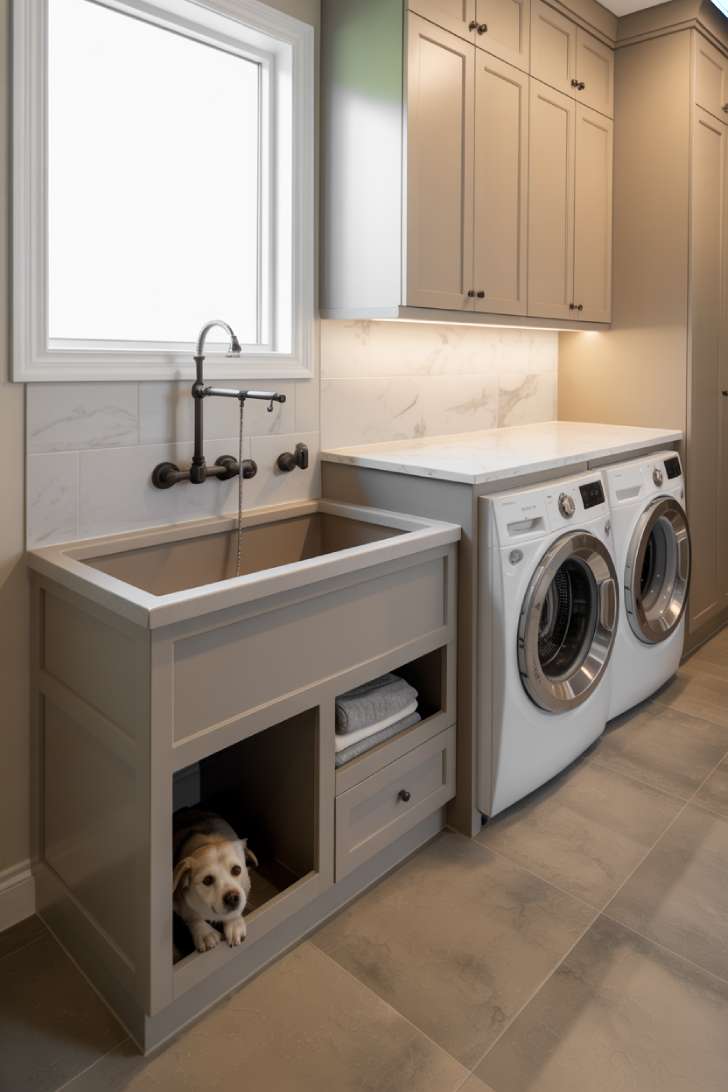
The pet washing station has moved from novelty feature to genuine priority for pet-owning homeowners — and once you see one done well, it’s hard to understand why anyone would do without it.
The dedicated dog wash basin addresses one of the most common laundry room frustrations: the aftermath of muddy walks, beach trips, or rainy-day adventures.
Having a proper, purpose-built space for it changes the dynamic entirely.
The adjustable wall-mount hand shower on a slide bar is the detail that makes this feature genuinely functional rather than just impressive on paper.
It allows you to direct water exactly where you need it, at whatever height suits the size of your dog, without wrestling with a fixed faucet or improvising with bathroom fixtures.
The slip-resistant matte floor tile is a non-negotiable here.
Wet dogs and wet humans on a glossy floor is a recipe for disaster. Matte large-format porcelain tile provides traction without sacrificing the polished aesthetic of the rest of the room.
Positioning the dog wash station beside — not across from — the washer and dryer creates an efficient workflow: wash the dog, towel them off, throw the dirty towels straight into the machine. Done.
The marble-look porcelain backsplash throughout reads as genuinely luxurious without the maintenance requirements of actual marble.
Style Blueprint:
- Deep rectangular built-in dog wash basin at a comfortable working height
- Adjustable wall-mount hand shower with a slide bar in matte black or brushed nickel
- Pull-out ramp or built-in step for easy pet access
- Slip-resistant matte large-format porcelain floor tile
- Marble-look porcelain slab backsplash for a high-end finish
Design Pro-Tip: When planning a pet washing station, raise the basin height by 4–6 inches above a standard sink height. Bending over a low basin while managing a wet, wriggling dog is one of those small ergonomic details that makes an enormous difference to the actual experience of using the space.
The Art of the Open Shelf
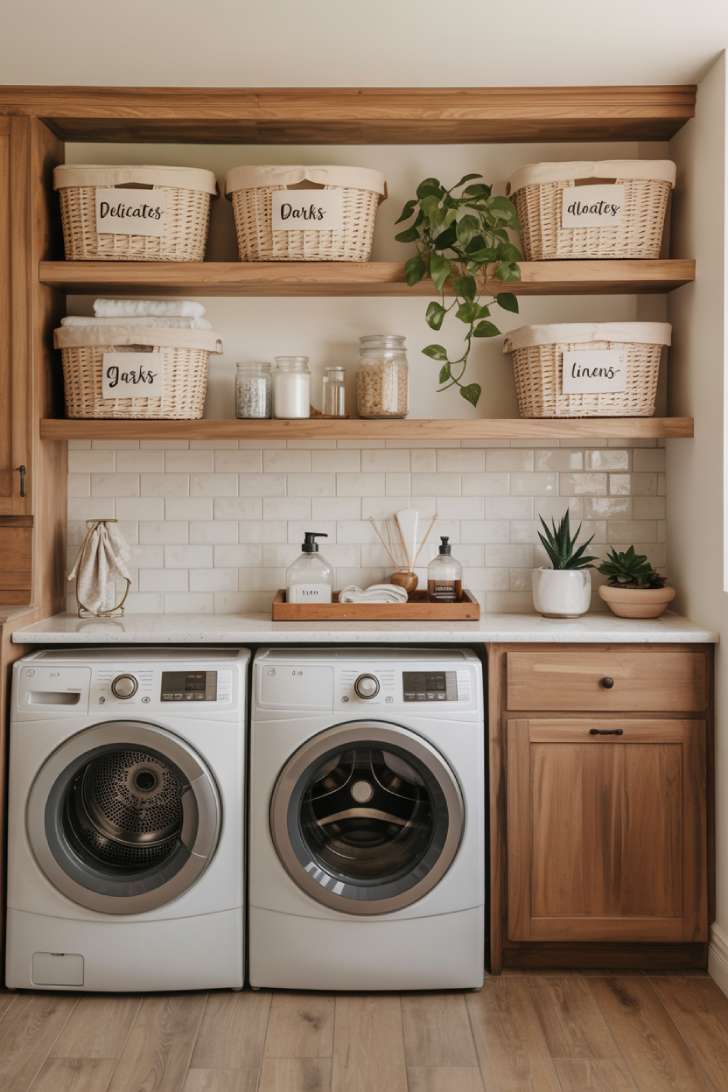
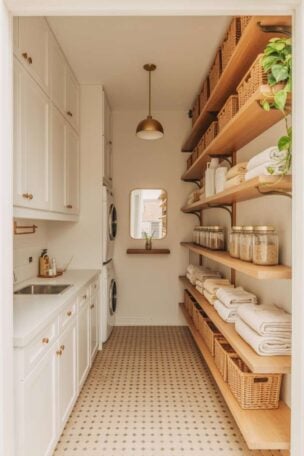
Open shelving in a laundry room is one of those ideas that gets dismissed as impractical — and then executed beautifully and promptly reconsidered.
The key is in how you approach what goes on the shelves.
In a laundry room, open shelving works best when the items stored on it are either genuinely beautiful or consistently organized. Ideally, both.
Matching linen baskets with hand-lettered label tags are doing more than organizing — they’re creating a visual rhythm across the shelf that the eye reads as calm and ordered.
When the brain perceives order, the space feels more spacious than it actually is. A well-organized open shelf in a small laundry room can make the room feel noticeably larger.
Glass apothecary jars for detergent pods and dryer sheets are a small but meaningful upgrade from the original plastic packaging.
The transparency of glass keeps contents visible and easy to monitor, while the container shape adds a consistent, cohesive element to the shelving display.
The trailing pothos plant at the end of the top shelf is the organic counterpoint to all those clean straight lines.
Its irregular, trailing form softens the geometry of the shelving arrangement and introduces life into a space that can otherwise feel very hard and functional.
Natural oak shelving material is warm at a glance, too. Wood at eye level, where you’re spending the most time in the room, registers as inviting and tactile in a way that painted MDF or metal simply doesn’t.
Style Blueprint:
- Natural oak or white oak floating shelves spanning the full wall width
- Matching linen or rattan labeled storage baskets in a consistent color palette
- Glass apothecary jars for small laundry supplies
- A trailing or potted plant at the end of the top shelf
- A narrow wooden tray on the countertop to group daily-use items
The Laundry Room That Feels Like a Retreat
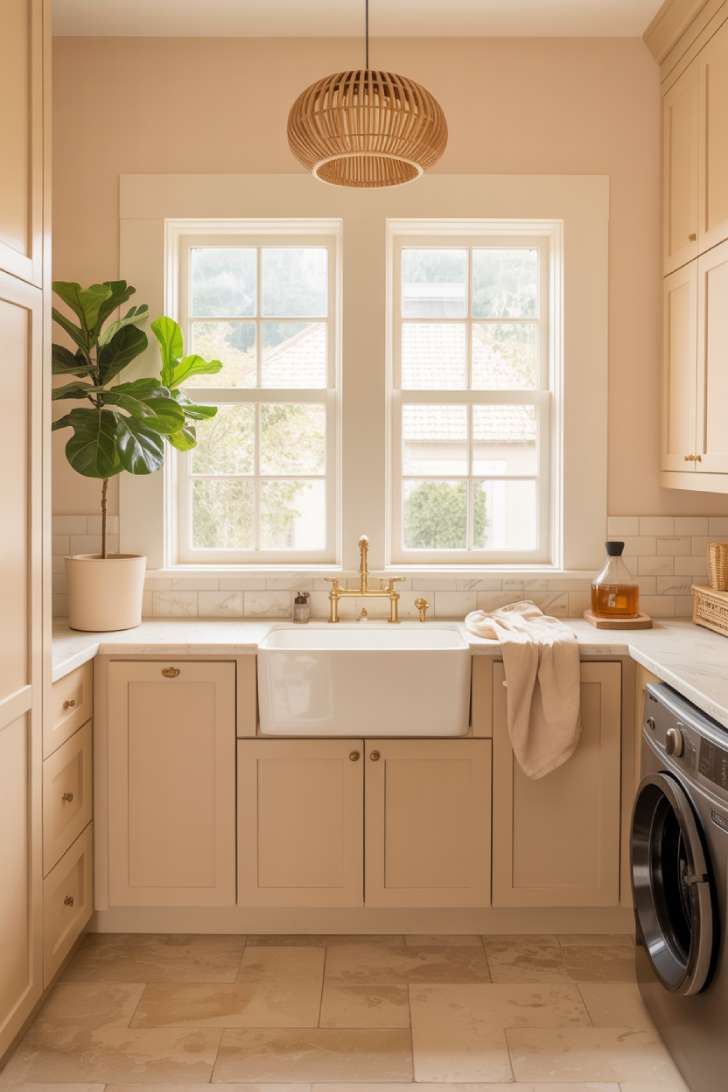
This is the laundry room idea that makes people stop scrolling.
The spa-inspired laundry room isn’t about extravagance for its own sake — it’s about the recognition that a space you use multiple times a week deserves to feel genuinely good to be in.
Natural light is the most transformative element here.
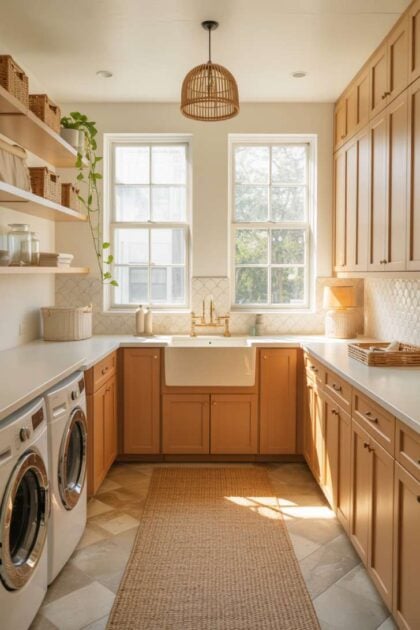
Two large casement windows above the sink flood the room with daylight that shifts subtly throughout the day, keeping the space feeling alive rather than static. If your laundry room doesn’t have windows, a well-placed large mirror on the opposite wall can replicate some of that effect by reflecting whatever light does exist back into the space.
The warm cream wall color with a barely-there blush undertone is doing quiet, important work.
It’s warmer than white, softer than beige, and it makes the room feel like it was designed with intention rather than default. Against warm oak cabinetry and unlacquered brass hardware, it creates a color story that feels cohesive and lived-in.
Honed marble — or a convincing marble-look porcelain in a honed finish — has a matte quality that reads as softer and more organic than polished stone.
In a space built around calm and serenity, that matte quality matters. Polished, reflective surfaces can feel clinical. Honed surfaces feel handcrafted and unhurried.
The rattan pendant light is the finishing touch that brings the outdoor in.
Natural fiber lighting at ceiling level softens the entire overhead plane of the room, casting a warm, dappled light that makes the space feel like somewhere you’d actually want to spend time.
And honestly? That’s the whole point.
Style Blueprint:
- Warm cream or soft blush wall paint with a matte finish
- White oak or painted oak shaker cabinetry with unlacquered brass hardware
- Honed marble or marble-look porcelain countertop
- Large casement or picture windows, or a large mirror to maximize existing light
- Natural fiber pendant light (rattan, jute, or woven seagrass)
Your Dream Laundry Room Is Closer Than You Think
The gap between the laundry room you have and the one you want is almost always smaller than it appears.
You don’t need a full renovation to start moving in the right direction.
A new countertop above your existing machines, a coat of cabinet paint, a set of matching baskets on an open shelf, or a statement light fixture — each of these moves the needle.
Pick the one idea from this list that genuinely excited you.
Start there. Build from it.
A well-designed laundry room adds real value to your home and, more importantly, makes one of the most repetitive parts of domestic life feel a little less like a chore and a lot more like a routine you’ve actually got under control.
Save this post — you’ll want to come back to it when the renovation planning begins.