
The dark academia living room aesthetic brings scholarly sophistication into your home through rich mahogany woods, leather-bound books, and deep jewel tones.
This design style transforms ordinary spaces into intellectual sanctuaries that feel like private libraries from centuries past.
Whether you have a spacious area or a compact apartment, these dark academia interior design concepts will help you create a refined retreat for reading and contemplation.
Scholarly Sanctuary With Floor-to-Ceiling Bookshelves

This classic dark academia living room showcases how vertical storage can become the room’s defining feature.
The floor-to-ceiling mahogany shelving creates an immediate sense of grandeur.
Leather-bound volumes in burgundy and forest green add visual depth without overwhelming the space.
The chocolate brown Chesterfield sofa serves as a comfortable anchor point.
What makes this work is the careful balance between the heavy oak furniture and the filtered afternoon light through mullioned windows.
The brass telescope and vintage globe aren’t just decorative—they tell a story about curiosity and exploration.
Emerald Velvet Meets Timeless Wood Paneling

Wood paneling creates instant warmth that painted walls simply can’t match.
This space proves that emerald velvet can hold its own against dark architectural elements.
The brass nail head trim on the Chesterfield sofa adds just enough metallic contrast.
A carved writing desk with brass hardware provides a functional workspace that feels period-appropriate.
The burgundy drapes filter natural light in a way that creates atmospheric depth throughout the day.
Oil paintings in gilded frames break up the wood paneling without disrupting the scholarly mood.
Layered Lighting for Evening Reading Sessions

Brass reading lamps create pools of focused light that make this space functional after sunset.
The positioning matters—flanking seating areas rather than relying on overhead fixtures alone.
Multiple light sources at different heights add dimension that single fixtures miss.
The mahogany coffee table becomes more than furniture when topped with proper task lighting.
Framed botanical prints gain new life when illuminated by warm amber bulbs.
Those floating dust motes in filtered daylight? They’re not a problem—they’re part of the charm that makes dark academia interior design feel lived-in rather than staged.
Contemporary Touches in Traditional Settings

Sleek black marble brings this traditional aesthetic into contemporary territory.
The key is knowing which modern materials complement rather than clash with vintage elements.
A crystal decanter on marble feels intentional, not confused.
Clean lines on the coffee table prevent the space from feeling too heavy or dated.
Deep charcoal velvet offers a modern alternative to traditional leather while maintaining the moody palette.
This approach works for those who love the scholarly vibe but live in newer homes without original architectural details.
Jewel-Toned Textiles as Statement Pieces

Persian rugs in burgundy and forest green establish the color foundation before anything else goes in.
Layering these textiles across dark hardwood creates visual interest at ground level.
The emerald velvet sofa echoes the rug’s green tones without matching too perfectly.
Brass nail head trim acts as a bridge between the warm wood tones and cooler green hues.
Tall arched windows need those heavy charcoal curtains—not for privacy, but to control the light quality throughout different times of day.
Gold-framed oil paintings of classical landscapes complete the upper visual plane.
Compact Spaces With Maximum Sophistication

Smaller rooms benefit from this aesthetic because the richness reads as cozy rather than cramped.
A single burgundy velvet armchair makes more sense than trying to fit a full sofa.
Built-in bookshelves use vertical space efficiently without eating up floor area.
The sleek black coffee table provides surface space without visual bulk.
Framed botanical prints and architectural sketches fill wall space with personality at minimal cost.
That brass desk lamp? It’s doing double duty as both task lighting and decorative sculpture.
Intimate Reading Nooks With Purpose

This setup prioritizes function—every element serves the person who actually uses this room.
The burgundy velvet armchair sits exactly where natural light hits during afternoon reading hours.
A sleek black reading lamp handles evening sessions without harsh glare.
Dark wood paneling on the lower walls adds warmth without the commitment of full floor-to-ceiling coverage.
The vintage globe on an antique desk isn’t just decorative—it’s an invitation to curiosity.
Brass accents catch lamplight and create little moments of visual interest as you move through the space.
Layered Seating for Varied Activities

Burgundy velvet armchairs paired with a charcoal sectional accommodate different postures and activities.
Some moments call for upright reading; others need full recline.
The dark walnut coffee table provides a central surface that everyone can reach.
Floor-to-ceiling built-ins maximize storage without custom carpentry costs—many affordable systems now offer this look.
Persian rugs in muted jewel tones layer across dark hardwood to define distinct zones.
Vintage brass table lamps create those pools of golden light that overhead fixtures never quite achieve.
Burgundy Leather as the Anchor

A worn leather Chesterfield in burgundy becomes the room’s emotional center.
The vintage wooden desk with brass hardware offers a dedicated workspace that feels separate from the relaxation zone.
Built-in bookshelves eliminate the need for freestanding furniture that would crowd a small footprint.
An ornate Persian rug in crimson and navy defines the seating area without permanent commitment.
That small marble-topped side table holds just enough—a brass magnifying glass and fountain pen—to suggest scholarly pursuits without clutter.
Heavy velvet curtains control not just light but also the room’s acoustic quality.
Emerald Sophistication With Modern Comfort

Emerald green brings life to the typically dark palette without breaking from the aesthetic.
Modern comfort doesn’t mean sacrificing style—this plush sofa proves both are possible.
A sleek black leather armchair provides visual contrast and a different seating experience.
The low walnut coffee table keeps sightlines open across a compact floor plan.
Framed botanical prints and antique maps fill wall space with intellectual curiosity.
A brass floor lamp with dark green shade ties the color scheme together while providing adjustable task lighting.
Creating Intellectual Atmosphere Through Curation

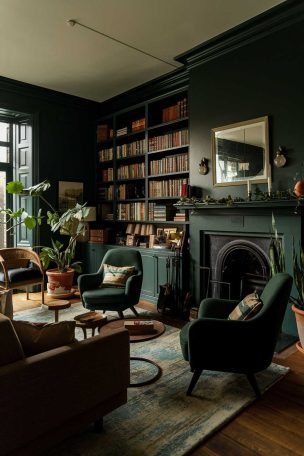
Forest green walls provide a dramatic backdrop that makes every other element pop.
That large oil painting of a classical landscape becomes a window to another world.
The burgundy velvet sofa placed directly beneath creates a natural focal point.
Vintage brass reading lamps cast directional light that changes the painting’s appearance throughout the day.
An antique wooden coffee table stacked with old atlases and manuscripts invites hands-on exploration.
Amber light filtering through charcoal curtains creates constantly shifting shadows that prevent the room from feeling static.
Multiple Seating Styles for Visual Interest

Emerald green velvet armchairs paired with a charcoal sectional create conversation areas without formal rigidity.
The mahogany coffee table grounds the arrangement with substantial presence.
Built-in dark walnut bookshelves house the collection without dominating the room.
Decorative antique globes break up rows of book spines with three-dimensional interest.
Ornate brass reading lamps provide localized light that adapts to how people actually use each seat.
That Persian rug in burgundy and gold defines the seating zone while protecting the hardwood from furniture wear.
Texture Layering for Sensory Depth

Forest green velvet armchairs flanking a charcoal sofa create symmetry without stiffness.
The low walnut coffee table displays leather-bound books and vintage brass objects at easy reach.
What makes this work is the texture variety—velvet, leather, brass, and aged paper.
Floor-to-ceiling built-in bookshelves provide rhythm along the walls.
A large Persian rug in burgundy and navy anchors everything with pattern and warmth.
Tweed throw pillows and a cashmere blanket add tactile comfort that invites actual use rather than just admiration.
Cognac Leather for Lived-In Character

Cognac brown leather ages beautifully, making it a smart long-term choice.
The worn patina on this Chesterfield tells its own story.
Mahogany wood paneling with forest green walls creates a two-tone approach that adds depth.
Built-in bookshelves filled with vintage hardcovers and brass accents bring the walls to life.
A marble-topped coffee table holds a vintage globe and leather-bound journals—functional décor.
That classic banker’s lamp provides focused light for reading without the harshness of overhead fixtures.
Atmospheric Shadows as Design Element

Brass floor lamps and pendant fixtures create dramatic shadows that become part of the design.
The charcoal velvet sofa serves as a neutral foundation for burgundy and forest green accent pillows.
A sleek black marble coffee table reflects light in unexpected ways throughout the day.
Persian rugs in deep jewel tones layer across dark hardwood for both comfort and visual grounding.
Framed botanical prints and vintage maps gain depth from the directional lighting.
That steaming cup of tea and scattered open books? They’re reminders that this space is meant for living, not just looking.
Apartment-Scale Academic Elegance

Apartments don’t need architectural details to achieve this look—color and furniture selection do the work.
Charcoal gray walls create drama without the permanence of wood paneling.
A forest green velvet sofa paired with worn leather armchairs mixes textures at different price points.
Floor-to-ceiling dark wooden bookshelves can be freestanding rather than built-in.
An antique brass floor lamp with an amber shade casts the warm glow that defines this aesthetic.
Framed vintage botanical prints and old maps personalize blank walls without expensive gallery art.
Exposed Brick for Urban Academic Vibes

Exposed brick brings textural warmth that pairs surprisingly well with mahogany bookshelves.
The forest green velvet armchair and worn leather ottoman create a dedicated reading zone.
A sleek black metal floor lamp with brass accents provides modern functionality.
The compact writing desk with brass hardware fits into corners that larger pieces would waste.
Burgundy and charcoal gray textiles soften the hard surfaces of brick and wood.
Multiple light sources at different heights create an intimate atmosphere that single fixtures can’t match.
Maximizing Natural Light in Small Spaces

Recessed ceiling fixtures distribute light evenly without taking up visual space.
The forest green velvet armchair positioned beside a sleek reading lamp creates a purposeful reading corner.
Persian rugs in burgundy and gold add warmth underfoot without overwhelming a small footprint.
Dark wooden furniture complements exposed brick walls rather than competing with them.
Brass accents on picture frames and a vintage globe catch light and create focal points.
Soft ambient lighting creates intimate pools rather than harsh illumination—the difference between a showroom and a sanctuary.
Jewel-Toned Maximalism Done Right

Burgundy leather armchairs anchored by a forest green velvet sofa create a rich color story.
Floor-to-ceiling dark wood bookshelves filled with classic literature establish the room’s purpose immediately.
Persian rugs in deep jewel tones layer for comfort and visual complexity.
Vintage globes, ornate picture frames, and potted ivy cascading from floating shelves add personality at every level.
Warm brass reading lamps cast golden light that creates dramatic shadows across surfaces.
This approach works when you love the aesthetic enough to commit fully rather than hedge with neutrals.
Conclusion
The dark academia living room aesthetic offers more than just visual appeal—it creates spaces that encourage reading, thinking, and intellectual pursuits.
From compact apartments to spacious homes, these design principles adapt to various scales and budgets.
Rich woods, deep jewel tones, vintage accessories, and layered lighting work together to transform ordinary rooms into scholarly retreats.
Start with one signature piece—a velvet sofa, a brass lamp, or floor-to-ceiling bookshelves—and build your space around it gradually.