There’s something quietly wonderful about a laundry room that actually makes you want to spend time in it.
Cottage style does exactly that.
It takes a purely functional space and wraps it in warmth — beadboard, woven textures, soft colors, vintage finds — until doing laundry starts to feel less like a chore and more like a moment of calm in your day.
These 11 cottage laundry room ideas are packed with real inspiration, practical details, and honest design perspective to help you create a space that works hard and looks beautiful doing it.
Beadboard Walls That Set the Whole Tone
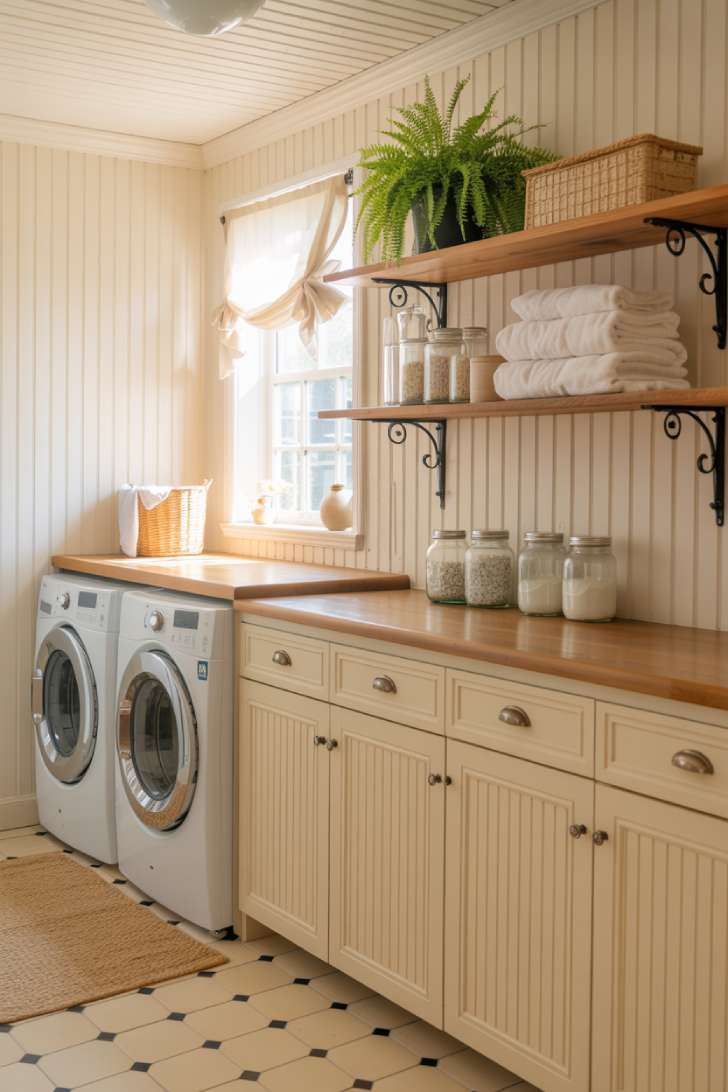
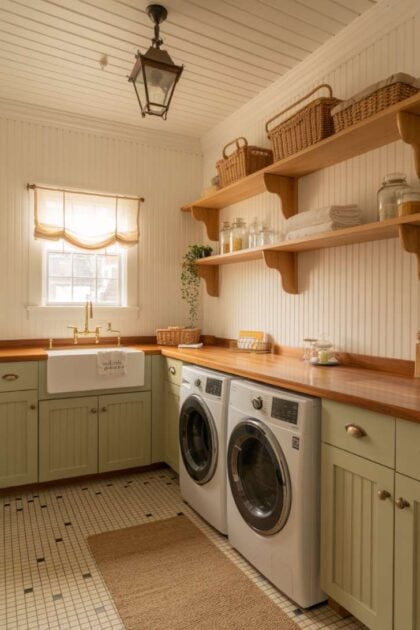
Beadboard is the single most recognizable feature of a cottage laundry room, and there’s a good reason it keeps showing up everywhere.
Those narrow vertical panels do something clever to a small space — they draw the eye upward, making the room feel taller without changing a single structural thing.
Painted in a warm white rather than a cold, stark white, beadboard absorbs light gently and gives the walls a quiet, layered texture that flat paint simply can’t achieve.
Pair it with cream shaker cabinets, and the room immediately stops feeling like a utility closet and starts feeling like a real, considered space.
The checkerboard floor adds graphic personality without competing with the softness of the walls, and a jute runner softens the whole thing beautifully underfoot.
This is the kind of room where the materials do most of the work for you.
Style Blueprint:
- Full-wall or wainscoting-height white beadboard paneling
- Cream or warm white shaker cabinets with vintage-style hardware
- Butcher block or reclaimed wood countertop over the machines
- Open wood shelves on decorative iron corbels
- Jute or cotton runner on the floor
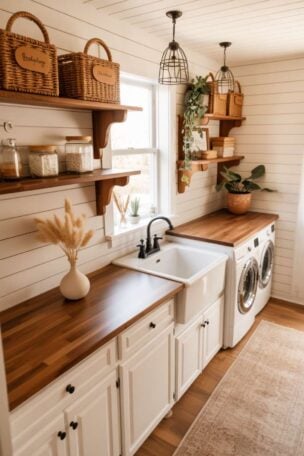
Shiplap and a Farmhouse Sink: A Natural Pair
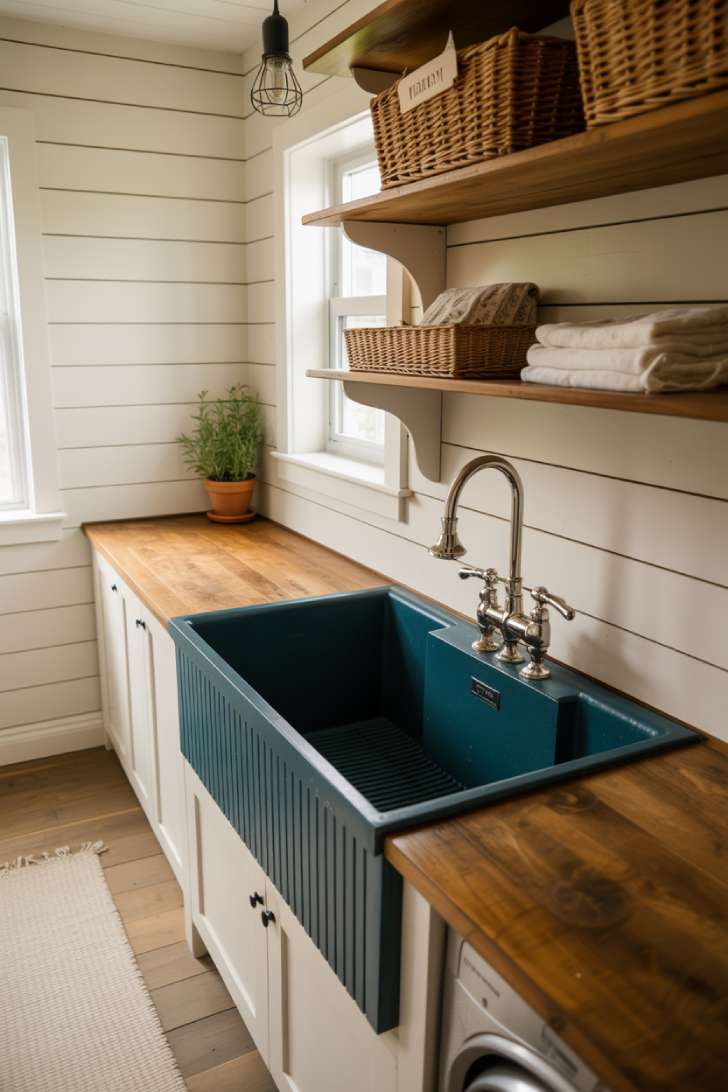
Shiplap and farmhouse sinks were practically made for each other.
The horizontal lines of white shiplap move your eye across the room, making even a narrow laundry space feel wider and more open.
And that deep apron-front sink — particularly in fireclay or porcelain — does double duty as both a workhorse and a visual anchor.
It’s large enough to soak a duvet, hand-wash a delicate blouse, or rinse muddy sneakers, and it looks genuinely beautiful doing all of it.
What makes this combination so satisfying is the contrast of textures: the flat, clean lines of the shiplap against the smooth curves of the apron sink, the raw warmth of reclaimed wood countertop against a cool polished nickel faucet.
None of it matches perfectly, and that’s exactly the point.
Cottage style has always been about collected pieces that feel right together rather than pieces that were designed together.
Style Blueprint:
- White-painted horizontal shiplap on all four walls
- Deep fireclay or porcelain apron-front farmhouse sink
- Polished nickel or vintage-style gooseneck faucet
- Reclaimed wood or butcher block countertop
- Black cage-bulb or lantern-style pendant light above the sink
Vintage Floral Wallpaper That Changes Everything
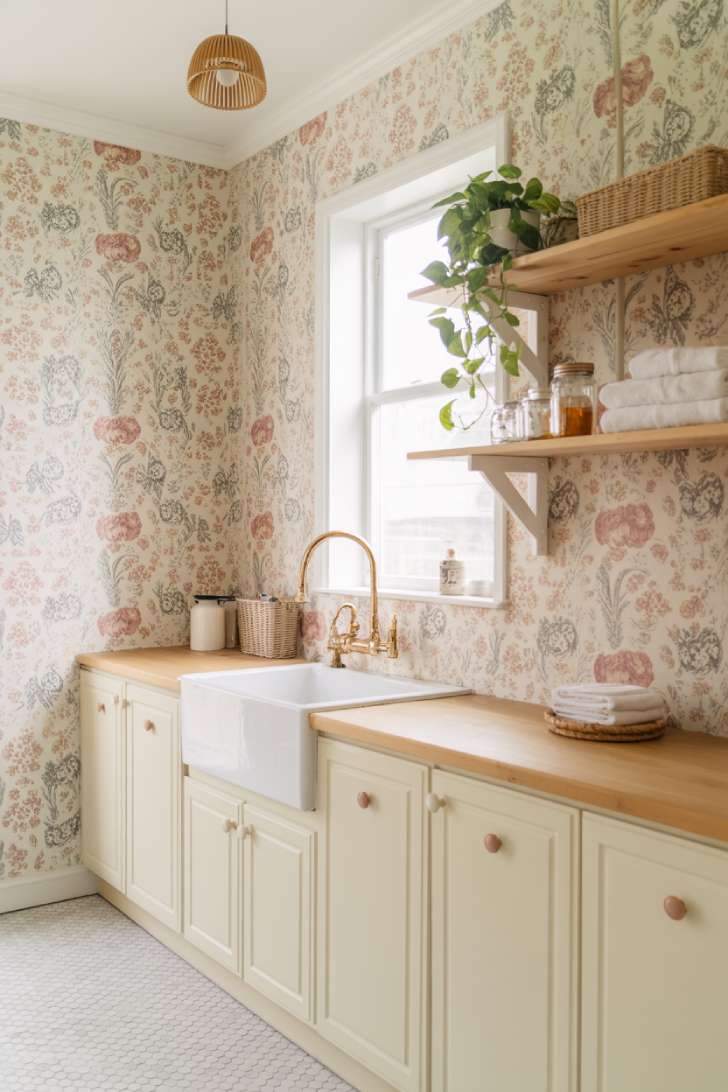
One roll of floral wallpaper can do what months of decorating sometimes can’t — it gives a room an instant, undeniable sense of place.
In a cottage laundry room, vintage botanical wallpaper works particularly well because the scale of the space is small enough that the pattern becomes truly immersive.
You’re surrounded by it.
And when the print is muted and hand-painted in dusty, washed-out tones rather than bright saturated colors, it feels genuinely old and gathered rather than purchased.
The key is pairing the wallpaper with simple, quiet cabinetry so the walls can do the talking.
White inset cabinets, small ceramic knobs, and a plain farmhouse sink let the paper breathe without the room feeling chaotic.
For anyone renting or hesitant to commit, peel-and-stick vintage floral wallpaper has improved dramatically in quality and is a completely reversible way to get this look.
Style Blueprint:
- Vintage botanical or garden-print wallpaper in muted, washed tones
- Simple white or cream inset cabinets with ceramic knob hardware
- Natural pine or white floating shelves
- Small rattan or woven pendant light
- Hex tile flooring in white or cream with contrasting grout
Design Pro-Tip: In a small laundry room, apply wallpaper to all four walls rather than just one accent wall. The immersive effect reads as intentional and cozy rather than overwhelming, and it makes the space feel much larger than a single featured wall would.
Open Shelving That Works as Hard as It Looks
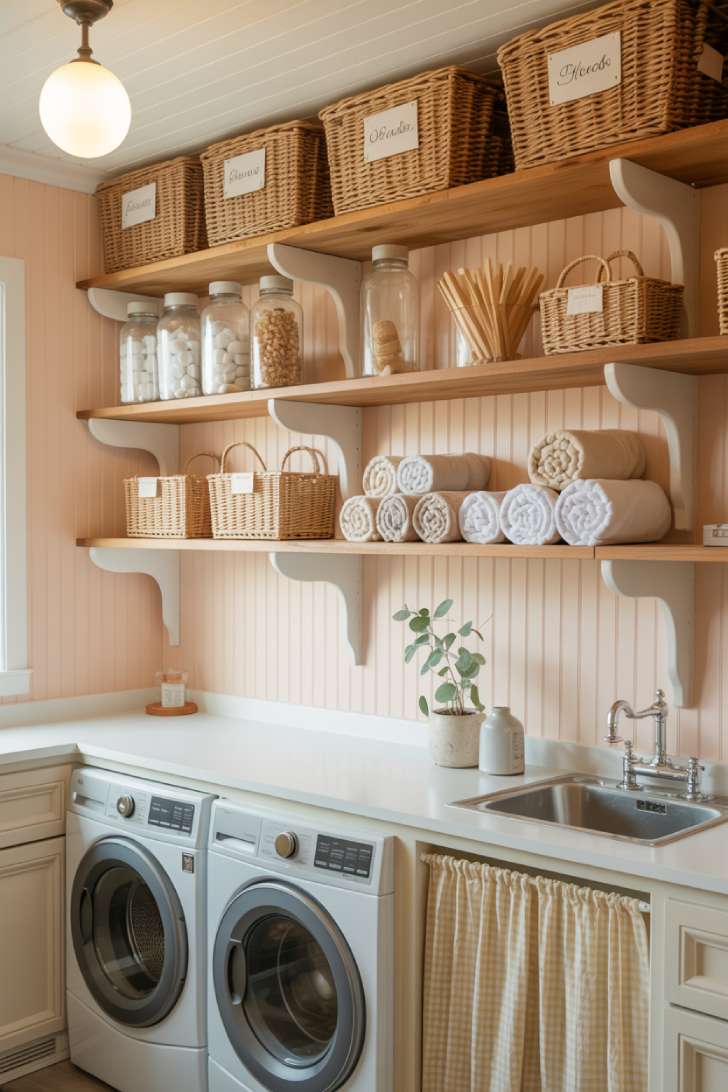
Open shelving in a cottage laundry room is where storage becomes decoration.
The combination of woven baskets, glass jars, folded linens, and a stray plant on a wood shelf does something that closed cabinets simply cannot — it tells a story about the home and the people in it.
That said, open shelving only works when it’s genuinely organized.
The trick is using containers that are cohesive in color and material — natural rattan, clear glass, white ceramic — so the shelf reads as curated rather than cluttered.
Labeling baskets helps enormously, not just for finding things, but for maintaining the system over time.
Corbels are worth the extra effort.
They add architectural detail and a soft, furniture-like quality to shelving that plain L-brackets can’t provide.
This is the kind of storage solution where the more you look at it, the more intentional and considered it feels.
Style Blueprint:
- Wood shelves on decorative white or natural wood corbels
- Labeled natural woven baskets in coordinated sizes
- Glass mason jars for small items like detergent pods and clothespins
- Rolled or folded white and cream linen towels as decoration
- One or two small potted plants for life and color
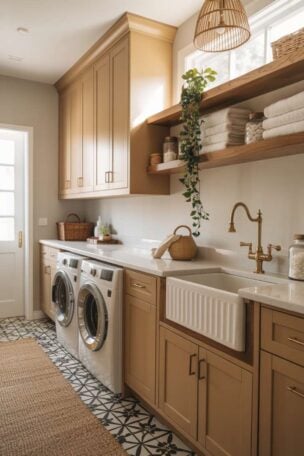
Sage Green Cabinets With Warmth Built In
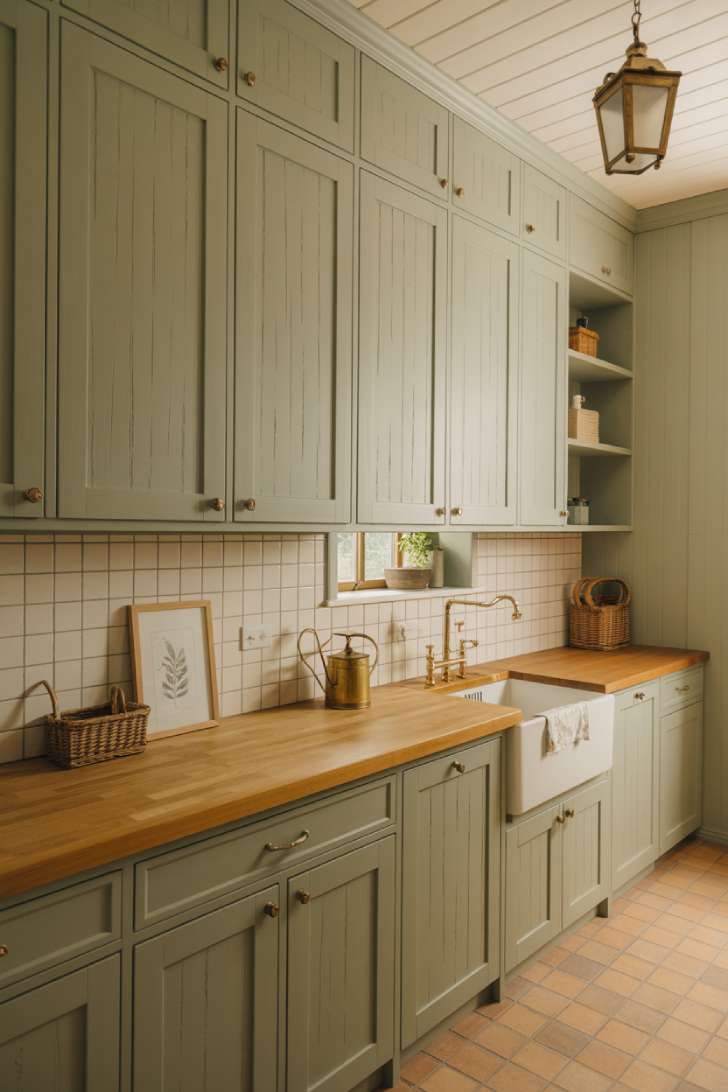
Sage green might be the most perfectly cottage color that exists.
It’s grounded without being heavy, warm without being yellow, and natural without trying too hard.
On shaker cabinet doors in a laundry room, it creates a sense of calm that makes the space feel like a considered room in the house rather than an afterthought.
The brass hardware is doing a lot of work here.
Unlacquered brass ages over time, developing a slightly darkened, uneven patina that feels genuinely old and collected — which is precisely the quality that separates a cottage room from a farmhouse showroom.
Pairing sage cabinets with a butcher block countertop in light oak adds warmth from a completely different direction — the organic variation of wood grain against the flat, painted surface of the cabinet doors creates just the right amount of visual tension.
This is one of those rooms that gets better as it ages.
Style Blueprint:
- Muted sage or soft olive green shaker cabinets, floor to ceiling
- Unlacquered brass hardware throughout
- Light oak or reclaimed wood butcher block countertop
- White subway tile backsplash with cream or warm gray grout
- Terracotta or warm-toned hex tile flooring
Design Pro-Tip: Unlacquered brass hardware is a better choice than lacquered brass in a cottage laundry room. It starts warm and only gets better with handling and age, developing a natural patina that no manufactured finish can replicate.
Galvanized Metal and Reclaimed Wood: Rustic Done Right
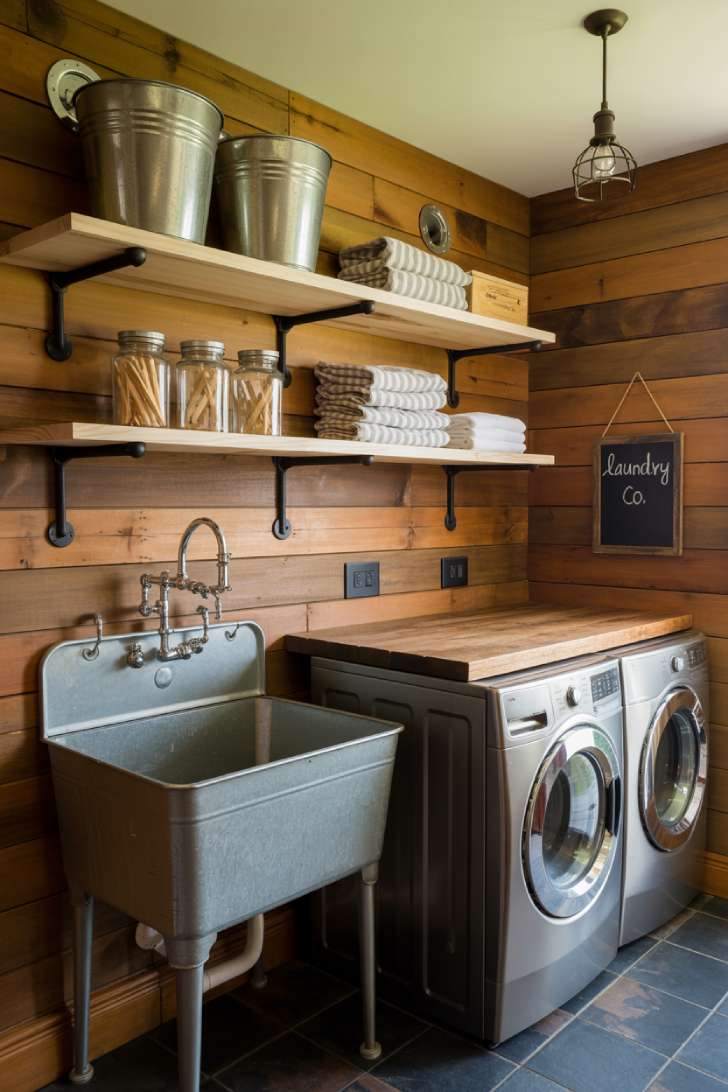
There’s a particular kind of charm that only comes from things that have actually been used.
Galvanized metal buckets, cast-iron sinks, reclaimed wood shelves with their original nail holes and saw marks — these are objects that carry history, and in a cottage laundry room, that history is the whole point.
This approach works especially well in basement laundry spaces or rooms where the architecture is a little rough around the edges.
Rather than trying to hide the rawness, you lean into it.
The black iron pipe brackets for the shelves are honest about their industrial function.
The galvanized buckets are doing real storage work while looking like they belong there.
A small chalkboard label or a handwritten sign is one of the easiest and least expensive ways to add a handmade, human quality to the room — it signals that someone lives here and cares about the details.
Style Blueprint:
- Reclaimed wood plank walls or wide-plank wood shelving
- Black iron pipe shelf brackets
- Galvanized metal buckets and containers for storage
- Vintage cast-iron or high-back porcelain utility sink
- Industrial cage-bulb pendant light on a black or aged cord
A Barn Door That Earns Its Place
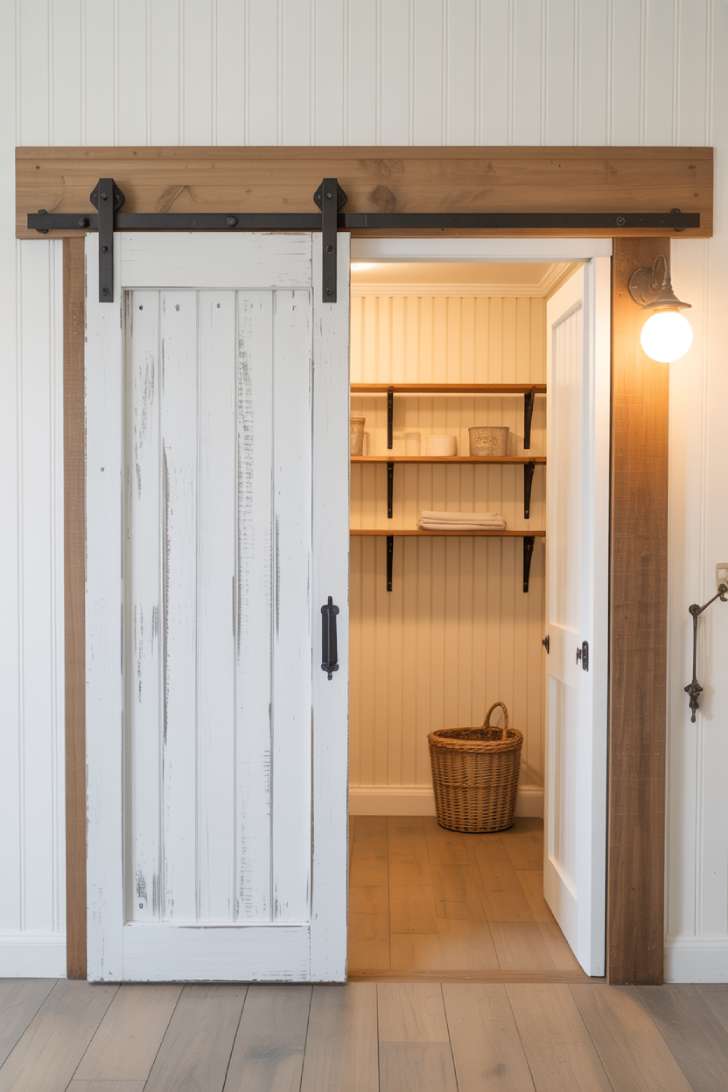
A sliding barn door solves a real problem while creating a real moment.
In most homes, the laundry room is tucked off a hallway or a mudroom where a standard swinging door eats into already limited floor space.
A barn door slides completely out of the way, which is genuinely useful.
But beyond the practicality, the door itself becomes part of the design — a weathered white painted wood door with visible grain and black iron hardware communicates the cottage aesthetic before you’ve even stepped inside the room.
The choice of a white or cream painted finish rather than a dark stained wood keeps things light and connects the door to the room rather than making it feel like a separate object.
It’s worth noting that the barn door header beam — the thick piece of wood the hardware mounts to — is often overlooked.
A reclaimed wood header adds another layer of warmth and texture that ties the whole entry together.
Style Blueprint:
- Sliding barn door in weathered or painted white/cream wood
- Black iron sliding barn door hardware and track
- Reclaimed wood header beam above the door opening
- Vintage-style wall sconce beside the door frame
- Wide-plank wood or tile flooring at the entry point
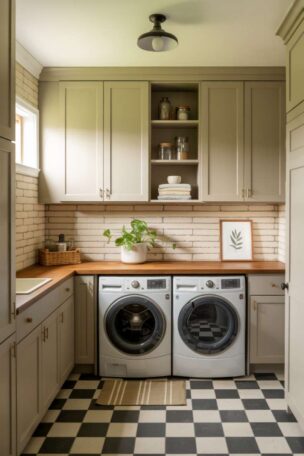
Patterned Tile Floors That Anchor the Whole Room
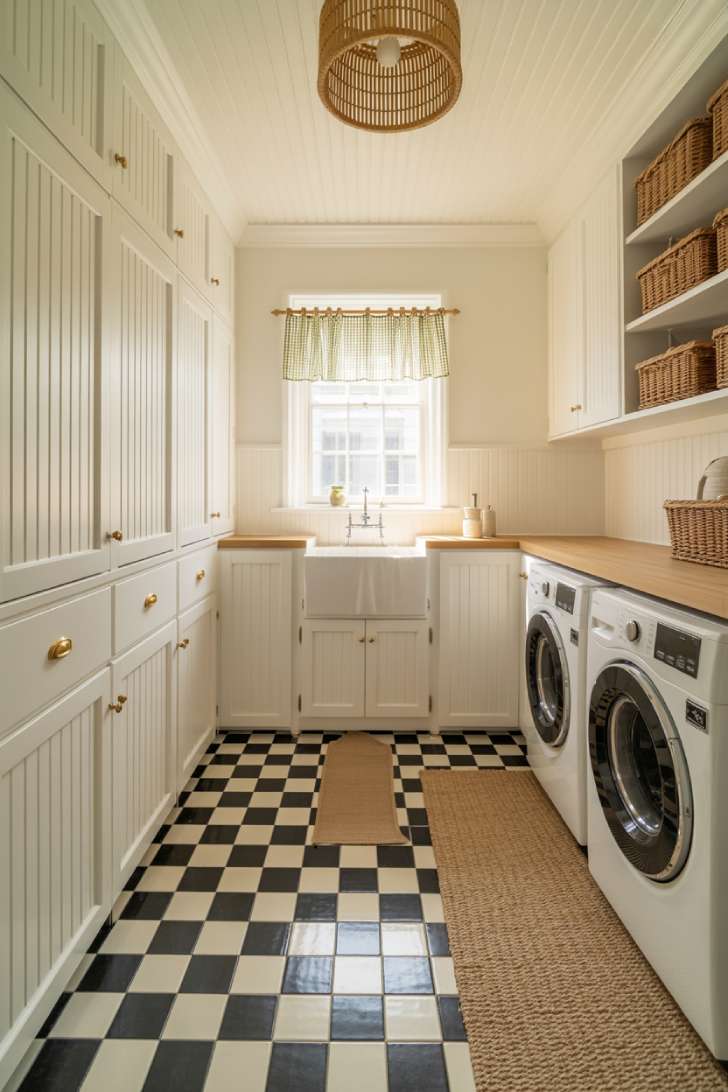
The floor is probably the most underused design opportunity in a laundry room.
Most people paint the walls, choose the cabinets, pick a countertop — and then tile the floor in plain white or pale gray without a second thought.
A checkerboard floor changes everything.
It gives the room a strong graphic foundation that every other element can lean against, and in a cottage laundry room, the slightly vintage, scullery-like quality of a black and cream check is absolutely perfect.
What’s interesting from a spatial perspective is that the pattern actually helps a small room feel more complete and intentional rather than cramped.
The eye has something to settle on.
Pairing it with a jute runner softens the high-contrast pattern and brings warmth back to the floor, which keeps the room from feeling cold despite the graphic tile beneath.
Style Blueprint:
- Classic black and cream or sage and cream checkerboard ceramic tile
- Natural jute or cotton runner over the tile in the main work zone
- White shaker cabinets with brass or oil-rubbed bronze hardware
- Gingham cafe curtain at window in a complementary muted color
- Rattan or woven pendant light for ceiling warmth
Design Pro-Tip: Choose a checkerboard tile in a slightly smaller scale — around 4×4 inch squares rather than 12×12 — for a laundry room. The smaller pattern reads as vintage and refined rather than bold and graphic, and it suits the intimate scale of the space far better.
A Ceiling Drying Rack With Old-World Charm
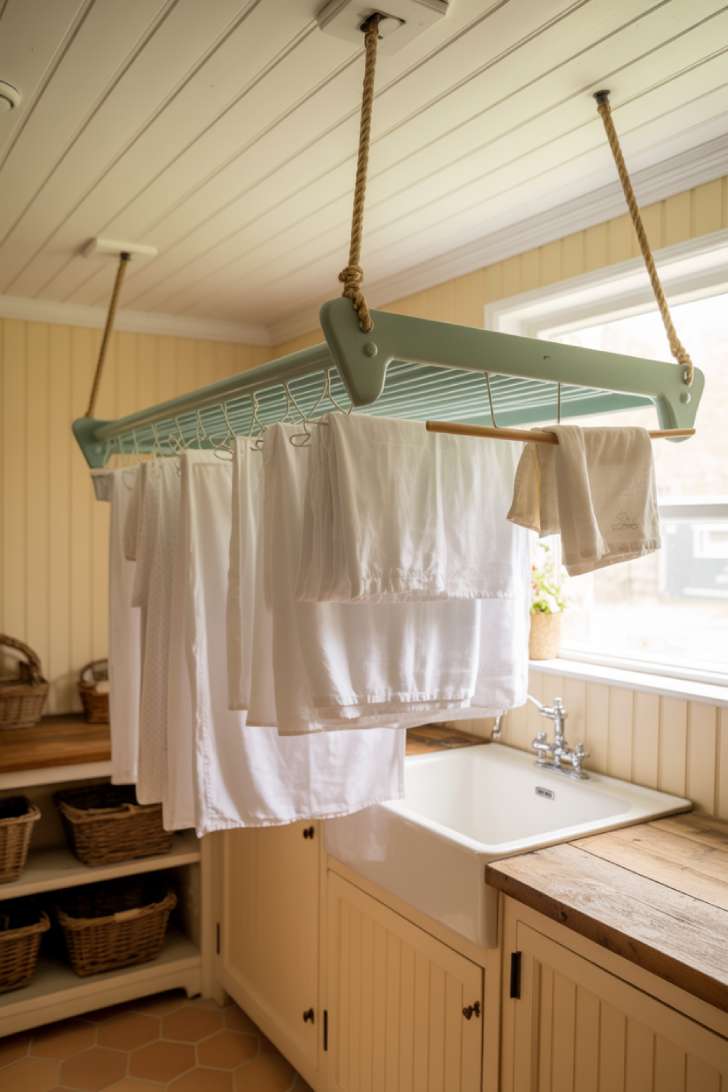
A ceiling-hung drying rack is one of those features that is both completely practical and deeply beautiful.
It pulls the eye upward — which is always a good thing in a small room — and it carries an old-world, homekeeping quality that no modern drying solution can match.
The rope and pulley system means the rack can be lowered to hang clothes, then raised back up toward the ceiling while things dry, completely out of the way.
In a cottage laundry room, painting the wooden rack in a soft dusty sage or cream rather than leaving it bare wood gives it a finished, considered look that connects it to the rest of the room’s palette.
This is the kind of detail that guests notice and ask about.
It’s functional, it’s beautiful, and it costs far less than another cabinet.
Style Blueprint:
- Wooden ceiling-mounted drying rack on rope and pulley system
- Paint the rack to match or complement the room’s color palette
- White tongue-and-groove or beadboard ceiling planking
- Reclaimed wood countertop below for folding surface
- Terracotta or warm-toned hex tile on the floor
A Small Laundry Nook That Feels Fully Designed
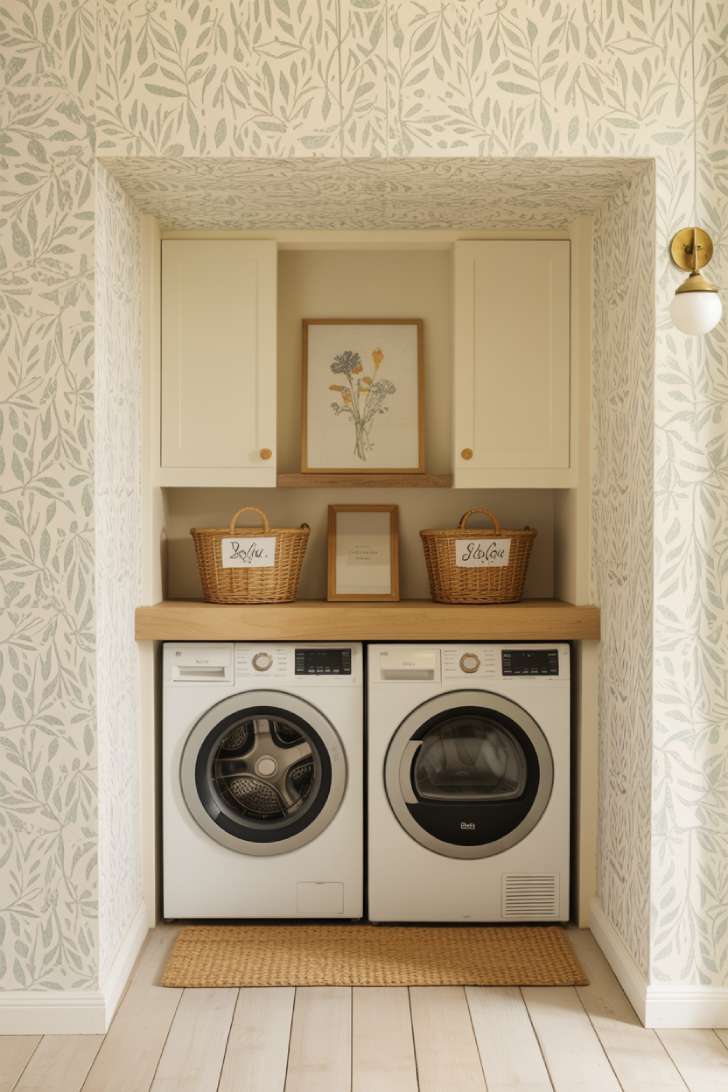
A small laundry space is not a limitation — it’s an invitation to be more thoughtful.
When the footprint is tight, stacked machines are the obvious solution for freeing up wall space.
But what happens above and around those machines is what separates a forgotten nook from a genuinely lovely one.
Wallpaper is a particularly powerful tool in a small alcove because the walls are so close together — the pattern wraps around you, creating a sense of enclosure that feels cozy rather than cramped.
A single floating shelf above the machines gives just enough room for two baskets and a small piece of art, and that combination — storage plus something purely personal — is what makes the space feel like it belongs to someone rather than belonging to a house.
The brass wall sconce is a small but telling detail.
It says the room has been thought about and cared for, and that shifts the whole experience of using it.
Style Blueprint:
- Stacked washer and dryer units to free up wall space
- Leaf-print or subtle botanical wallpaper inside the nook
- One floating shelf above machines for baskets and small art
- Brass or aged metal wall sconce for warm task lighting
- Woven cotton mat in front of machines for softness underfoot
English Cottage Style With a Fabric Skirt and Vintage Soul
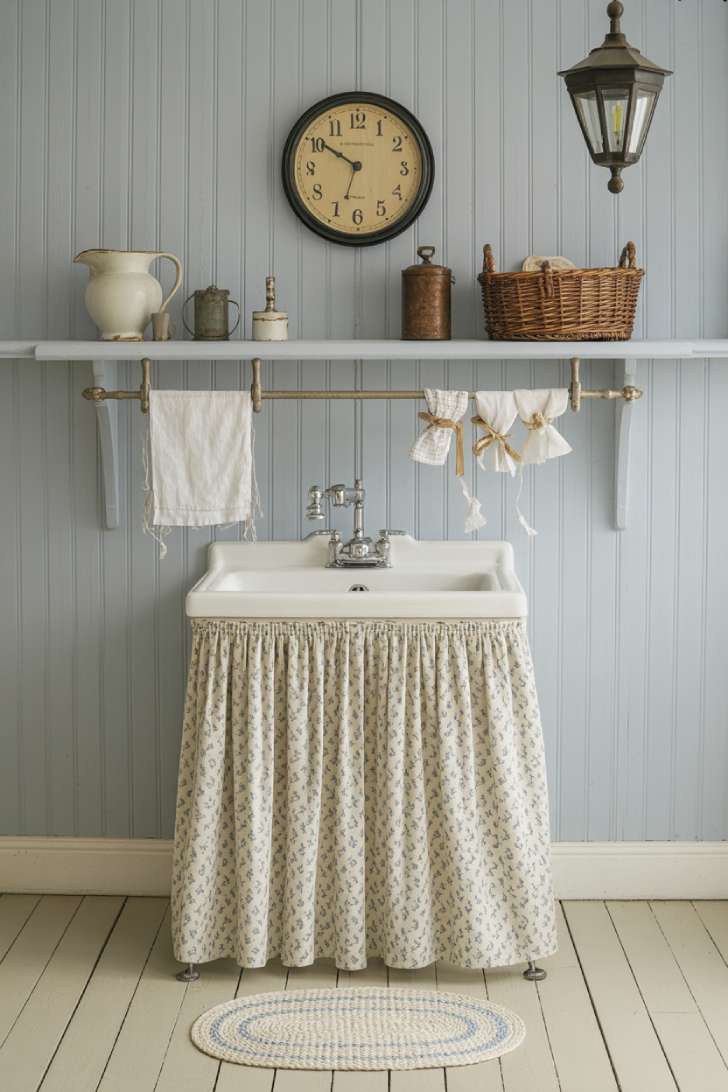
This is the kind of laundry room that feels like it has always been there.
The English cottage approach to a utility space is built on two principles: nothing should look too new, and everything should look slightly personal.
The fabric skirt beneath the sink is the defining gesture.
It replaces a cabinet door with something soft and handmade — a gathered piece of small-print linen that hides the plumbing and brings an irreplaceable domestic warmth to the space.
It’s easy to make yourself with remnant fabric and iron-on hemming tape, which makes it one of the most accessible and highest-impact cottage details you can add.
The mismatched antique objects on the open shelves above — the old ceramic pitcher, the metal soap tin, the tea towels tied with twine — create the impression that these pieces arrived in the room individually over time rather than being ordered from a single source.
That sense of accumulation is exactly what cottage style is.
No showroom achieves it.
Only living in a home, finding things slowly, and placing them with care creates this kind of warmth.
Style Blueprint:
- Gathered fabric skirt under sink in small-print linen or gingham
- Mismatched antique and vintage objects on open shelves
- Pale blue or soft green painted walls with white beadboard wainscoting
- Vintage-style black lantern pendant ceiling light
- Oval braided rug in coordinating tones underfoot
Design Pro-Tip: Source at least three or four accessories for your cottage laundry room from antique markets, estate sales, or thrift stores rather than buying everything new. The slight imperfection and variation in age between objects is what gives the room its authentic, lived-in quality — and it cannot be replicated with new purchases alone.
Bringing It All Together
A cottage laundry room doesn’t ask for a big budget or a complete renovation.
It asks for intention.
A piece of beadboard, a vintage basket, a roll of floral wallpaper, or a simple fabric skirt under the sink — any one of these things starts the conversation.
Mix the ideas here to suit your space, your budget, and your own taste.
The best cottage rooms are never copied exactly from anyone else.
They’re built slowly, with pieces that mean something, in a space that ends up feeling like yours.
Save the ideas that spoke to you, start with one change, and let the room grow from there.